

Corruption has become a leading issue for US voters heading into the 2026 midterm elections, driven in no small part by concerns about President Donald Trump’s unprecedented self-enrichment while in office.
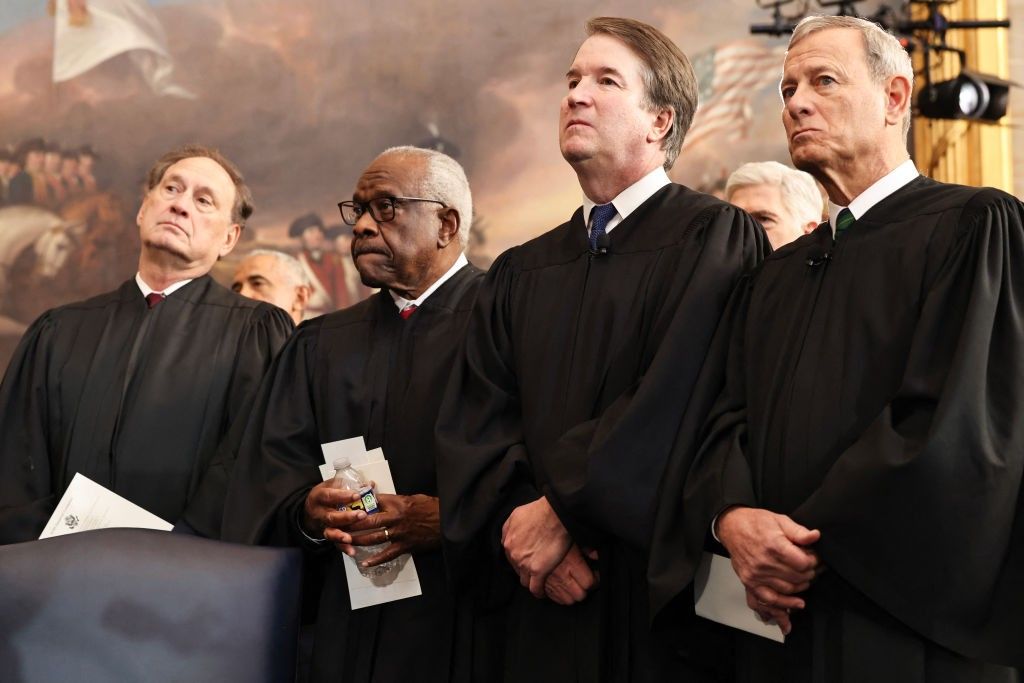
But even as Americans express greater worry about corruption in government, actually prosecuting corrupt politicians has grown significantly more difficult over the last 40 years—and one legal expert places blame for this directly on the US Supreme Court.
In an essay published by The Atlantic on Monday, former federal prosecutor Leo Wise argued that the Supreme Court since the 1980s has “interpreted anti-corruption laws in ways so narrow as to effectively legalize flat-out corruption,” thus putting “whole categories of politicians’ conduct beyond a prosecutor’s reach.”
The trend began in 1987, Wise explained, when the court overturned a mail fraud conviction of a member of the Kentucky governor’s Cabinet, which relied upon proving that the official had violated the public’s right to “honest services” from its government.
In its ruling, the court declared that federal mail and wire fraud statutes only protected money and property, and did not apply to abstract principles like the right to an honest government.
Wise noted that Congress would subsequently step in and pass bipartisan legislation that effectively overturned the court’s ruling, although this kind of congressional action would grow increasingly rare in the coming years.
Far greater damage would come after John Roberts took over as chief justice of the court in 2005, Wise continued, starting with a 2010 case that overturned former Enron CEO Jeff Skilling’s conviction of conspiring to commit honest-services fraud.
The majority opinion, written by the late Justice Ruth Bader Ginsburg, claimed that “because bribery and kickbacks were the ‘basis of most honest-services prosecutions,’ that’s what the statute’s application would be limited to,” Wise explained.
The impact of this decision, Wise added, was to further restrict prosecutors’ ability to bring corruption charges.
Wise then singled out the 2016 decision that overturned the bribery conviction of former Republican Virginia Gov. Robert McDonnell, which he described as the court’s “grossest” intervention.
“A jury had convicted the former governor on bribery charges for accepting $175,000 in loans and gifts from the CEO of a nutritional-supplement company that wanted Virginia’s public universities to run clinical trials on his product,” Wise wrote. “The court held that what McDonnell did for the CEO—setting up meetings, hosting events, talking to other elected officials, all to benefit his company—did not qualify as ‘official acts,’ for which McDonnell could be bribed.”
In 2024, the court took another major step forward in legalizing corruption with its ruling granting US presidents absolute immunity from criminal prosecution for carrying out official acts.
This decision was particularly egregious, Wise contended, because “unlike the earlier decisions that interpreted statutes and that therefore Congress can reverse by passing new legislation, the Court claimed that presidential immunity was required by the Constitution itself,” thus making it vastly more difficult to overturn.
Nonetheless, Wise said that Congress could chip away at presidents’ ability to act corruptly by “prohibiting the US government from accepting gifts such as the Qatari plane” that Trump accepted last year, as well as “disqualifying companies that invest in a president’s businesses or donate to his library from bidding on government contracts.”
“This behavior should be illegal,” Wise emphasized, “because corruption is poison to democracy.”
From Common Dreams via This RSS Feed.