


By Nikos Mottas
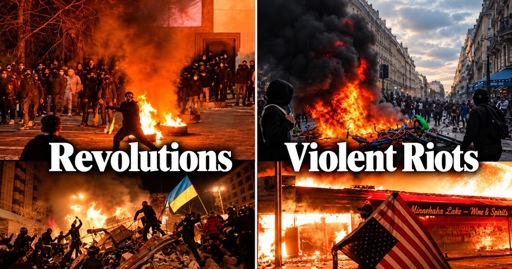
The Western ruling classes have developed a remarkable ability to distinguish between a “revolution” and a “violent riot". The criteria have little to do with the demands of the demonstrators or the methods of their struggle.
What matters is whose power is threatened, whose interests are served and whether the existing capitalist order is being challenged or strengthened. After all, democracy has never been independent of class interests.
When protesters confronted the Khamenei government in Iran, Washington, London and Brussels suddenly rediscovered their enthusiasm for popular uprisings. Demonstrators were celebrated as “courageous fighters for freedom”, clashes with security forces became evidence of a regime losing legitimacy, and repression provoked solemn declarations about human rights.
Yet this enthusiasm is inseparable from the economic and geopolitical ambitions of Western imperialism. The suffering and legitimate grievances of the Iranian people become convenient material for a foreign policy aimed at weakening a rival state. Popular discontent is welcomed not because it threatens exploitation, but because it can be exploited.
On the other side, look at France. Hundreds of thousands of workers, students and ordinary people take to the streets against deteriorating living standards, attacks on public education and policies that place the burdens of capitalist society on those who produce its wealth. Suddenly, the language changes. Instead of courageous protesters, we hear about violent mobs, thieves and “far-left agitators" seeking to impose chaos. Instead of legitimate popular anger, we hear about vandalism, looting and the need to restore public order. The Macron government responds with mass arrests, riot police and threats of punishment. The same bourgeois state that lectures other countries about democratic freedoms mobilizes its repressive apparatus against young people demanding decent schools and a future. Apparently, rebellion is admirable everywhere except where French capital exercises its power.
The same double standard was on full display in Ukraine. In 2014, the overthrow of Viktor Yanukovych following the violent Euromaidan coup was enthusiastically welcomed by Western governments as a triumph of democracy. The involvement of far-right and openly fascist organizations, together with Washington’s political intervention, did little to diminish their enthusiasm for the so-called “Revolution of Dignity”. Behind the grand declarations about freedom stood a fierce struggle over Ukraine’s geopolitical orientation, markets and economic future. The United States and the European Union were not disinterested spectators defending abstract democratic principles. They were pursuing their own strategic interests in a country caught between competing capitalist powers. Even reactionary forces could be treated as respectable allies when they proved useful to Western imperialism.
Compare this with the United States in 2020, when millions protested following the police killing of George Floyd. The Trump administration threatened military intervention, denounced protesters as criminals and looters, and raised accusations of foreign interference. Washington, which openly supports political movements against governments abroad, suddenly became outraged at the possibility of outside involvement in its own domestic affairs. More fundamentally, when the streets exposed the racism, poverty and entrenched class inequalities of American capitalism, the response was not admiration for popular resistance but a massive display of police power. The right to rebel, it seems, ends where the authority of the American bourgeois state begins.
There is nothing accidental about this selective indignation. Capitalist governments do not approach popular movements as neutral guardians of democracy. They defend definite class interests. A protest that weakens a geopolitical adversary can be encouraged, financed politically or celebrated as a democratic awakening. A protest that challenges austerity, capitalist exploitation or the authority of the bourgeois state at home becomes a threat to stability. And what exactly is this much-celebrated stability? The uninterrupted accumulation of profits, the protection of capitalist property and the preservation of a social order in which a minority controls the wealth produced by the majority.
The major Western media perform an indispensable function in this operation. The same burning barricade becomes a symbol of freedom in one country and proof of criminal disorder in another. Police violence abroad exposes authoritarianism; police violence at home becomes an unfortunate necessity of maintaining order. The demonstrators’ political demands are pushed aside, while images of confrontation dominate the headlines. This is not merely the personal prejudice of individual journalists. It reflects the class character of a media system concentrated in the hands of powerful capitalist interests, deeply connected to the political and economic establishment. Its task is not always to conceal events, but often to determine how those events are understood.
Behind these convenient distinctions stands the reality of capitalist society itself. Workers and the popular strata are expected to endure declining living standards, insecure employment, expensive education, militarization and the systematic transfer of wealth towards the monopolies. When they resist, they confront not some impartial institution standing above society, but a state whose fundamental function is to safeguard the existing relations of production. Nor should the working class allow its struggles to become instruments of rival bourgeois factions or competing imperialist centres. Its political interests are independent of all of them. The emancipation of working people cannot be delivered by Washington, Brussels, Moscow or any other capitalist power.
For the Western bourgeoisie, the question has never been whether people have the right to rebel. The question is whether their rebellion serves the interests of capital or threatens them. Bourgeois democracy grants freedoms within the limits imposed by capitalist ownership and class power. Once those limits are seriously challenged, the familiar appeals to democratic rights give way to police operations, criminalization and the defence of the existing order. The state does not cease to be a class state simply because it holds elections and invokes the constitution.
And that explains the entire hypocrisy: when the streets rise against their enemies, they celebrate revolution. When the working people rise against the rule of capital, they send in the riot police. The working class has no reason to accept this fraudulent division between supposedly legitimate and illegitimate rebellions. Its struggle is not for the approval of imperialist governments, but for liberation from the system that exploits it. The bourgeoisie may applaud revolutions - or “revolutions” - abroad, provided the revolution never reaches its own doorstep.
* Nikos Mottas is the Editor-in-Chief of In Defense of Communism.
From In Defense of Communism via This RSS Feed.