

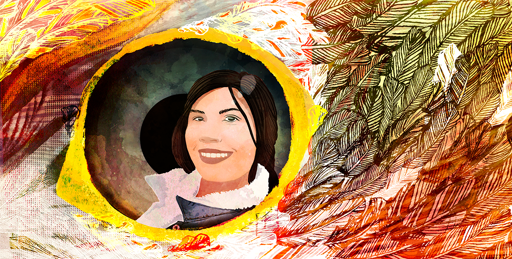

Jolene Banning’s daughter Amber-baa, depicted through the eye of an eagle. Illustration by Jessie Boulard
Content warning: This story deals with child loss and grief. Please look after your spirit and read with care
Three years ago I was hit with a pain so deep that it seared through every fiber of my body.
Two police officers pulled up in my driveway, driving a dark SUV, wearing dark suits and ties. They came to inform me that my child, my baby, my daughter Amber had died.
The blow of information left me numb, stunned, separated from myself like I was watching this happen instead of partaking.
Instantly, I became a member of a club I never wanted to belong to: of parents who have lost their children. Because I know I’m not alone in this rapidly growing group of people. It doesn’t feel natural to bury our children, so young, so beautiful.
Amber-baa had long, shiny dark brown hair, round brown eyes, thick eyebrows and a million dollar smile — which she should, considering how much I paid the orthodontist. She was warm, caring, and fun to be around. She lit up a room and made sure everyone felt seen. And in the blink of an eye, without warning, I had lost all of that. The silence was deafening. The pain was inescapable.
Experiencing this kind of loss and grief is not uncommon for Indigenous people. In “Canada,” our communities experience significantly higher mortality rates. Our women and girls are at a 12 times higher risk than the average citizen to go missing or be murdered.
Violence against us is fuelled by systemic racism, sexism, and colonialism — as outlined in Reclaiming Power and Place, the Final Report of the National Inquiry into Missing and Murdered Indigenous Women and Girls.
We hear about these losses. Sometimes it makes the news, stats are shared, but then we don’t hear from anyone again. The news has passed, new topics are making headlines.
Losing my daughter, and losing other important people in my life too soon, led me to want to acknowledge this and share my reality, and I grapple with how we can begin to heal.
My first loss came when I was only 13. My baby brother was only six months old and died of meningitis after spending a week in the Toronto Hospital for Sick Children. After that, I would go on to lose many of my aunties, uncles and cousins, and grandparents.
Many lives shut down before they even reached their prime.
“For these four days, my pain was spread out amongst everyone at the fire.”
When I lost my girl, on April 28th, 2023, there was no way I was sending her on her next journey in a way that was not ours — in a church made of brick and mortar while someone delivered a sermon about finding God and peace.
So I turned to my Anishinaabek community and found knowledge holders and learners willing to share with me.
I was told I need to send my girl off with a four-day sacred fire ceremony, something I had never done or even participated in until this loss.
I called the Elders that I knew, and many people worked behind the scenes to ensure I had enough fire wood, food, and company. Firekeepers attended to the fire and explained which direction to enter, drum groups stopped by and offered songs.
Every morning, as the sun rose, my dad was there, sharing family stories. Relatives from the north made the trek to offer medicine, condolences and stories of their own.
Another community member, who lost a child, offered to make my daughter a headstone. It’s a simple cross, with her information, and features a painted medicine wheel.
For these four days, my pain was spread out amongst everyone at the fire.
I also learned during this ceremony that my daughter needed to start her journey and there were ways I could assist her.
She needed her own bundle with exactly four matchsticks, a copper cup, an outfit made in her colours so our ancestors can recognize her and moccasins — basic and unembellished ones, since our offerings grow in size when they reach the other dimension, realm, Spirit World, and we don’t want her weighed down, unable to walk.
I was told she will come to a crossing, where she will have to share everything about herself and her journey so far. Then our ancestors will travel across the divide to accept her. Her bundle was packed just right.
Every day and every night over four days we feasted for her by offering a spirit plate to the land, another to the fire.
In Anishinaabek culture, we add the prefix -baa onto a name to signify they have passed on.
It was with the love and support of family, community and ancestors that kept me going through that initial service. It was being surrounded by everyone that made the days go by.
But eventually, the service came to an end and everyone went back home. For the first time since the loss happened, I was completely alone with my thoughts, and all I thought about was my child.
What could I have done differently? How are her babies going to live without her? How do such little people, babies, process this monumental loss? How do I live again, knowing a huge piece of me is gone? Did I love her enough?
I decided I needed to go home to my maternal homelands, in Sioux Lookout, where my mom was born, and the land my grandparents came from. I wanted to visit my cousins Shirley and Dennis Anderson.
Together, they have a world of knowledge behind them. Both Shirley and Dennis were raised on the land, growing up traditionally, raised in the language. As a young adult, Shirley was working in a thriving metropolis as a model and hairstylist before coming back home to work for her people.
She and I can spend hours talking about everything from life, love, family, death — you name it — over BINGO or while driving around to garage sales. It was during one of our talks that she asked me to talk to my girl, like I would if she was right there with us.
Shirley brought me to a camp she has on an island on Lac Seul First Nation. It’s a shared space where her son and daughter have camps as well. That summer I had eagles all around me, watching me, talking to me. I even captured it on video and audio recording as we fed one.
“I felt reassured that our ancestors were guiding me and my daughter.”
While I was in Sioux Lookout, I went to visit a friend in long-term care, Garnet Angeconab-baa (who has since passed on).
When I first met him, he was suffering from Kennedy’s disease, a degenerative disease that eats away at his body. The last time I saw him, during a film screening in 2019, we talked about the epidemic of missing and murdered Indigenous Peoples.
We have a connection because the body of my aunt Audrey-baa Anderson was found on the side of the highway in Sioux Lookout in 1972, at the young age of 19-years-old. Not yet an adult. On this visit I told him that I lost my daughter. He told me he could read it on my face before I said anything.
Garnet-baa told me how he first started talking about his experiences of Indian Residential School, in sharing circles with other students and a social worker. When the sharing was done, he hopped in his car and drove more than a thousand miles before taking a real rest stop at a lake, where he ran into an Elder from his university days.
The Elder advised him to pick up a rock, and to take each thought, memory, pain, and share it with the rock he was holding. Then, to offer that rock to the water and let the water take it and carry it for you. Garnet-baa asked me to do this.
Not long after that, I went to a women’s healing retreat. The retreat began with a morning introduction to each other, and the Elder in residence. At the end of the first morning’s introductions, as I was leaving, the Elder tapped me on the arm and said: “she made it to the other side.”
Without asking the Elder anything, she offered me this knowledge. During my daughter’s sacred fire, I prayed for her connection to our ancestors and a huge relief came after the Elder shared that information.
I felt reassured that our ancestors were guiding me and my daughter.
After that, I was more open to attending ceremonies for healing and connection.
I am someone who’s never grown up with ceremonies but they were always around me, their simple acts always evident, like seeing asemaa (tobacco) laid on the ground where we cut wood, cedar branches hung on doorways or in my grandma’s shoes, ashes from the fire marked on foreheads of children, sharing of moose meat after a good hunting season.
Our cultural and traditional practices were banned and outlawed for more than 60 years, but it didn’t matter if I had years of experience or not.
I had to acknowledge that ceremony is something that lives within all of us, and certain practices help aid in that connection. I couldn’t deny it anymore, especially after having experienced it first-hand. I was open, mindful and held blood memory.
During my time in ceremony I was given the knowledge that love never dies and I felt my daughters love and the love of all my ancestors. It is unwavering, determined, warm and always present even if one person is in this world and the other is not.
My grief is unharnessed love, at times exploding through tears. But I learned enough about my ceremony; the acts of a sacred fire, the importance of feast plates for both land and fire, medicines and the messages they can carry with asemaa.
I can take my pain and offer it to ni-mishoomis, grandfather rock, and Gichigami, Lake Superior, because they are strong enough to carry that pain away for me. I can connect and direct that love to exactly where it needs to go, with the ones who need to hear this message most: my daughter’s children.
They are listening, watching and ready to learn that a mothers love never dies. Our ancestors showed us how.
The post My ancestors showed me how to grieve appeared first on Indiginews.
From Indiginews via This RSS Feed.