

Alexander Lovera is a founding member and spokesperson of the El Sur Existe Commune in Valencia, Carabobo State. A former student leader and participant of the MBR-200 revolutionary movement, he now focuses on urban planning and social property enterprises. In this interview, Lovera discusses the El Sur Existe communal project, its productive initiatives, and the relationship with state institutions.
How did the El Sur Existe Commune come about?
We began in 2011 as a political organizing collective called the Complejo Deportivo Recreativo del Sur, made up of 11 people.
Through that collective, we sought to secure spaces within the facilities of the Valencia National Racetrack in Carabobo State, creating recreational and cultural spaces for the communities, and it was there that we began to organize activities and envision the El Sur Existe Commune. The racetrack is next to the Santa Inés neighborhood, where all the communal councils in the area come together. Another community, Ciudad Plaza, also joined the commune.
Then, in 2013, we launched the El Sur Existe communal property enterprise (EPSDC), which serves as the umbrella organization for all the initiatives we have established in the area.
In 2015, we formally created the commune, which brought together 22 community councils covering the Ciudad Plaza and Santa Inés communities and several surrounding rural settlements. Subsequently, the territory was divided into other communes; today we have 14 communal councils.
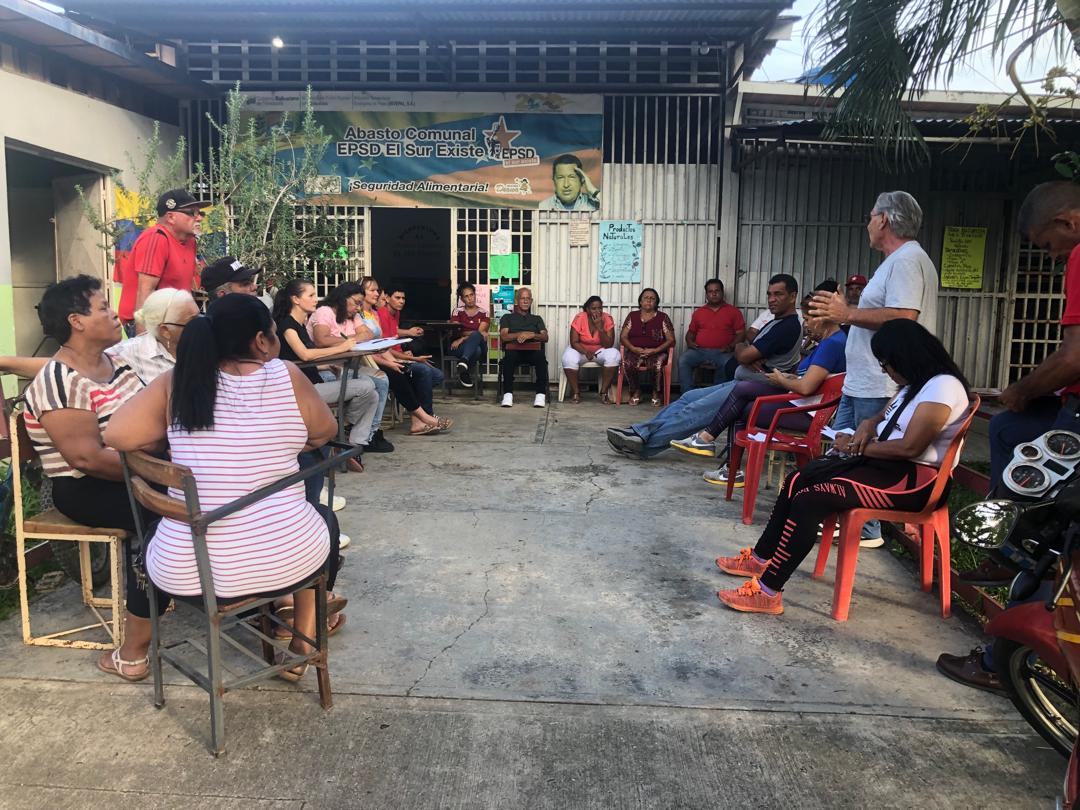
Assembly at the El Sur Existe Commune. (@MinComunas)
The El Sur Existe Commune has been known for its focus on productive initiatives, such as the textile workshop and the animal feed plant. What is the history of these projects?
The textile workshop was born out of surplus from our first company, El Sur Existe. We purchased various types of sewing machines and began making school uniforms, both within the commune and in collaboration with nearby communities.
We started with 5,000 uniforms per school term. This initiative gave us the momentum to develop other ventures. Within the commune, with support from the Ministry of Communes, we managed to reclaim a space that had been abandoned. There, we created a communal market to sell products from local producers, as well as goods from agreements with companies nationalized by the government, such as Fama de América [coffee], Aceites Diana [cooking oil], and Lácteos Los Andes [dairy].
Long before the CLAPs [subsidized food program] began, we had a similar system that we called “the clock.” It worked like this: every week, a different communal council was in charge of distributing all the products available at the communal store. Later on, the management of all those state-owned companies changed, and we were no longer able to purchase their products.
In that same space, we opened a store, which we called La Tienda de Papel, where we distributed school supplies: notebooks, books, exam papers, and pencils. We also sold our school uniforms.
Starting in 2017, other projects began to take shape, such as the slaughterhouse, which arose from an agreement between the commune and a private entrepreneur. This project benefits local producers who cannot access the municipal slaughterhouse, as it is complicated to transport the cattle there.
We went on to establish the “Cárnicos El Sur Existe” Family Production Unit to process the cattle. We were able to set up a space within the slaughterhouse equipped with machines for cutting, grinding, and packaging. We also began producing sausages, ground beef for hamburgers, and other vacuum-sealed cuts. These products were distributed through the communal food market and during special events organized by the communal councils.
We then noticed that some byproducts, such as blood, bones, and fat, were left over in the slaughterhouse, and we realized they could serve as raw materials for producing animal feed. Thus, together with local producers, in 2021 we established the Aba El Auyamal social property firm, dedicated to the production of balanced animal feed.
What is the current status of these ventures? How have they dealt with problems such as shortages of raw materials and supplies, as well as the electricity crisis?
The projects have had their ups and downs, but they are still going strong. To summarize, the EPSDC El Sur Existe, which serves as the umbrella organization for all the projects, is currently still operating in our commune.
The textile factory is still active, with its fair share of obstacles, because the raw materials for making uniforms are expensive, and when sold on the market, the clothes end up being more expensive than imported ones. This is an issue that needs to be addressed at the government level, because small textile businesses cannot compete.
The slaughterhouse continues to operate, although the family production unit has scaled back its operations due to electrical problems. Three main freezers, the cold storage room containing all the vacuum-packed meat, and the engine were damaged by electrical surges. We are finding ways to replace the equipment so we can resume operations. We hope the electricity problem improves somewhat this year, because it has been severe in Carabobo State.
For now, the animal feed plant is processing only raw materials, because the prices of other components like corn, soybeans, and protein concentrates have risen sharply; the final product ends up being too expensive and harder to sell.
On the other hand, the Venezuelan food market is increasingly controlled by large agribusiness corporations. Even so, we’ve managed to source some items from local producers, who are also our main customers for animal feed. In addition, we have other projects, such as raising chickens and pigs, and we distribute eggs and meat through our communal store.
These projects have faced setbacks, but we’ve tried to keep them going using our own resources. The economic situation has been difficult, and exchange rate instability also affects us.
Through our enterprises, we’ve also tried to support many local entrepreneurs. These ventures have also served as spaces for political interactions, where delegations come to learn from our experiences so they can replicate them in other territories.
We have recently established ties with the University of the Communes (UNACOM) and its communal production communities to offer classes in these spaces. Here in the territory, we are offering classes in business administration and veterinary medicine, and we will soon begin offering training in food production. All students will participate in these production units. We have served as a model within the territory and will continue to drive this process forward so that the government recognizes these productive initiatives and gives them greater support.
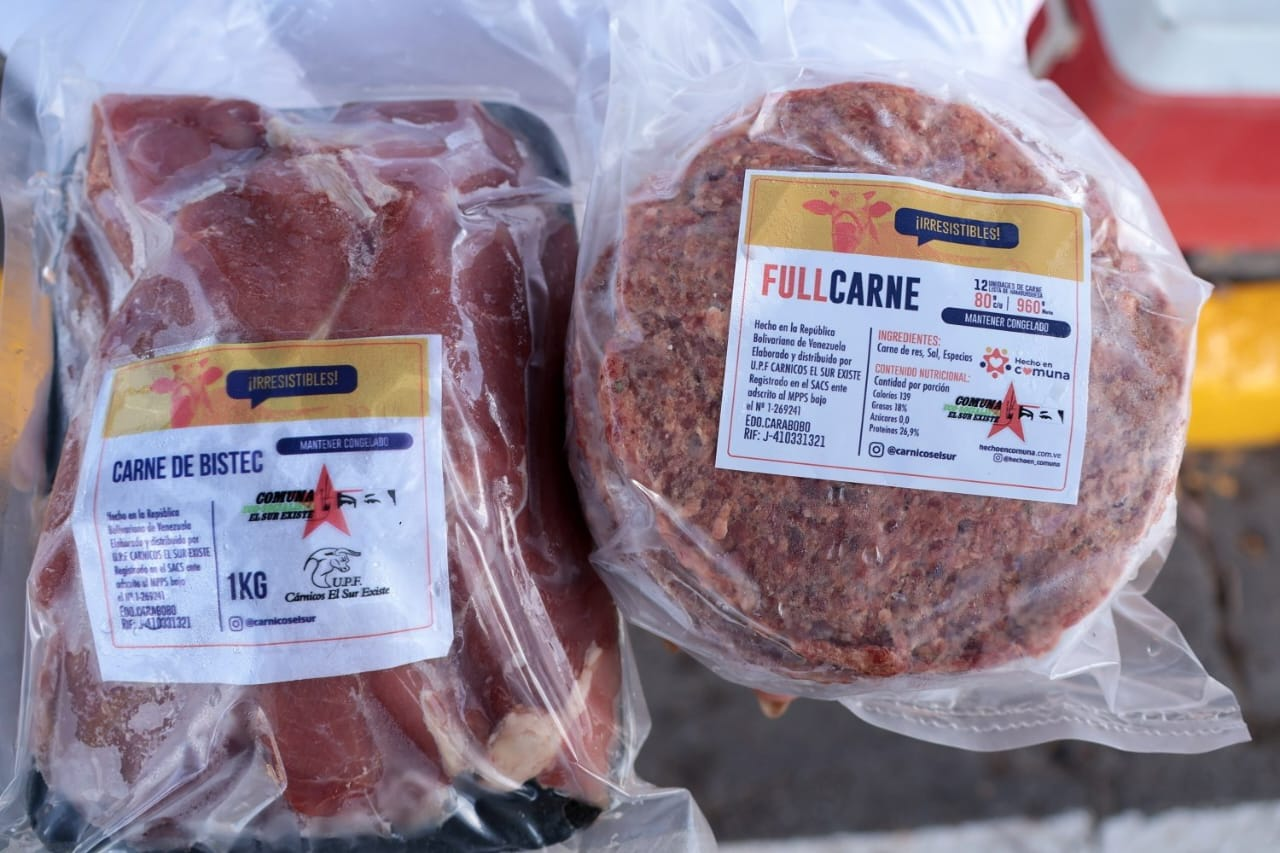
Meat products from El Sur Existe. (@comunaelsurexiste)
The El Sur Existe Commune developed self-government mechanisms for the direct management of public services in coordination with the mayor’s office. What can you tell us about these initiatives?
From the El Sur Existe Commune, the political coordination team sought to form community brigades in the area. Many comrades joined this effort.
In 2019, there was a nationwide surge in the formation of Communal Brigades (BRICOM) to carry out or support work in areas such as electricity and plumbing. We attempted to establish the BRICOM through the Ministry of Communes, making it a legal entity, but that is where the process began to stall.
Through the BRICOMs, we carried out various projects in the area. We supported the communal councils on projects related to wastewater, drinking water, and electricity. We also carried out various electricity-related projects in the agricultural communal councils. However, there came a point when the mayor’s office and the regional government realized that we were occupying a space they had previously managed.
We were unable to make further progress through the ministry. We wanted to establish socially owned enterprises so that the municipal and regional governments, using the resources allocated to them, could contract these enterprises to work within the territory. But this touched on vested interests: certain political groups that controlled those contracts did not allow the project to move forward.
Later on, the BRICOMs ceased to function. Then there was another initiative called BRICOMILES, with brigades that included the military, but they never actually came into existence. In Carabobo State, this was a ploy to give the impression that the communal councils participated in the projects carried out by the mayor’s office or the governor’s office, when in fact almost all of them were executed by companies linked to those very same government institutions.
Building a commune in an urban setting like Valencia, Carabobo State, means fighting against the individualistic logic of capitalism, compounded by migration and the impact of the country’s economic crisis. How is the commune responding to the challenge of incorporating new generations?
Engaging in politics here, in Carabobo State, primarily within the municipality of Valencia, is very challenging. This is in part because the communal project has not yet been embraced by government institutions. The mayor’s office and the governor’s office are not closely aligned with popular power.
Although on all television and radio shows, government officials claim to work with popular power, reality tells a different story. These institutions lack the political will to fully support the commune.
Despite everything, we have pressed forward with the communal process. We, the communards, are driven by conviction and the idealism of our Comandante Chávez. We strive to ensure that our territories, be they urban or rural, since our commune includes both, develop with the goal of making the commune economically self-sustaining over time.
Regarding the process of engaging young people, we prioritize culture in the territory. We try to involve the youth in cultural activities, music, modeling, and educational programs. In the commune, we’re offering courses in more practical fields such as hairdressing, baking, cosmetics, and safe operation of motorcycle taxis.
Of course, we start by recruiting the youth and then provide them with political orientation. Engaging in politics in the midst of the crisis has been difficult, and even worse since January 3. Since that US attack and the kidnapping of President Nicolás Maduro, the political landscape has changed drastically across the board.
Valencia is a stronghold where individualism and unbridled capitalism prevail. Even so, we’re working to spread the commune’s philosophy, including through sports. It’s been another way to reach young people, and we’ve had good results.
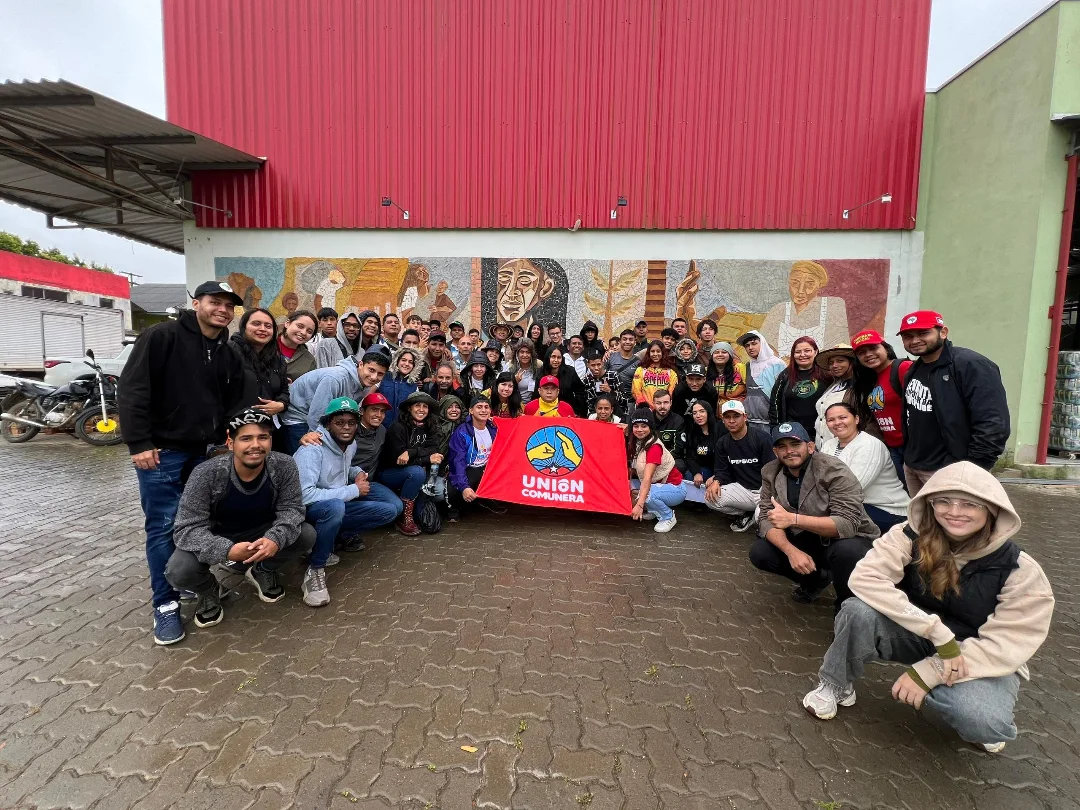
El Sur Existe has also fostered solidarity meetings with other popular power organizations. (@comunaelsurexiste)
From a big-picture perspective, how do you interpret the current relationship between Venezuela and the United States? How have issues such as the oil agreement with the Trump administration been addressed within the commune?
From my perspective, the way to describe Venezuela’s relationship with the United States right now is that the country has entered an era of tutelage. The national government argues that it is a win-win relationship, where the United States needs our resources and we also need its support to exploit them.
We must remember that for many years, our country suffered from US sanctions which caused a great deal of damage. People want to regain the quality of life they once had. Perhaps the Venezuelan economy can rebound if these agreements with the US and multinational corporations create a large number of jobs, which in turn generate other benefits.
Politically, our challenge is to deepen the revolution economically and socially within our territory. But unfortunately we haven’t really discussed national-scale issues, such as the oil agreement, here in the commune. In areas like Carabobo State, other needs take priority on the agenda, such as electricity and public services.
The post Alexander Lovera: ‘Communes Must Be Economically Self-Sustainable Over Time’ appeared first on Venezuelanalysis.
From Venezuelanalysis via This RSS Feed.