

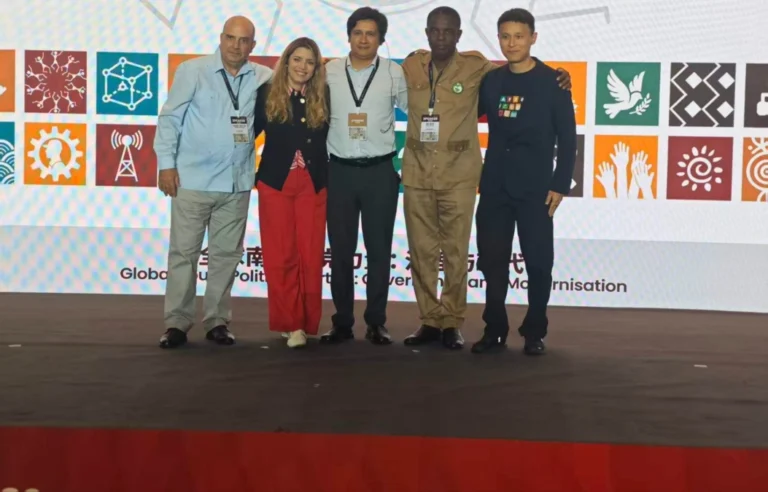
Global South Media Center launches in China with teleSUR, Prensa Latina, Brasil de Fato and Pan Africa TV to strengthen Southern media cooperation.
Related: China Deploys Liaoning Carrier Strike Group to Western Pacific for Military Drills
Global South Media Center Launches in China
The Global South Media Center was established in China on Sunday as a new platform for cooperation among media organizations from Latin America, Africa and Asia.
The initiative, known by its Spanish acronym CMPSur, was created by four media outlets with correspondents in China: teleSUR, Cuba’s Prensa Latina, Brazil’s Brasil de Fato and Ghana’s Pan Africa TV.
The launch took place during the Global South Academic Forum, held in Shanghai on October 17 and 18 under the theme “Global South Political Parties: Governance and Modernization.”
The forum brought together political leaders, academics, researchers and media representatives from Asia, Africa, Latin America and other developing regions.
Jeff Xiong, secretary general of the Global South Academic Forum, said the new media center seeks to strengthen joint journalistic production and build narratives from the perspective of the peoples of the South.
The platform aims to deepen links between China and other Global South countries while challenging the dominant communication frameworks of the Global North.
Xiong highlighted the role of the Global South Academic Forum in creating the conditions for multinational cooperation. He also expressed hope that additional media organizations from developing countries would join the initiative.
The Global South Media Center plans to expand the circulation of stories about China among audiences in Africa, Asia and Latin America through collaboration among outlets from different regions.
The initiative reflects a growing effort by Southern media to coordinate reporting, share content and develop common perspectives on development, governance and international relations.
The center will not replace the editorial independence of its founding organizations. Instead, it is expected to provide a framework for exchanging material, coordinating coverage and promoting joint productions.
The creation of the platform comes at a time when media organizations in developing countries face increasing pressure from concentrated technology platforms, algorithmic distribution and dependence on foreign digital infrastructure.
The Global South Academic Forum has become a space for discussing those challenges alongside broader questions of governance, development and international cooperation.
Global South Media Center Focuses on AI and Sovereignty
Global South Academic Forum | UNESCO—Media development and information
The Global South Media Center was announced during a panel on communication, party governance and social mobilization.
Participants discussed how media organizations can respond to the expansion of artificial intelligence and growing technological inequalities between developed and developing countries.
Alejandro Gómez, vice president of Prensa Latina, defended technological sovereignty and informational independence as essential conditions for Southern media.
He said developing countries must build their own capacities rather than relying exclusively on infrastructure and platforms controlled by external actors.
Gómez proposed the creation of a permanent training mechanism in artificial intelligence for journalists and media organizations in the Global South.
The initiative would be developed in cooperation with Chinese institutions and other specialized organizations. It could include training in AI-assisted reporting, data verification, digital security, content production and responsible use of new technologies.
The Prensa Latina executive also emphasized the need for Southern media to produce their own narratives about international transformations.
He argued that dominant global media frameworks often condition coverage of countries such as Cuba and limit the visibility of perspectives from developing nations.
The proposal reflects a broader concern that artificial intelligence may reinforce existing inequalities if Southern countries do not participate in the design, regulation and use of these technologies.
AI tools can help journalists analyze information, translate content, identify trends and improve audience engagement. However, they can also reproduce biases, amplify misinformation and concentrate power in companies that control the underlying models.
For media organizations in the Global South, the challenge is to use new technologies without becoming dependent on foreign platforms or losing control over editorial decisions.
The Global South Media Center could therefore play a role in training, research and the development of shared technological standards.
teleSUR President Patricia Villegas also defended South-South cooperation as a means of strengthening communication sovereignty.
She said media organizations in the South must reduce their dependence on digital infrastructures and technological platforms controlled by external actors.
Villegas warned about the influence of algorithms on the circulation of content. She argued that platforms can determine which stories reach audiences and which voices remain marginal.
The teleSUR president called for greater collaboration among Southern media, including the exchange of productions and the transfer of technological capacities.
She highlighted China’s role as a strategic partner for expanding communication cooperation and strengthening the ability of developing countries to produce and distribute their own content.
Villegas also referred to the creation of teleSUR+ in July 2026. The collaborative platform brings together audiovisual material, texts and photographs produced by media organizations and creators from the Global South.
She also mentioned the Global South correspondent network in Beijing, which includes Brasil de Fato, Prensa Latina and Brazil’s TVT, with the planned incorporation of an African media outlet.
The correspondent network provides a practical model for the new media center. It allows participating outlets to share reporting, coordinate coverage and reduce the costs of maintaining international bureaus.
Southern Media Seek a Common Global Voice
UNESCO—Global Media and Information Literacy | International Federation of Journalists
The Global South Media Center represents an effort to build a more coordinated voice for developing countries in the international information system.
Media organizations from the South often face unequal access to technology, advertising revenue, satellite capacity, distribution networks and international audiences.
Many outlets rely on platforms owned or controlled by companies based in the Global North. Those platforms can shape visibility through algorithms, moderation policies and commercial priorities.
The new center seeks to address that imbalance by promoting cooperation among media with shared interests in sovereignty, development and multilateralism.
The initiative also responds to the need for greater representation of Southern perspectives in coverage of China, Africa, Latin America and the Caribbean.
Mainstream media in the Global North have often presented developing countries through narratives focused on crisis, instability or dependence. Southern media organizations argue that those narratives ignore local experiences, historical context and the diversity of development models.
The Global South Media Center aims to provide alternative coverage that reflects the voices of communities, governments and social movements in the South.
The platform could support reporting on infrastructure, public health, education, food sovereignty, climate adaptation, digital governance and regional integration.
It could also promote stories about cooperation among developing countries, including China’s role in infrastructure, technology and trade.
The center’s creation is part of a wider effort to strengthen South-South cooperation in communication.
The Global South Academic Forum has promoted exchanges among academics, institutional representatives and media organizations on governance, development, international cooperation and the role of developing countries in global affairs.
The forum’s discussions have included state capacity, social mobilization, institutional innovation and the use of party organizations to strengthen governance.
Those themes are closely connected to the media agenda. Communication is not only a technical issue; it is also part of how societies organize political participation and respond to global challenges.
The panel in Shanghai emphasized that media organizations must prepare for the impact of artificial intelligence while defending editorial independence and public interest journalism.
Participants argued that technological innovation should not replace journalists but should support their work by improving research, verification and audience access.
The Global South Media Center could therefore become a space for developing ethical guidelines on AI, protecting journalists’ rights and promoting responsible use of new technologies.
Geopolitical Context
The launch of the Global South Media Center has geopolitical significance because communication has become a central arena of global competition.
Countries and media organizations increasingly compete to shape narratives about development, security, technology and international cooperation.
China’s role in the initiative reflects its growing engagement with Africa, Asia and Latin America. Beijing has expanded partnerships in infrastructure, trade, education and digital technology through initiatives such as the Belt and Road Forum and the Forum on China-Africa Cooperation.
For Southern media, cooperation with China offers access to training, technology and new distribution channels. It also allows them to diversify their sources of information and reduce dependence on traditional Western media networks.
For China, the platform provides an opportunity to strengthen its image among Global South audiences and present its development experience through media organizations from the region.
The initiative does not eliminate political differences among participating countries. Media organizations in the Global South have different political systems, editorial traditions and national interests.
However, the center reflects a shared concern about technological dependence and the unequal distribution of global communication power.
The platform could also influence debates about digital sovereignty, data governance and the regulation of artificial intelligence.
Developing countries have increasingly argued that international standards should address the concentration of technological power and protect the right of nations to control their own digital infrastructure.
The Global South Media Center may become part of that broader discussion by promoting training, content exchange and cooperation among media organizations.
Its success will depend on whether participating outlets can sustain joint projects, develop shared standards and expand the initiative beyond its founding members.
The launch of the Global South Media Center marks an attempt to build a stronger communication network for countries seeking greater influence over the global information order.
SEO Title: Global South Media Center: 4 Outlets Launch Bold New Platform in China
From teleSUR English via This RSS Feed.