

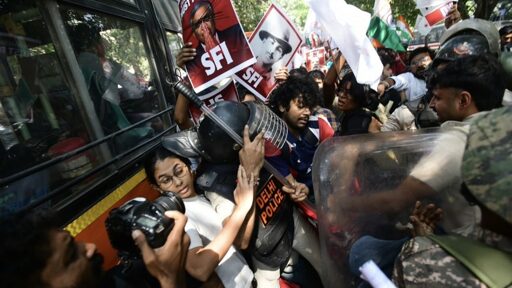

60,000 security personnel were deployed across India’s national capital on October 10. This included the police of Delhi and neighboring states, as well as paramilitary forces pulled from regions of India affected by armed insurgencies.
They sealed off central Delhi to stop protesters opposing the mass disenfranchisement of 130 million voters from reaching Jantar Mantar, the designated protest site on Parliament Street.
The railways cancelled over 250 trains to Delhi. “So far as I remember, it has never happened in the history of Indian Railways that so many trains were cancelled just because of a protest or agitation,” said Shiv Gopal Mishra, general secretary of the All India Railwaymen’s Federation (AIRF).
Scores of activists already travelling to the national capital from other states of India were detained on moving trains and forced to alight at numerous railway stations in multiple states. Many grassroots activists in several other states were placed under preventive detention in their homes ahead of the protest. Paramilitary forces were deployed at checkpoints on Delhi’s borders, where vehicles were searched for any signs of protesters, placards, etc.
Within the national capital, 45 metro train stations were closed. Internet and telecommunications were down in the four-kilometer radius of Jantar Mantar. Around Parliament Street alone, where Jantar Mantar is located, over 3,000 security personnel were deployed, with multi-layer barricades, each manned by about a hundred.
Even outside this garrisoned zone, police held up commuters entering central Delhi at numerous checkpoints, causing traffic jams while enquiring about their purpose of travel before letting them through, to ensure they were headed to work, not to protest.
Communists fight back
Evading this anticipated hurdle, hundreds of activists from the Students Federation of India (SFI) and the Democratic Youth Federation of India (DYFI) had already positioned themselves the previous night just over three kilometers northeast of Jantar Mantar at HKS Surjeet Bhavan.
A memorial to the freedom fighter and veteran communist leader, HKS Surjeet, it serves as an education center of the Communist Party of India (Marxist) [CPIM] and also hosts SFI’s Central Committee office.
The Delhi Police’s midnight attempt to intimidate students at the SFI Central Committee office in HKS Surjeet Bhawan was promptly rebuffed by the CPI(M) party leaders there. pic.twitter.com/x45gOglsCk
— CPI (M) (@cpimspeak) October 10, 2026
“But the police knew we were there,” recalled SFI activist Asikul. The police had tried over the last two nights to enter the premises to take stock of the preparations, but were stopped. Activists worried the police could barricade the gates and stop this mobilization of hundreds from stepping out to protest the following morning.
Quietly, after midnight, student activists slipped out of HKS Surjeet Bhavan in groups of five, one after another, with cover stories for travel reasons if intercepted on the way. By six in the morning, about 250 of them had relocated to the CPIM’s national headquarters, AKG Bhavan, to the west of Jantar Mantar.
Back at HKS Surjeet Bhavan, where hundreds more stayed behind, barricading began between 10 and 10:30 am, just 100 meters from its gate, recalled Aman Saini, the Delhi State Secretary of the DYFI.
About 300-350 activists stormed out of the gates and made it through before the barricades could cut them off. Waving red flags and holding placards calling for the dismissal and arrest of the Chief Election Commissioner (CEC), Gyanesh Kumar, they marched barely a kilometer before facing a police cordon. The police lined up shoulder to shoulder, batons held horizontal to block the protesters’ way forward.
Continuing to march, the protesters headed straight into the cordon. A tussle ensued amid chorus chants of ‘vote chor, gaddi chhod’, demanding the “vote thief” CEC’s resignation. As the protesters in the front line grappled with the police – each engaging multiple officers by dropping to the ground and resisting detention – others broke through the cordon and sprinted ahead.
Barely 300 meters ahead, a line of barricades blocked the road. Protesters stormed ahead and engaged the police. Slipping through the tussle, “I pulled the barricade from below and shoved its top. Thaad! – it fell over,” explained Aman.
Wrangling themselves free from the security personnel, many more dashed ahead, several slashing their feet against the metal of the fallen barricade, only to turn left on Minto Road and drop another barricade.
They had covered nearly half the distance to Jantar Mantar, reaching within 150 meters of the Connaught outer circle, one curve away from Parliament Street hosting the protest site.
“But the barricade there was re-enforced. We had almost managed to pull one down when the police charged at us with batons,” added Aman. Having lost numbers at each of the previous barricades, “we were only about 50 left. So they managed to detain us and shove us into buses. At least six of us were injured.”
Those who had evaded detention at the previous barricades, but were unable to push ahead, regrouped outside HKS Surjeet Bhavan and started sloganeering. Police, accompanied by paramilitary, charged with batons and detained them, and even allegedly tried to break into the premises, but were held back at its gate.
Paramilitary at the party gates
The contingent of activists who had relocated to AKG Bhavan under the cover of darkness did not have it any easier. They had only managed to stretch the security personnel and their barricades across two fronts. A paramilitary force began assembling outside its gates around 10 am, roughly the same time as the barricading began at HKS.
Several members of CPIM’s Central Committee (CC) and Politburo, including current and former Members of Parliament, many of them grey-haired, were staying at the AKG Bhavan for a CC meeting. They joined the students as they marched out.
“Some 20 people were detained right outside the gate – almost the whole frontline. The rest of us behind them pushed through. We kept running,” recalled Asikul.
About 15-20 minutes into the march, SFI activist Noel was detained. “I was not taken to a detention bus, where others were held. I was held alone in a bus used to transport the police. There I was beaten for two hours,” he said, sharing pictures of the injuries he sustained on his face.
“Two of my comrades realized that I was being held alone. So they intentionally got themselves detained near my bus and joined me. They also got beaten up,” he added. Later, when the police started marching them to the detention bus, allegedly prodding them forward by jabbing the blunt ends of their batons into their backs, “we managed to escape.”
Meanwhile, others had pushed ahead. Among them were SFI National Joint Secretary Aishe Ghosh and the DYFI’s national president, AA Rahim. They marched about a kilometer from AKG Bhavan before being apprehended at the roundabout near Gurudwara Bangla Sahib. The SFI alleged that “Aishe Ghosh was assaulted by male police personnel in the absence of women officers.”
A showdown ensued. Dropping to the road and bracing in a huddle, Aishe and other female activists held ground as female police personnel who arrived later grappled with them, eventually dragging them away to detention buses, about 1.5 km away from Jantar Mantar.
Other activists, including Asikul, had strode ahead, breaking through three barricades, and reaching within 400 meters of Jantar Mantar. “We were not able to break through the fourth. We were only about 35 left,” said Asikul.
“Using chokeholds and baton charges, they detained us. Some managed to escape detention by breaking out through a bus window,” an increasingly popular mode of resistance by the younger generation of activists, determined to make detentions as costly and as strenuous as possible.

Police detaining student activist and SFI president Adarsh M Saji. Photo: CPIM
Detention at the stadiums
Asikul and the rest of the detainees were driven almost 50 km to Bawana in northwest Delhi and held at the Rajiv Gandhi stadium, where hundreds more were already being held. Among them was 77-year-old Manik Sarkar, a senior communist leader and Tripura state Chief Minister from 1998 to 2018. He was accompanied by the northeastern state’s current opposition leader, Jitendra Chaudhury. Veteran trade unionist and former Member of Parliament (MP) Tapan Sen, along with other ex-legislators, were also held there.
“There was not a drop of water in any tap in the toilet. We were not even provided with clean water to drink. When we demanded, we were asked to drink from” an old, ill-maintained leaky tank in the premises, said SFI activist Utkarsh, who was also held here. “We challenged the police to drink that water. They refused.”
When detainees began falling sick, Utkarsh and other activists warned the senior police officer in charge of this detention of consequences for mistreating a former Chief Minister and ex-MPs. They reminded him of his responsibility if one of these elderly political leaders fell seriously ill. Only then did the police “finally provide us with water and some snacks.”
Seven other stadiums in the city, along with several other public facilities, were reportedly turned into detention centers that day, when security personnel detained over 7,000 people from the streets of the national capital, including protesters, journalists and even pedestrians suspected of being protesters.
More than 7 km south of Jantar Mantar, near the INA market, outside barricaded central Delhi, police detained protesting activists of the All India Students’ Association (AISA), led by Neha Bora, one of the most recognizable faces of the protest movement.
Detentions were also reported in Raj Ghat, about 4.5 km northeast of Jantar Mantar, where the Revolutionary Workers’ Party of India (RWPI) and its affiliated mass organizations had organized a protest.
At the airport, almost 15 km to the southwest of Jantar Mantar, the police boarded a plane as soon as it landed from Mumbai – even before the passengers could disembark – to detain Abhijeet Dipke, Saurav Das, and Ashutosh Ranka from their seats. They are the top leaders of the Cockroach Janta Party (CJP).
“Cockroaches”
The pressure group started as a satirical protest on social media in May, after the Chief Justice of India said: “There are youngsters like cockroaches, who don’t get any employment or have any place in profession. Some of them become media, some of them become social media, RTI activists and other activists.”
The CJP has since become a material force, playing a key role in the protest against exam paper leaks that forced the Union Education Minister to resign in July.
About two months after his resignation, an investigation by the Indian Express newspaper exposed irregularities in the conduct of the Chief Election Commissioner (CEC), Gyanesh Kumar. Several times, his two fellow election commissioners had flagged their concerns about his potentially illegal and unconstitutional decisions.
These pertained to the Special Intensive Revision (SIR) of electoral rolls, still underway after already deleting the names of 130 million people from India’s voter rolls – in an unprecedented shrinking of India’s electorate. Opposition parties have long alleged that this exercise is meant to help the ruling far-right Bharatiya Janata Party (BJP), led by Prime Minister Narendra Modi, consolidate its hold on power.
Earlier this month, on the birth anniversary of Gandhi on October 2, protests began, calling for the scrapping of the SIR and the CEC’s resignation. On October 7, the CJP called on youngsters to take Jantar Mantar again on October 10.
In response to its call, thousands of youngsters, most in their late teens and early 20s, kept arriving in small groups to central Delhi throughout the day, only to be whisked away by the police.
Detention as deterrence
“These youngsters, who were not part of any cadre-based organization, were particularly harassed by police because they identified them as vulnerable. They were threatened, their phones and keys were snatched,” said DYFI’s Delhi State Vice President, Rikta Krishnaswamy, who was held with hundreds of them at a makeshift detention center in Jafar Kalan, over 45 km west of Jantar Mantar.
Bundled into a bus at the final barricade reached by the march from HKS Bhavan that morning, Rikta was brought here by midday, when “the electrician was still installing the fan. We were held until evening with nothing to eat – not even a cup of tea. The police are trying to make detention as much of a deterrent as possible.”
But the protesters were not deterred. The very next day, DYFI activists, including several central committee members, gathered at Connaught Place, a 15-minute walk from Jantar Mantar, which remained cordoned off, even as the overall restrictions on movement in central Delhi had eased.
Custodial torture, sexual harassment
Soon after they began staging a protest, security personnel swarmed in. The detained protesters “were not taken to any police station,” according to a petition alleging custodial torture, filed in the Supreme Court by AA Rahim, the youth organization’s national president and an MP.
“Instead, while still near Connaught Place, the bus was driven to a closed and heavily guarded space in front of the Daryaganj restaurant, away from public view, out of the reach of the media and without any CCTV cameras. There, the detainees were sorted according to gender and then forcibly shifted into a specialized police van divided into five separate cells.”
These vehicles “functioned as unrecorded, mobile places of detention, wholly outside the safeguards of the Constitution,” added the petition. “Inside the cells of the van, the detainees were beaten on the face, kicked on the backbone with boots and struck on the head. Several of the personnel wore no name badges.”
At a press conference on October 12, women activists of the SFI showed bruises and alleged sexual harassment by security personnel.
But even the alleged custodial torture and sexual harassment has not deterred the protests, which are widening, drawing in more sections of society into the agitation.
Farmers and workers to join the agitation
Representatives of India’s largest and oldest farmers’ union, the All India Kisan Sabha (AIKS), the All India Agricultural Workers’ Union (AIAWU), the Centre of Indian Trade Unions (CITU), the All India Democratic Women’s Association (AIDWA), along with SFI and DYFI leaders, met at the HKS Surjeet Bhavan on October 14.
Several public intellectuals and artists also participated in this meeting of mass and class organizations’ leaders, where they jointly formed the All India Platform of People Against SIR. This platform announced October 23 as a Nationwide Street Action Day Against SIR.
Condemning the central government’s denotification of Jantar Mantar as a designated protest site on October 12, the platform gave a slogan to turn every street and every village into Jantar Mantar.
From BT News via This RSS Feed.