

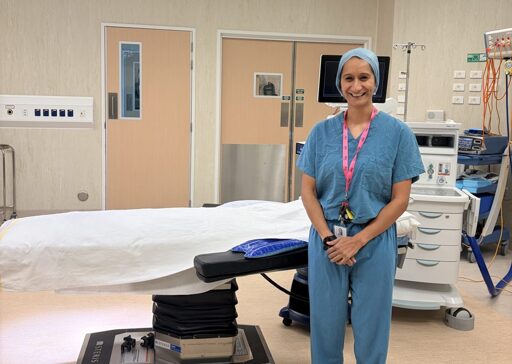

Orthopaedic surgeon Dr Ailsa Wilson.
When Ailsa Wilson left high school in Tokoroa to study music at Auckland University, she was still dreaming of becoming a concert pianist. It was only after meeting a group of Māori and Pacific medical students that she realised her future might lie in medicine. Now, she’s an orthopaedic surgeon, and the first Pacific woman in her field. Here she is talking with Dale.
Ailsa Te Rina Kari is a beautiful name. Can you tell us how you came to carry those names?
I’m named after my grandmother, my Māmā, on my dad’s side, Ailsa Wilson, who was Ngāpuhi. She was a descendant of Tiraha from Waikare, and she had Scottish heritage through her father.
Te Rina is from my dad’s side as well, from my great-great-great-grandmother, Te Rina Rewharewha, who was from Pupuke. Kari is after my mum’s sister, from Aitutaki in the Cook Islands.
My grandfather, my Pāpā, was Timikara Wirihana Tomo Hone Tua from Whangaroa. His last name was changed from Wirihana to Wilson when he was young. Actually, it was changed to Jim Wilson. He told us he was advised by the old people to change his name to a European name.

Ailsa’s grandparents on her father’s side. Māmā Ailsa and Pāpā Timikara Wirihana Tomo Hone Tua (Jim Wilson).
Isn’t it wonderful that our people celebrate those who’ve gone before us this way?
Absolutely. I’m very proud of my whakapapa. I feel we’re here on this earth because of our tīpuna, so it’s important to our family that we carry on their names and acknowledge them. My brothers and sisters and many of my cousins carry our family names. My daughter, too. We decided to call her Te Rina Christine. Christine after her great-grandmother on my partner’s side.
Obviously, your old man’s from the north, so you’re Māori, but you’re also a Cook Islander.
My mum, Kopuku Teokotai, was born and bred in Aitutaki, Ureia. Tapairu Ariki and Teokotai Ratai are my grandparents. I’m very proud to call Aitutaki my home. It’s our paradise home. Mum’s home in Ureia, where she grew up, is still there for us to go to whenever we want. We just need to get over there more often.
And I see you’re from the proud Cook Islands town of Tokoroa.
Yes, Tokoroa’s my hometown, and I’m also very proud of that. My grandfather moved to Tokoroa from up north back in the 1930s, and it’s where Mum and Dad met.
Mum and all her family had come over from the Cooks for work, and many of them worked at the timber mill. My dad, John Wilson, worked in the bush for a little while before he started at the mill, and he worked there for more than 40 years.

Ailsa and her baby Te Rina Christine, then four months old, in Tokoroa.
It’s got a strong Cook Islands connection, Tokoroa. Why is that?
Many Cook Islands families migrated to Tokoroa for work from around the 1950s on. There were a lot of job opportunities there because of the timber mill, and I guess, coming over from a small island, they wanted to stay closer together in New Zealand.
Our Tokoroa Cook Islands community is huge. We’re a very close-knit Pacific community. The culture is very strong, and it’s awesome. Tokoroa is known as the 16th star or island of the Cook Islands.
Was your schooling in Tokoroa?
Yes. I went to Central School primary, Tokoroa Intermediate, and Forest View High School. There are two high schools in Tokoroa. All my siblings and most of my whānau went to Tokoroa High. I just had to be the opposite, and I went to Forest View.

The Wilson children (from left): Hone, Jimmy, Tapairu, Johnny and Ailsa, with their dad John, at the Hutt Timber Yards in Tokoroa.
You mentioned culture, and I wondered about te reo and Kuki Airani. How did this feature in your high school years? Were you encouraged along those paths?
My mum speaks Cook Islands Māori fluently, so I was exposed to a lot of Cook Islands language and culture growing up. But my dad isn’t fluent in te reo. That went back to my grandfather. He spoke fluent Māori, but you know how it was back in his day — he was told he had to speak English and not speak the reo anymore.
I remember my dad saying that his father had told him: “This is a Pākehā man’s world now, son. Learn the way of the Pākehā.” Unfortunately, that was instilled in him when he was young, and he passed that mentality on. My dad knew some reo, but he taught us very little Māori. My mum, however, would always encourage us to speak Cook Islands Māori.
My reo isn’t very good, and I regret not listening properly to Mum when I was little. So now I’m on the back foot, but I’m trying to catch up and improve my reo. I’m envious of all those who speak beautiful reo and yearn to improve, and I know I’ll get there. We’re trying to speak with our daughter now. It’s time to break the cycle.

Ailsa’s family on a visit to Aitutaki, Cook Islands.

Ailsa showing her tree-climbing skills at the back of her mum’s house in Aitutaki.
Surgeons need skilful hands, and I know you’ve got them, because you were going to be a concert pianist, I believe.
I picked up the piano very early, when I was about eight. It was my Māmā, Ailsa, who took me to my first piano lesson, and from that day on, I was dedicated — 7am practice before school every day. I sat my grade eight piano exam in the fourth form. I did more exams and competitions around the North Island. My dream when I left high school was to one day become a concert pianist.
When you say a concert pianist, does this mean you were drawn to classical music?
Yes, classical music, which is not the typical music that Māori and Pasifika people are drawn to. And when I used to go to competitions, there would be no other Māori or Pacific people in the room. It was really cool to go with my family and see how people would be like, “Who are these people?”, then get up on stage and be able to play really well.
I do recall someone saying to my dad: “I thought you guys were only good at playing the guitar.” That was quite funny.
After high school, I went to Auckland University to do a degree in music, majoring in piano performance. I was taught by Michael Houston, Rae de Lisle, and Sarah Watkins, all renowned New Zealand concert pianists. I’m very lucky to have been under their wings.
Did you get your degree in music?
I got my degree, but I also picked up another degree in sports science, because I wasn’t sure I wanted to do just music for the rest of my life. Being a performance pianist involves spending a lot of hours at the piano every day, working hard to perfect every bar. Sometimes people practise for six or seven hours a day, doing that every day to perform on stage. I didn’t know if that was going to be me for the rest of my life.
I’m delighted that I sometimes see pianos in public spaces. There’s one at the train station in downtown Auckland. Have you ever sat at one of those pianos and surprised people with your abilities?
I have. I’m quite a shy person, but sometimes, if I’m asked to, I’ll go and play.
Who encouraged you to go to varsity? And were you the first in your family to go to uni?
It was my piano teacher, Mr Crawford, who encouraged me to go to university to continue with music. He was the one who instilled the belief that I could do music and become a performance pianist.
But no one else in our family had gone to university before me. I come from a family of bushmen and timber-hands, and my mum looked after us five kids. So it was a big step, and leaving home was also a huge thing.
My parents had to make a lot of sacrifices. I actually don’t know how we all survived or how I got to go to university. But we were loved, and my parents were always present, and that’s all that mattered, really.

Ailsa is the second eldest of five siblings, pictured here on a recent visit to Aitutaki. From left: Hone, Tapairu, Ailsa, Johnny and Jimmy.
When did you decide that medicine was the path for you?
While I was studying music and sports science at Auckland University, I lived at the Grafton hall of residence for students. There were Māori and Pacific students living there who were studying medicine, and they became my best friends. I spent a lot of time with them, and they’d come home and practise for their exams on me. They would use me as a patient.
I became really inspired by what they did, and they were also just beautiful people. Kind and very hardworking. They’d grown up with similar backgrounds to mine, and I started thinking: “If they can do it, why can’t I?”
I thought I’d enjoy it, and it involved helping people, so I decided to try to get into medicine. My plan was to graduate with my two degrees and then apply to medical school.
Did you get in under MAPAS (the Māori and Pacific Admission Scheme for medicine at the University of Auckland)? That’s been under attack again recently — what do you make of the political standoff about MAPAS?
Those students who inspired me were MAPAS students. I applied as a graduate through MAPAS, so I’m a proud ex-MAPAS student as well. My take on MAPAS is that it’s absolutely necessary. We need a workforce that reflects our community.
Many of my MAPAS friends have gone back to work in their home areas, and a lot of them are in places where it’s been a struggle to find doctors. I have friends working in Opononi, Kaikohe, and Wairoa. My sister Tapairu is a GP in Tokoroa.
All these ex-MAPAS students go back to where they come from to serve these underserved communities that really need and deserve good healthcare.
As MAPAS students, we go through medical school, we do the exact same exams as everybody else, and we come out as well-rounded doctors who are kind, who are hardworking, who are beautiful people, and who can walk in te ao Māori, te ao Pākehā, and te ao Pasifika. We’ve also lived in these communities, so we understand what’s needed to deliver better healthcare for our people.
Tēnā koe, ngā mihi. Thank you for sharing that.
I’m passionate about it because I feel the media gets a different story from what actually happens. I think most healthcare workers understand that too.

Ailsa and some of her doctor friends, all ex-MAPAS students: L-R Jamie-Lee Rahiri (general surgery), Ailsa, Audrey Robin (GP in Hawke’s Bay), Laine Marsh (GP in Hokianga). “All these ex-MAPAS students go back to where they come from to serve these underserved communities that really need and deserve good healthcare.”

Ailsa’s sister Tapairu, who’s a GP in Tokoroa, and niece Jessie Wilson.
Tell us how surgery unfolded for you as a pathway.
Initially, I thought I’d be a GP working in the communities, with a bit of sports medicine on the side. But when I did my orthopaedic run, a consultant at Middlemore sat me down and asked if I’d ever thought about surgery as a career. I was taken aback because I never ever thought that surgery was a possibility for me, and I knew it wasn’t going to be easy.
From then on, I had to work extra, extra hard because it’s very difficult to get on the orthopaedic training programme in New Zealand. If you think getting into medical school is hard, getting on the orthopaedic training scheme is something else. In my year, only 12 got into training in New Zealand. It’s a very tough journey and a lot of people don’t make it, even after years of trying. I was grateful that after many hard years of work, I got on.
And here you are, the first wahine Pasifika orthopaedic surgeon! Congratulations. Tell us about that first time when they said: “Right, you’re running the show, Ailsa,” and the people in the surgery were supporting you rather than you supporting them.
It’s an amazing feeling knowing that you’re in charge of giving this person a better quality of life, or giving them back their independence. It’s hard to describe, but I remember it vividly.
What would you identify as being the main skills you need in the very high-pressure environment of surgery?
That’s a good question. I think with orthopaedics, you can teach anybody to do surgery. Just like the piano, you need time, dedication, and repetition to keep perfecting and improving your skills to be a better surgeon. But you can’t teach someone hard work, commitment, and dedication, or how to be a safe, kind and caring doctor to your patients. And how to be a good colleague too. I think it’s these soft skills that are more important.
How might you refine your skills even more? I know you do all sorts of procedures, but is there another area you might specialise in now that you’re an orthopaedic surgeon in Tauranga?
At the moment, I’m working in Tauranga and Whakatāne hospitals, but I’m going to Perth for a year to do a fellowship in paediatrics, to refine my skills in children’s orthopaedics. When I come back, I’ll be based in Whakatāne, with the hope to do some work in the Eastern Bays and in Tauranga, and hopefully the islands too in the future.

Ailsa works at Tauranga and Whakatāne hospitals. She hopes to run clinics in smaller centres to make orthopaedics more accessible to underserved communities. “Surgeons need to come out here rather than stay in the big cities, because these people aren’t going to them. I think that’s the start of trying to address inequities.”
We know that our health determinants aren’t restricted just to medical issues, because housing, unemployment, and mental health all have an influence. So it does become somewhat political as we try and address Māori and Pacific health inequities. How might we move forward, and how important do you think the Māori health journey is for the improvement of wider Pacific health needs?
It’s really hard. The reality, I think, is that we have to start with small steps. Another goal of mine is to run clinics in smaller centres that are more highly populated with Pacific people, such as Tokoroa, so my skills as a specialist are more accessible to them.
Right now, I’m in Kawerau, and we’re trying to start some clinics here to improve access to orthopaedics. These communities need specialist input. Surgeons need to come out here rather than stay in the big cities, because these people aren’t going to them. I think that’s the start of trying to address inequities.
Surgeons are seen as the elite of the medical profession, but everybody on the ward contributes, don’t they?
I’m a person who feels like I’m level with everyone. Everyone who has a job in healthcare is important. If we don’t have the healthcare assistant who takes patients from the ward to the theatre, that surgery won’t happen. If we don’t have the nurses giving people medications or pain relief after their surgery, they aren’t going to be happy patients.
Everyone has a really important role in giving patients a good outcome or a pleasant journey through their care. Surgeons aren’t better than nurses or healthcare assistants. We should all value each other because if one person can’t do their work, then none of us can do ours.

Ailsa with her parents Jim and Kopuku, siblings, and two of the grandchildren. (Photo supplied)
How many kids do you have, Ailsa?
I only have one pēpi, but I was very lucky she came after my major exam, so I’ve been able to enjoy her, and I’ve only recently returned to work after maternity leave.
It’s been challenging going back to work full-time and driving back and forth to Whakatāne, but being a mum is just awesome.
It’s been lovely talking with you. Is there anything you’d like to add?
I’ll just add that I haven’t done this all by myself. I’ve been very lucky to have really good parents who’ve been there for me. From the beginning of my life until I left home, they instilled in me good values, respect and hard work, and I think that’s made me who I am today.
I’m so grateful to also have a very supportive partner, Jesse, and extended family — all the aunties and uncles whose houses I’ve had to bunk in during my training, and who’ve gone through this journey with me. As well as really amazing mentors, friends and colleagues. Just talking about it makes me cry.
(This interview has been edited for length and clarity.)
The post Ailsa Wilson: Surgery, soft skills, and starting small appeared first on E-Tangata.
From E-Tangata via This RSS Feed.