

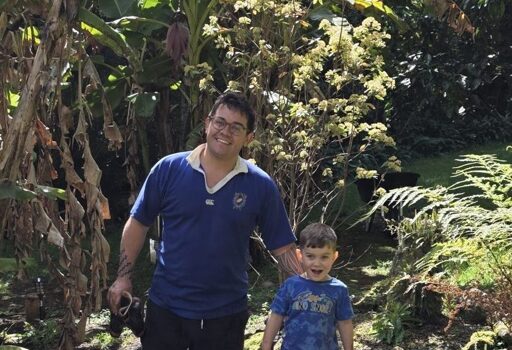

“Our wairua was never built to filter a hundred strangers’ feelings before breakfast. If the noise has grown exponentially, then our need for quiet space has grown with it,” writes Kingi Snelgar, pictured here at home in Whangārei. (Photo supplied)
We need to turn to tikanga to manage online life, writes Kīngi Snelgar.
Somewhere between waking and standing up, we reach for our phones. Within seconds, we scroll past a war, a wedding, a stranger’s grief, an advertisement, a friend’s holiday, a headline designed to alarm us, and a video that made someone else rich by holding our attention for a few seconds.
Thousands of pieces of information, emotion and energy might pass through us before we’ve even stretched. We call it a phone, but I’ve come to think of it as a portal, one that can bring us greater connection and drain our mauri at the same time.
We absorb a friend’s heaviness through a post without them saying anything is wrong. We feel the grief in a story we watch online about Palestine. In 2012, Facebook altered the news feeds of almost 700,000 people for a week, as part of a psychology study. Those shown fewer positive posts went on to write more negative ones, and the reverse was also true.
The sheer volume of this has changed beyond recognition. Twenty years ago, most of us did not carry the internet in our pockets. The first iPhone had not yet been released. Ten years ago, the endless stream of short videos, each one chosen by an algorithm to keep us watching, was only just arriving. Now the feed never ends. One clip after another, each carrying someone’s joy, rage, grief or sales pitch — and we move through them faster than we can feel them.
I came across the work of Gloria Mark, who has spent two decades studying attention. She found that people stayed on one screen for around two and a half minutes before switching to something else. That was in 2004. More recently, it’s around 47 seconds.
Our nervous systems haven’t kept pace, and our wairua was never built to filter a hundred strangers’ feelings before breakfast. If the noise has grown exponentially, then our need for quiet space has grown with it. Time out is now a necessity, the way a māra needs time to grow, the way the tide needs to go out before it can come back in.
For my whānau, this became a real decision. In December 2025, we moved from the busy streets of Ponsonby in central Auckland to two hectares of native bush in Whangārei. We are surrounded by kauri, tōtara and pūriri, our tūpuna. Their energy helps us to balance the intensity that sits in my role as a lawyer, and as a parent. It was a lifestyle change, and I know I’m privileged to have had that choice. In a high-stimulation digital age, we needed to put our whānau’s collective wellbeing first.
That doesn’t mean we’re a device-free household. Far from it, I love my sport and watching the Warriors, and my kōtiro loves her IPad time. But we have chosen to be somewhere where we can have time in the taiao, to ground us and unplug us all from our busy, high-stimulus lives. As a lawyer, and as a rongoā practitioner, I needed quiet and stillness to recharge my mauri.

Kīngi’s daughter among the trees at home in Whangārei. (Photo supplied)
Which brings me back to the portal in our pocket. Our tūpuna understood that every exchange carried more than the object itself. When a taonga was given, the mauri or energy of the giver travelled with it, and that mauri sought its way home. Every koha, every gift, every kōrero carried something of the person behind it.
I believe the same is true online. There is mauri there. A comment written in anger carries that anger to whoever reads it. A post made in aroha carries aroha. Yet, we’re often drawn into more extreme clickbait fuelled by moral outrage, disgust or shame. When we like, share, scroll and pile on, we’re exchanging wairua and mauri, and we seldom set the terms. An algorithm decides what enters our nervous system next, and it is rarely peace.
Very often we give our mauri to things that diminish our mana and wellbeing, for the sake of being tantalised, and take back something heavier in return.
The problem is there’s very little kawa or tikanga for online behaviour. It’s a free market of ideas that often leaves us overstimulated, prompting us to seek respite in other places — vapes, more scrolling, other distractions. Across the Tasman, Australia has drawn one line, banning under-16s from holding social media accounts since December 2025. Whatever you think of that law, it shows that someone is willing to set the tikanga.
Our tūpuna left us tikanga for these reasons. When a fishery was depleted, when a forest was under strain, or when a life was lost on the water, a rāhui was placed. It was there to allow the mauri of that place to return. I’ve started to think of time-out the same way — a rāhui on ourselves. An evening when the phone stays in another room, or a morning that begins with karakia rather than scrolling the news feed. For our whānau, it’s become necessary to have screen-free time so we can recharge in the wairua web that surrounds us in our ngāhere.
In our whakapapa of creation, te ao mārama, the world of light, emerges from te pō, the long night. Darkness was where things gestated, where they gathered strength before they came into the light.
The screen gives us a constant artificial daylight. It glows in our hands at midnight and wakes us before the sun does. If we never let ourselves go into te pō, into darkness or the state of unlimited potential, rest, and silence, we shouldn’t be surprised that we struggle. For some, perhaps the phone is an easy distraction from te pō, because silence and stillness aren’t always easy if we hold deeper internal struggles.
The exchange flows the other way too. Every time we post, we share a piece of ourselves; our face, our tamariki, our whenua, our grief, our wins. Sharing is how we connect, and some of the most beautiful things I’ve seen online are people offering their truth so others feel less alone. Like the beautiful “I love you bro” video I saw recently posted by She Is Not Your Rehab, which showed men calling their mates to tell them they loved them.
Te Mana Raraunga, the Māori Data Sovereignty Network, has long held that Māori data is a taonga, carrying whakapapa and obligations with it. I think that principle holds for all of us. Every photo, every location tag, every late-night post becomes data that a company stores, studies and profits from, long after we’ve forgotten posting it. Once something leaves our hands online, we rarely get it back.
And being pono matters. Pono is truth, integrity, being genuine in who you are. Online, it’s easy to become a slightly different person, a curated version, more certain, more polished, more sure of ourselves than we really are. Holding up that mask takes energy too. Being genuine takes less of my energy.
Much of what drives that gap is ego. Ego gets us moving and builds the confidence to take on that new job. There’s nothing wrong with wanting to do well, but ego also wants to be right, and to be seen as more evolved, more successful, and more together than the person next to us. Social media is built for stoking the ego.
Pono also asks us to be mindful of what we take in. More of what we scroll past is now created by artificial intelligence — faces of people who don’t exist, voices cloned from a few seconds of audio, stories made up to be shared. Knowing what is true, and who is really speaking, has become part of protecting our mauri. Being pono online means acting with integrity, because even the online version of ourselves carries our energy.
Where ego seeks to elevate, wairua seeks to connect. When I notice myself drawn into judgment or comparison, scrolling to see who is doing better or reaching for the reply that will win the argument, I know the ego is driving. When I feel aroha, peace and a widening sense of connection, I know I’m walking with wairua. That has been a useful touchstone for how I engage online, and in my daily life.
We can protect our mauri by being a good kaitiaki of what we’ve been given. Online, that can be as simple as noticing how you feel after 15 minutes on an app, and letting that feeling, not habit, decide how long you stay. Letting go of the accounts that leave you feeling heavier after you’ve spent time there. Guarding some space each day where you give yourself time out from the screen.

A favourite recharging spot at Ngunguru Bay. (Photo supplied)
I’ve learned that the simple things, done with real intention, are what change everything. Putting down the phone and focusing on the breath is the simplest of all. Slowing the inhale, lengthening the exhale, breathing into the chest and the stomach rather than staying stuck in the head, is the most ancient rongoā we have, and it’s available in an office as easily as on a bed in the morning.
We watch how much petrol is left in the tank because fuel is getting more expensive. Our mauri deserves our attention and care. Watch for when it’s being depleted, and use the tools that renew it. And those tools for me are found when I sit with myself and check in with my mauri and nervous system, not online.
The next time your phone lights up and demands your attention, ask what you’re about to take in and what you’re about to give away. Ask whether what you’re receiving and what you’re returning is pono.
Your mauri is a taonga from your tūpuna. And where you choose to share it should reflect your sacredness. Treat it well.

Making time for whanaungatanga in the backyard at home. (Photo supplied)
Kingi Snelgar (Ngāpuhi, Te Whakatōhea, Ngāti Whakaue, Ngāi Tahu) is a barrister and Rongoā practitioner based in Whangārei. He completed a Master of Laws at Harvard Law School as a Fulbright Scholar.
The post Your mauri is a taonga appeared first on E-Tangata.
From E-Tangata via This RSS Feed.