

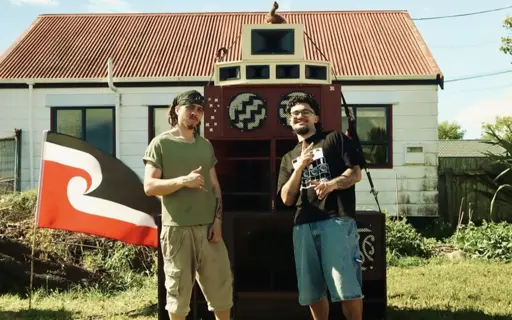

“Recent figures from the Electoral Commission paint a worrying picture. More than a third of 18- to 24-year-olds aren’t yet registered to vote, a proportion that rises to half for rangatahi Māori,” writes Jamie Tahana. Pictured: Te-Ika-a-Māui Soundsystem hīkoi, which kicked off at Māoriland in Ōtaki, calling for rangatahi to make their voices count at the ballot box. (Photo: On a Roll)
With more than half the Māori population under 30, rangatahi Māori could become one of the country’s most important and powerful blocs, writes Jamie Tahana. But that requires signing up and turning out first — and time is running out for this year’s election, with the enrolment deadline only a week away.
It’s little wonder people are disengaged from politics. An uninspiring guy named Christopher, whose party is polling at 28 percent, up against another uninspiring guy named Chris, whose party is polling at 28 percent.
On Wednesday night last week, the stoppable force came up against the movable object at the second leaders’ debate, hosted by the Herald in Auckland. The two Christophers came together for their latest round of rehearsed attacks and recycled arguments. “Why are you guys doing so poorly?” the moderator, Ryan Bridge, asked. They both blamed someone or something else.
By the end, we’d all lost the will to live. It’s hard to get the sense that either of these men stands for anything beyond what a focus group or self-help book tells them, let alone any sense of hope, imagination or direction. It’s a blandness that seems totally disconnected from the moment the country finds itself in.
I landed in Wellington this week in a plane that wobbled violently in the wind, as if Tawhirimātea was trying to throw it back to Australia. The waves of Te Moana-a-Raukawa, whipped into white caps, seemed ominously close. “I’ve felt worse,” someone behind me muttered in some weird act of Wellington bravado, after the pilot nailed the landing.
Those winds seemed something of a portent for a country being buffeted. People are dying in the waiting rooms of crumbling hospitals, and children’s cancer treatment is being delayed for lack of staff. There is record Māori unemployment, driving record numbers of people to Australia. With a bottle of milk pushing $5, people can’t put kai on the table, while petrol nears $4 a litre. I could see it immediately in the number of people sleeping in the doorways of empty shops in central Wellington. At Pak’nSave this week, I saw someone doing maths on a notepad in the produce aisle. Someone else tutted at the price of bread.
Māori bear the brunt of these struggles. Yet again we find ourselves overrepresented in the homeless, unemployment, and underemployment figures. Those who have work often earn less, and our health inequities have grown ever more stark. Earlier this month, the Australasian College of Emergency Medicine released a report cleverly called State of Emergency. Māori ED presentations had increased by 39 percent in the past decade, it said, twice the overall growth rate. That can’t be explained by an ageing population, it said. After all, we die on average seven years earlier than Pākehā.
This election comes at the end of one of the most testing periods for Māori-Crown relations in at least a generation. Some iwi leaders have described the relationship as being at rock bottom after a wave of legislation that specifically targeted Māori, stripped provisions for Te Tiriti, seized the remainder of the foreshore and seabed, and relegated te reo. The ultimately doomed Treaty Principles Bill sparked the largest protest the country has ever seen.
Following the 2023 election, I wrote in E-Tangata that “the kōhanga reo generation is here. They’ve found their voice, and they know how to use it.” The past three years have borne that out, with rangatahi spearheading a spirited defence of the Treaty, land, language and culture. It was rangatahi who hoisted the flag at the head of the hīkoi’s phalanx, and it is a young wahine, Nga wai hono i te po, who has quickly moulded te Kiingitanga with youthful vigour.
But while more than half the Māori population is under 30, recent figures from the Electoral Commission paint a worrying picture. More than a third of 18- to 24-year-olds aren’t yet registered to vote, a proportion that rises to half for rangatahi Māori.
Several rangatahi-led campaigns are underway to try to boost the number of voters, with signs of a surge in enrolments in recent weeks. But controversial law changes, passed last year, have imposed a deadline of next Sunday to enrol. You used to be able to enrol right up to election day.

On a Roll is youth-led campaign calling for the biggest youth voter turnout in Aotearoa’s history. (Photo: On A Roll)
It’s easy to see why so many people are uninspired by the state of the country and the state of the election campaign. The mediocre display from the Chrises, one of whom will be the next prime minister, can hardly instil confidence.
Many will say that voting in parliamentary elections is far from the only form of Māori political participation, and that’s true. It’s also true to say that Māori have long been ill-served by both sides of the political system. A clear example of that was in 2023 when Labour was punished in the Māori electorates, losing all but one of the seats. Recent polls, by Whakaata Māori and Mata, show an uptick in support, but nothing to suggest they’ve made up for it yet. Even Te Pāti Māori’s recent internecine squabbling has left many with a sour taste in their mouths.
Yet the next parliament, whoever is in charge, will also have huge ramifications for the everyday lives of whānau. Yes, you may hate the system. Yes, it may have failed Māori. Yes, it may be the coloniser’s house. But having your say within it doesn’t mean giving up on a greater pursuit of tino rangatiratanga.
There are some heartening signs, though. More people are on the Māori roll than ever before, seven percent above where it was in 2023. The Electoral Commission said more Māori are choosing it over the general roll, with the biggest rise among 18- to 24-year-olds.
Given the country’s demographic shifts, rangatahi Māori are increasingly becoming one of the country’s most important and powerful blocs. But that requires signing up and turning out.
The deadline for enrolling for this year’s election is next Sunday, October 25, at 5pm.
Changes to electoral law mean you can no longer enrol on election day, November 7.
You can enrol online, or check and update your enrolment details, here.
Or you can visit an enrolment hub in the community. See here for locations.
Jamie Tahana (Ngāti Pikiao/Ngāti Makino/Tapuika) is a journalist and broadcaster who has worked in both Aotearoa and the Pacific. He grew up between his Dutch mother in the Hutt Valley, Wellington, and his Te Arawa dad in Rotorua. He has a master’s degree from Te Herenga Waka Victoria University and was the Māori news editor at RNZ until May 2023.
The post Signing up and turning out appeared first on E-Tangata.
From E-Tangata via This RSS Feed.