

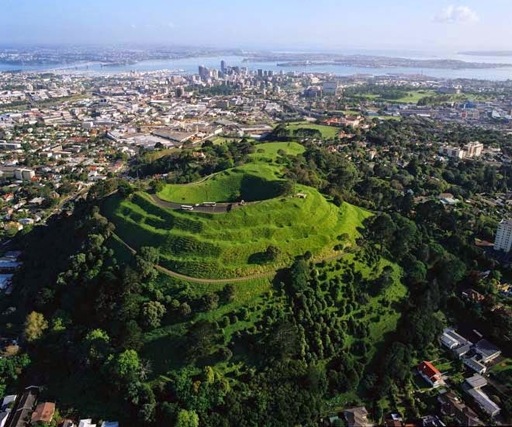

Maungawhau, Mount Eden. (GeoNetGNS)
Chris Bishop has no business reducing the maunga of Tāmaki Makaurau to monetary value alone, writes lawyer Nicola Hoobin.
In our regulatory frameworks, we often see a tension between immediate economic gains and long-term heritage preservation. Yet, a recent report commissioned by Chris Bishop, in his capacity as the minister for housing, infrastructure, and RMA reform, takes this tension to an alarming extreme.
The document — titled Economic Effects of Maunga Viewshafts: A spatial equilibrium approach to estimating the economic costs of protected views — was commissioned by Chris Bishop in his capacity as minister for housing, infrastructure and RMA reform and released by the Ministry for Cities, Environment, Regions and Transport (MCERT).
The economic argument presented in the report is that while the maunga themselves have deep cultural and civic significance to Māori, the strict boundaries of their view shafts are causing an extreme multibillion-pound drag on Auckland’s economy.
The report then attempts to reduce the irreplaceable cultural, historical, and visual heritage of the maunga in Tāmaki Makaurau to a raw dollar figure.
It’s an extraordinary exercise in administrative hubris.
Applying a generic economic model to these maunga is the regulatory equivalent of calculating the commercial real estate value of the Parthenon.
The report’s core thesis is as predictable as it is reductive.
It claims that Auckland’s 79 protected volcanic viewshafts stifle housing supply on premium land, thereby imposing an average annual economic burden of $2,500 on local households, totalling $67 billion.
To justify a “targeted pruning” of these statutory protections, it cites decades-old anomalies, such as sight lines originally drawn to accommodate motorists at long-defunct North Shore toll booths.
Using these fringe anomalies to mount a broader assault on volcanic viewshafts is a transparently flawed strategy. It deliberately ignores a fundamental principle of international legal architecture — namely that some assets have an intrinsic, non-quantifiable value that transcends the immediate ledger.
If this were merely a standard bureaucratic skirmish between heritage advocates and developers, it would be frustrating enough.
But the maunga report represents a dangerous late-term consolidation of executive power. It shifts the conversation out of local planning bylaws and squarely into the arena of constitutional integrity.
Chris Bishop has accumulated an unprecedented number of senior executive portfolios. He simultaneously controls housing, infrastructure, transport, and RMA reform while also serving as associate finance minister and attorney-general.
This creates a political paradox that’s too important to ignore. A single minister is championing executive overreach with one hand while also serving as the ultimate constitutional check against that very overreach with the other.
When the chief guardian of our constitutional boundaries becomes the principal architect of mechanisms designed to bypass them, the attorney-general ceases to be a shield for the rule of law and instead becomes an executive rubber stamp.
One must query why this sweeping bureaucratic consolidation was engineered to become fully operational only on July 1, 2026, so deep into the political calendar.
Establishing an entirely new, super-sized government agency at this late hour suggests a calculated rush to hardwire an infrastructure agenda into the state apparatus before the election.
With central government increasingly deploying heavy-handed mechanisms through the Fast Track Approvals Act to override local councils and statutory protections, this economic report aims to normalise the monetisation of public heritage.
The same structural argument applies to the wider legislative landscape. The Crown’s recent push to systematically strip or weaken Te Tiriti o Waitangi clauses across 19 existing statutes exposes the same constitutional friction. These reforms were actively co-designed by Bishop and approved as part of the executive’s core Ministerial Oversight Group.
Again, the chief defender of our constitutional boundaries is simultaneously designing executive mechanisms to bypass them.
It represents a fundamental breakdown of our democratic conventions.
The physical and cultural consequences of this constitutional drift are profound. Just last week, I attended the Jeremy Salmond Memorial Lecture as part of the Auckland Heritage Festival, which featured a keynote by renowned heritage landscape architect Stephen Brown.
His insights delivered a clear, legally grounded counter-narrative to central government’s transactional logic. Brown invoked the permanent protection of Maungakiekie, a landscape whose status as a priceless sanctuary has been defended for generations. Its return to mana whenua ownership under modern Treaty redress will ensure it remains shielded from the short-term calculations of commercial extraction.
Many of those in the room were the very individuals who had championed the original frontlines half a century ago. This living continuity became particularly poignant during the post-lecture Q&A, when Jeremy Salmond’s widow, historian and Distinguished Professor of Māori Studies, Dame Anne Salmond, spoke about his foundational role in those early struggles.
She spoke of her own vigil following his passing, when she climbed the entire maunga collective. Her words underscored a fierce, multi-generational resolve to defend the legacy today. Viewing these landscapes purely through the lens of development capacity is short-sighted economic reductionism.
We erode our credibility on the international stage if we attempt to project Aotearoa New Zealand as a sophisticated nation that respects Indigenous rights, cultural heritage, and environmental integrity while simultaneously treating our most sacred ancestral landscapes as inconvenient liabilities on a domestic spreadsheet.
This is a familiar pattern of structural duplicity. The state uses Indigenous identity and Te Tiriti compliance to project a sophisticated, high-integrity brand to the United Nations, the UK, and the EU, while systematically dismantling protections back home where the domestic electorate isn’t looking.
The political irony here is extraordinary.
On Wednesday, October 7, 2026, the Department of Conservation officially announced the revised New Zealand World Heritage Tentative List. In that announcement, the volcanic field of Tāmaki Makaurau was formally updated and selected under the title Ngā Tapuwae o Mataaho / Auckland Volcanic Fields to be pitched to the United Nations for its Outstanding Universal Value.
The United Nations World Heritage framework requires a multi-generational commitment to Outstanding Universal Value — a standard incompatible with short-term fiscal tallies.
The Crown is literally using its left hand to lobby the UN for global heritage status, while its right hand is engineering economic reports that dismantle the domestic viewshaft protections that make that global status viable.
A sovereign state simply can’t maintain such a glaring contradiction in its foundational obligations for the sake of immediate political or economic convenience.
A comforting misconception doing the rounds is that, because the Tūpuna Maunga o Tāmaki Makaurau Collective Redress Act 2014 vested the physical ownership of 14 prominent maunga in iwi hands, the government simply can’t execute these plans.
Unfortunately, this misunderstands how regulatory power operates.
While developers and the Crown are legally barred from building structures directly on the maunga, ownership of the soil doesn’t confer ownership of the surrounding airspace. Nor does it control the lines of sight across public and private land kilometres away.
By using central government directives to override local council viewshaft rules, the new ministry is creating a workaround. They are dismantling the protective corridors around the land, and considering allowing intensive high-rises that would visually block and choke out the volcanic cones entirely.
Weakening the spatial boundary lines surrounding these volcanic cones creates the legal loopholes required to potentially, or eventually, encroach on the margins of the maunga land.
Tāmaki Makaurau already possesses significant capacity for density within its existing urban boundaries without dismantling its defining geographical identity. This single, short-term spatial equilibrium model weaponises a sweeping macroeconomic restriction figure when it absurdly estimates the total drag on Auckland’s economy amounts to $67 billion.
The report states that these visual corridors enforce a less compact, more expensive city structure. By blocking high-density residential developments near central transit lines, the restrictions supposedly push housing outwards, inflate land values, and reduce the average Auckland households disposable income due to urban sprawl and inefficiencies.
If we let central government use this model while explicitly refusing to quantify in turn the immense cultural, historic, and civic value of Tāmaki Makaurau’s maunga, we compromise the very characteristics that make our city globally distinct.
This institutional clash is unfolding within a highly compressed administrative window.
Plan Change 120 represents the immediate arena where these boundaries are being tested. Formally known as the Housing Intensification and Resilience change to the Auckland Unitary Plan, this framework is the vehicle through which central directives dictate building densities and heights, directly colliding with the council’s local heritage overlays and viewshaft protections.
Formal public submissions on Plan Change 120 closed on September 24, 2026. The entire complex dispute is now under active consideration by an Independent Hearings Panel.
Still, even though the bureaucratic machinery is now grinding on behind closed doors, the ultimate outcome may not be decided there.
The true constitutional baseline will be established at the ballot box in three weeks, on Saturday, November 7, when citizens will make their final determinations on what has occurred.
When a state structure facilitates, whether through active design or collective constitutional oblivion, an arrangement where a single minister commands aggressive housing and infrastructure portfolios while also holding the keys to the office of attorney-general, it institutionalises an unconstitutional paradox.
We have permitted the chief architect of central overreach to serve as their own constitutional watchdog.
Whether this structural blindness stems from political calculation or a fundamental failure to grasp basic Westminster conventions, the result is the same. Cabinet’s own internal checks and balances have been disabled.
When the system can’t enforce its own boundaries, the electorate must step in as the final arbiter.
The constitutional identity of this nation belongs to its people, as do the maunga, and that identity is not up for trade, negotiation, or liquidation by an executive that has forgotten how to police itself.
Nicola Hoobin is a barrister based in Devonport, Auckland, Tāmaki Makaurau.
The post Why are we reducing Auckland’s maunga to absurd economics? appeared first on E-Tangata.
From E-Tangata via This RSS Feed.