

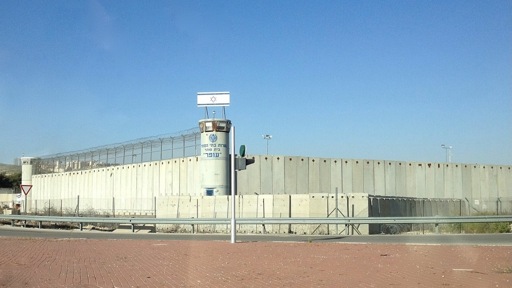

When Dana Joudeh, 35, went into labor in mid-September, she was six months pregnant and being held at Israel’s Damon Prison. Her daughter, Lia, was born premature, and her family says she gave birth shackled to a bed, with a rifle pointed at her.
Joudeh spent almost her entire pregnancy in Damon prison, held under a six-month administrative detention order. There she endured the conditions Palestinian prisoners have described since October 2023: medical neglect, inadequate healthcare, food deprivation, and sharp cuts to hygiene supplies.
Read more: “We are here to kill you”: Released Palestinian prisoner exposes torture and medical neglect in Israeli prisons
A day after giving birth, Dana and Lia were released from Damon Prison. Their time in detention exposed blatant Israeli violations, not only against women but even against infants.
BreakThrough News spoke to Maram Joudeh, Dana’s sister, to learn more about the circumstances of her sister’s arrest, conditions of detention, and how she gave birth amid it all.
The circumstances of her arrest
Dana’s ordeal began when Israeli forces raided her family’s home in Iraq al-Tayeh village, east of the northern West Bank governorate of Nablus and arrested her during Ramadan 2026 (between February and March). Dana was still living with her family at the time before getting married a couple of weeks later.
According to her sister, Dana was detained and interrogated for one day. She was released after losing consciousness due to complications from a medical procedure she had undergone shortly before her arrest.
Around mid-April, an Israeli commander contacted Dana, asking her to head to the Huwara Detention Center for another interrogation session.
Although Dana had never been involved in any political activity, she felt intimidated by the phone call and did not go, especially as the Israeli commander, who was speaking to her, asked her about her recent marriage.
A few days later she received a couple of other phone calls. During one of the calls, the commander informed her that he knows that the wedding of one of her sisters would be held within days, so Dana avoided attending the wedding fearing that the Israeli forces would storm the ballroom and arrest her from there.
In another phone call, she was threatened that if she did not come to the interrogation, her father would be arrested. Therefore, Dana’s father decided to go to the Huwara Detention Center instead of her, but the Israeli commander insisted that she should come personally.
As a result, Dana went to the interrogation on April 19, hoping that she would spend hours there then be released, but she was transferred from there to Hasharon prison, where she spent one night that she described as a “nightmare”.
“The toilet had a stall door that did not provide any privacy. It was very dirty. I lost consciousness there, so they transferred me to a hospital, blindfolded, and shackled. They conducted a pregnancy test for me, and sent me to Damon Prison from there,” Dana told her lawyer, who managed to visit her in Damon Prison in early May.
It was then that Dana’s lawyer found out about her pregnancy, and the inhumane detention conditions she had endured since being imprisoned.
Six months of pregnancy amid inhumane detention conditions
For six months, Dana was detained with five other female prisoners in a small cell, which should be allocated for two individuals only.
“There are only two metal bunks. The toilet has no door, and there is a lot of humidity as they do not open the vision panel.” Dana told the lawyer, describing the cell.
Dana also informed her lawyer that, despite her pregnancy, she was provided with a minimal amount of food, and that she lost weight and suffered from dehydration.
She added that only she and Amina Taweel, another pregnant prisoner, were sleeping on the bunks; the remaining four female prisoners were sleeping on the floor.
“Lina Naser and Tasneem Odeh used to give us their food, because they were expecting to be released soon,” Dana noted about other inmates, who shared the cell with her.
Dana said that the food was “inedible”, as they were sometimes given boiled eggs several hours after being cooked. Canned chickpeas soaked in water and lentils were among the limited options provided to them on almost a daily basis.
Dana also mentioned that their cell was violently stormed multiple times, with sound grenades being thrown. She said that sometimes they stormed the cell at midnight, when she and the other detainees were sleeping.
Whenever Dana fainted during those raids, prison security personnel dealt with the situation by asking other inmates to raise her legs and make her drink water, which she described as “undrinkable”.
During her detention, Dana also developed pimples between her fingers without knowing the diagnosis. Moreover, she wore the pajamas of Lina Naser after the latter’s release, as no other suitable clothing was available.
Shackled to the bed, Dana gave birth to Lia at gunpoint
One day before her scheduled discharge date, Dana experienced severe labor pains, despite being only six months pregnant. This occurred after she had bled for approximately 10 days in Damon Prison before the Israel Prison Service (also known as Shabas) finally approved her transfer to Rambam Hospital.
Already facing a high-risk health condition for herself and her fetus, Dana had her hands and ankles shackled to the bars of a metal bed. She was surrounded by several female Israeli soldiers, who pointed their rifles at her and shouted: “Push harder, you saboteur!”
As the delivery got obstructed, Dana underwent a caesarean section, but even during the surgery the soldiers continued to shackle her hands and legs, surrounding her and threatening her with firearms.
When Dana finally gave birth to Lia, the soldiers shouted: “Another saboteur has just been born!'”
When Dana breastfed Lia before discharge, one of her hands would remain cuffed.
One of the nurses taking care of Dana dressed Lia with pink babywear. Dana said that the nurse was Palestinian.
Nevertheless, the Shabas insisted on treating the premature baby as a prisoner. On the next day, Dana was escorted by Israeli soldiers to a bus, blindfolded and shackled, but Lia was taken away from her for hours.
She described those as the most terrifying hours, fearing what destiny lay ahead for her premature baby. To her surprise, she was then sent back to Damon prison.
Dana then realized she had been brought there because the soldiers had taken Lia to dress her in the same gray pajamas that the Israeli Prison Service (Shabas) has forced all Palestinian prisoners to wear upon release since October 7, 2023. They made customized pajamas for the 1.5 kg premature baby and took photos of her before she and her mother were released from prison, according to Maram, Dana’s sister.
Even upon her release at the checkpoint, Israeli soldiers kept their rifles pointed at Dana as she struggled to walk, carrying Lia in one arm and her belongings in the other.
“Keep walking, don’t stop. Otherwise you will be shot,” the soldiers warned her.
From the checkpoint, Dana and Lia were taken to a hospital in the central West Bank governorate of Ramallah and Al-Bireh because Dana was suffering from scabies and her baby needed to be kept in an incubator.
Dana’s scabies had gotten out of control as she was denied necessary medication while in prison. Her sister told BreakThrough News that the prison authorities only gave Dana cornstarch to apply to her skin to ease the symptoms.
When Dana left detention, she left behind two other pregnant Palestinian women in Israeli detention.
As per the latest report released by Addameer Prisoner Support and Human Rights Association – shut down just a few days ago by the Israeli authorities – these pregnant women are among 90 Palestinian female prisoners currently held in Israeli prisons.
Read more: Hadeel Shatara: the Palestinian woman who defied her jailors
From BT News via This RSS Feed.