

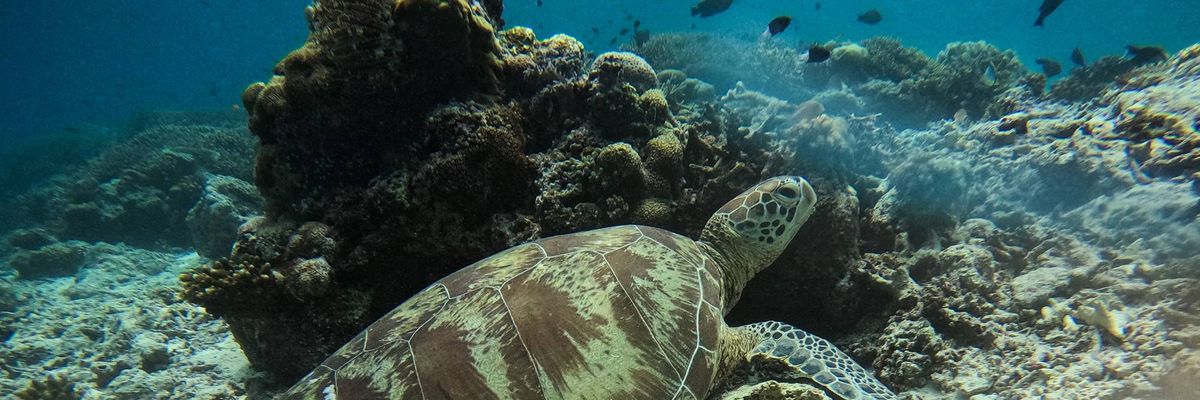
Nearly half the world’s reef-building coral species are at risk of extinction according to a global assessment released Thursday. Researchers warn that the accelerating climate crisis is making the danger even worse than the most recent data shows.
Coral reefs are among the most important ecosystems on Earth, providing food and shelter for around a quarter of all marine species. Their destruction jeopardizes not only entire marine food webs, but also the millions of people who rely on those species for food.
The study, published in the journal Nature, found that as of 2020, about 44% of coral species were threatened, compared with about one-third in 2008.
David Obura, a marine biologist and lead author of the study, said the new assessment “provides the most comprehensive evaluation to date of global extinction risk among reef-building corals, and a stark warning of the accelerating increase in global threats to coral reefs.”
But he said it also "highlights the challenges we face in addressing major data and knowledge gaps on the status of species at global scales, at the same time as having to take urgent decisions to reduce the drivers of global declines in critical species and ecosystems.”
The researchers stressed that the data they analyzed understates the danger. The assessment does not take into account the damage from the devastating bleaching event that began in 2023 and lasted until mid-2025. According to the National Oceanic and Atmospheric Administration (NOAA), it was the largest such event ever recorded, exposing about 84% of the world’s coral reef area to bleaching-level heat stress and causing widespread coral deaths.
It also doesn’t take into account what meteorologists have projected could be the strongest El Niño ever, which could break ocean temperature records in the coming months, likely leading to another massive die-off of corals.
“It is entirely possible that reassessing the status of corals just after this coming El Niño may show them to have crossed the 50% mark of the proportion of species at elevated risk of extinction,” Obura told AFP.
He noted that a previous “super” El Niño, in 1997-98, also caused tremendous damage to reefs.
“That this coming event is worse than that, after three intervening global bleaching events, is a terrifying reality,” he said.
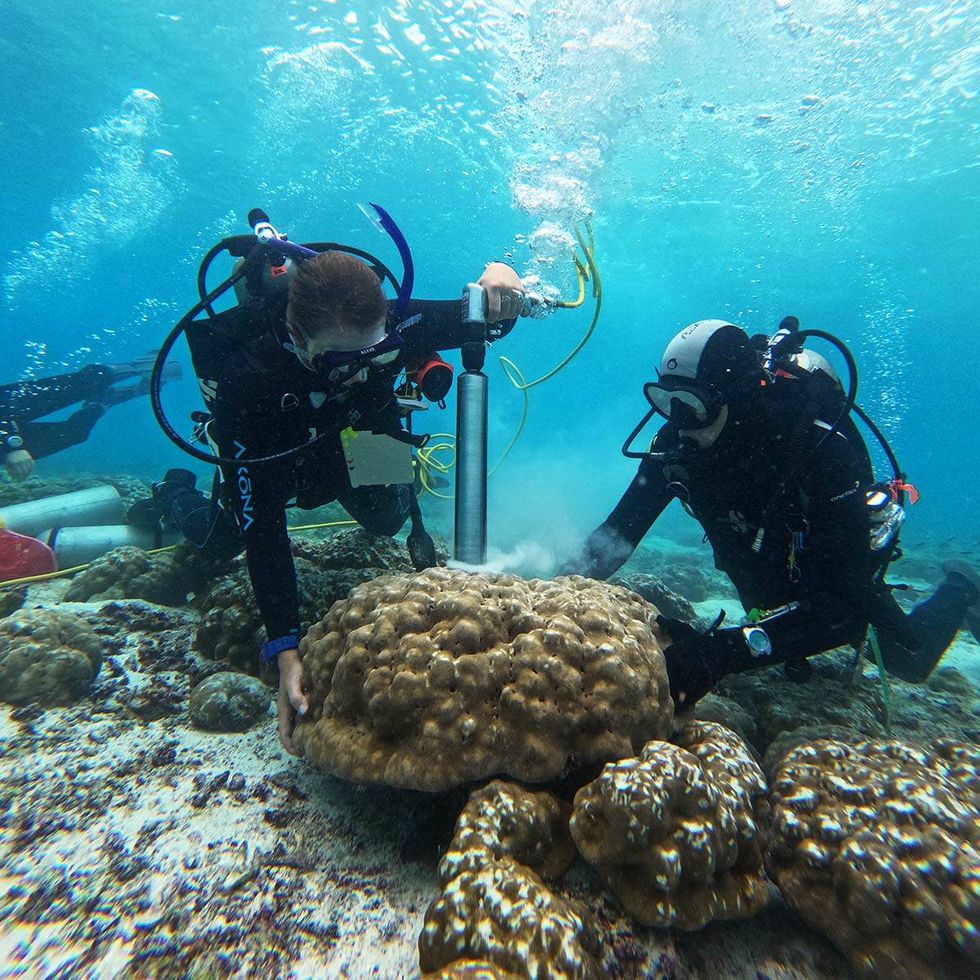 Researchers extract a fossil coral core sample from a massive coral colony in the Galápagos Islands to reconstruct historical climate and El Niño cycles as part of a study published in Science on August 27, 2026. (Photo by Julia Cole/Science)
In the new assessment, researchers found that human-caused climate change is the primary threat to reef-building coral, determining the fate of about 90% of the species at greatest risk.
They emphasized that coral reef health is more complex than simply “survival” versus “disappearance,” and that every reduction in global greenhouse gas emissions matters.
“Coral reefs can feel a world away…" said Françoise Cabada-Blanco, a marine ecologist at the University of Portsmouth and co-author of the study. “But they cover a tiny fraction of the ocean floor, while supporting an enormous share of marine life and the food, coastal protection and livelihoods of millions of people.”
“What happens to them affects all of us,” she said. "The message from this assessment is that every tenth of a degree of warming we avoid gives corals a better chance—so action now really does count.”
A report published last year concluded that the globe had already passed the 1.2°C warming threshold for widespread coral reef dieback and found that unless global temperatures drop substantially, reefs could largely disappear.
“The crisis facing corals is deadly serious,” said Miyoko Sakashita, oceans director at the Center for Biological Diversity. “If we don’t take swift action to curb climate pollution, we could lose half of them forever.”
“We’ve already seen a lot of disruptions to sea life from the much warmer waters El Niño has brought this year, and I’m really worried about what that will do to threatened coral species," she added. "Coral reefs are the backbone of the ocean, and we can’t have a healthy marine ecosystem without them.”
From Common Dreams via This RSS Feed.