

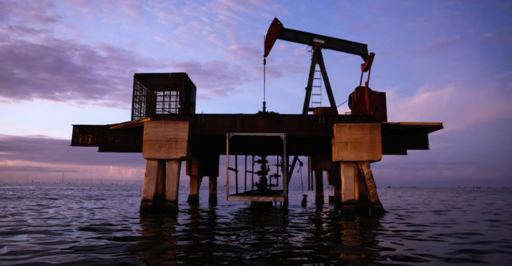
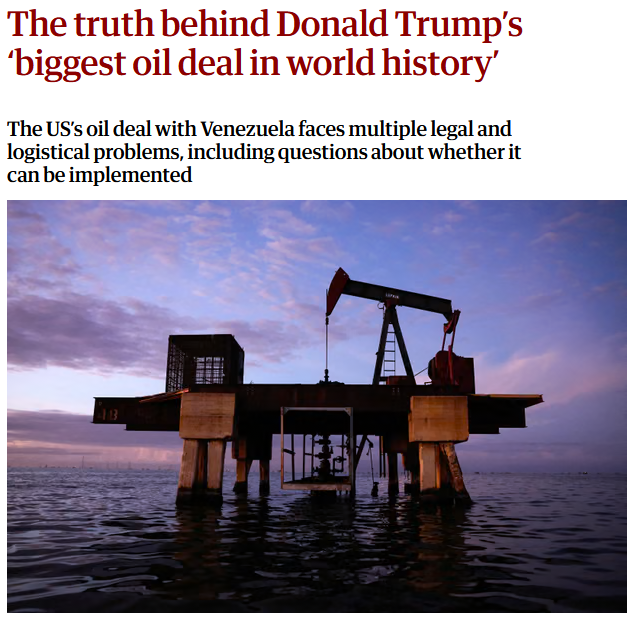
Guardian (9/26/26): “Donald Trump has long coveted the oilfields of other nations.”
Since the January 3, 2026, military strikes and kidnapping of President Nicolás Maduro, the Trump administration has imposed semi-colonial rule over Venezuela, forcing dramatic shifts in the country’s domestic and foreign policies.
The capstone of the new tutelary regime is an oil deal announced in late August that Trump called “the biggest in history.” The agreement turns over 17 prime oilfields, holding over 20% of the country’s reserves, to a Pentagon-controlled corporation tasked with supplying cheap fuel to the US war machine for decades to come.
After spending years manufacturing consent for US-sponsored regime change in Venezuela (e.g., FAIR.org, 6/4/21, 1/11/23, 2/12/25), having a government in Caracas subservient to Washington represented a new scenario for the corporate media. The novel conditions have raised few significant qualms for Western outlets. Tactical objections notwithstanding, there is no fundamental disagreement with the US running the affairs of a Global South country.
Not ‘stealing Venezuela’s oil’
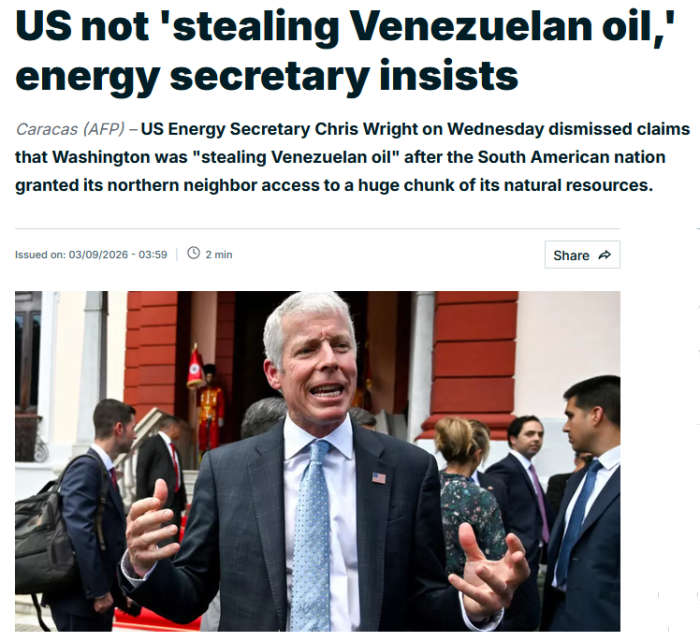
Energy Secretary Chris Wright (France 24, 3/9/26): “I’ve seen those headlines. ‘We’re Stealing Venezuelan Oil.’ Of course, that’s not true at all.”
Working hand in glove with the Trump administration, the acting Delcy Rodríguez government has overhauled Venezuela’s hydrocarbon legislation (Venezuelanalysis, 7/13/26) to offer what oil experts consider a business environment more favorable to foreign capital than at any point in the country’s history. The new oil agreement with the White House manages to go even further.
The 17 oilfields in question will be taken over by North American Blue Energy Partners (NABEP), a private company in which the Pentagon’s Office of Strategic Capital (OSC) will get a 35% stake while investing nothing—and wielding veto power over its board.
Furthermore, according to the White House, the US State Department will secure 20% of NABEP’s output at cost, and have a right of first refusal over the remaining 80%. On top of this, Venezuelan officials have already suggested Washington would be given an additional “sales discount” (Venezuelanalysis, 9/9/26).
In summary, Trump is looking to secure cheap crude supplies at a time when his disastrous Iran debacle has thrown global energy markets into upheaval. The agreement is so blatantly skewed that US Energy Secretary Chris Wright felt he needed to clarify that Washington was not “stealing Venezuela’s oil” (AFP, 9/3/26).
Nevertheless, Western media outlets were largely unfazed by such an obvious oil grab, euphemistically referring to the deal as “highly unusual” (New York Times, 8/29/26) or “remarkable” (BBC, 9/1/26), at most as “contentious” (Guardian, 9/1/26).
Corporate journalists did raise objections over the central role played by NABEP owner Alejandro Betancourt, a shady Venezuelan businessman who faced multiple money-laundering probes before the Trump administration intervened, and pressured judicial authorities at home and abroad to drop the investigations (BBC, 9/2/26; CNN, 9/4/26; New York Times, 9/4/26).
But media seemed satisfied with Trump’s state and energy secretaries Marco Rubio and Chris Wright pledging that US oversight will keep proceedings honest (Reuters, 9/2/26; New York Times, 9/4/26), despite the fact that billions in Venezuelan oil revenues, controlled by the US Treasury Department since January, are unaccounted for (Council on Foreign Relations, 6/3/26; Financial Times, 7/22/26).
Procedurally transparent plunder
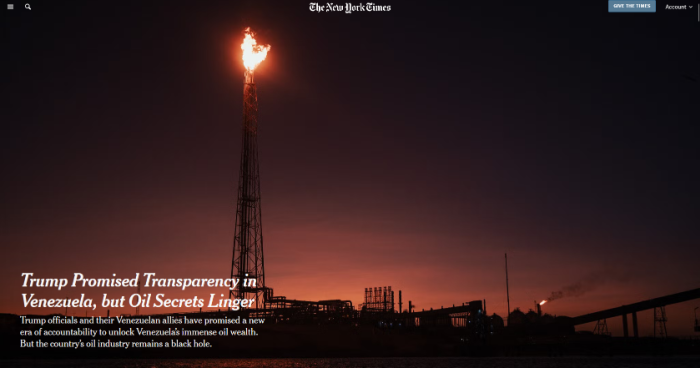
The New York Times (5/5/26) wrote positively of “a new era of accountability” in which “the United States would control Venezuelan oil sales” and “Venezuela would submit monthly budgets to the White House.”
Objections to the Venezuela/NABEP/Pentagon venture were mostly procedural and out of concern for appearances, not driven by any principled opposition to US imperialist predation. Faced with outright colonial plunder of Venezuela, the political and media establishment only demands “accountability” and “transparency” (New York Times, 5/5/26; Financial Times, 9/18/26).
For months, the White House has controlled Venezuelan oil export revenues, with Trump officials openly calling them “one of the largest assets ever to go on the US balance sheet,” and a source of “leverage” over Caracas. Yet Trump’s Democratic opponents have found no issue with seizing another country’s income, raising only questions about the allocation of the funds in reference to alleged corruption on the part of Caracas and Trump insiders (The Hill, 9/30/26; Washington Post, 9/17/26). This despite the fact that the Venezuelan government has to submit a “monthly budget” to access its own funds (New York Times, 1/28/26) and is subjected to US-imposed auditors (Reuters, 4/27/26).
The other source of disappointment with Trump stomping all over Venezuelan sovereignty, but prioritizing oil over regime change, is impatience for the restoration/recovery/return of “democracy” to Venezuela (Politico, 9/2/26; Guardian, 8/30/26; CBC, 9/3/26). Despite widely acknowledgement that Trump is eroding democracy at home (New York Times, 8/20/26, 10/14/26; Guardian, 10/8/26), somehow pundits expected him to prioritize it in an oil-rich foreign country.
In the establishment’s consensus, “democracy” does not mean a political system that meaningfully reflects the Venezuelan people’s collective will, but simply one that empowers opposition figures that have been groomed for years, like far-right María Corina Machado, their undemocratic credentials notwithstanding (FAIR.org, 10/23/25).
Eager to stay in power, Rodríguez has over-complied with every US demand, going as far as adopting language about Venezuela undergoing a “democratic transformation.” Her pliancy has earned her favorable corporate media profiles that completely contrast with the demonization of Maduro.
After securing an exclusive interview, Time (7/30/26) described the acting leader as a “disciplined operator” who “advocate[s] for greater economic openness,” in contrast to the “authoritarian” Maduro, who oversaw “economic collapse.” Along the same lines, the Guardian (9/12/26) presented Rodríguez as a “a pragmatic, witty and intelligent workaholic,” unlike her “authoritarian” and “incompetent” predecessor in the presidential palace.
Nevertheless, given the broad Beltway consensus for comprehensive regime change, it is unlikely that the Rodríguez administration’s subservience to Trump will secure any leeway in determining its political path forward, free from outside meddling—especially if, as is anticipated, the GOP lawmakers most likely to be impressed by such obsequiousness lose power in the US’s upcoming midterm elections (Axios, 9/23/26; Financial Times, 10/9/26).
Please think of the corporations!
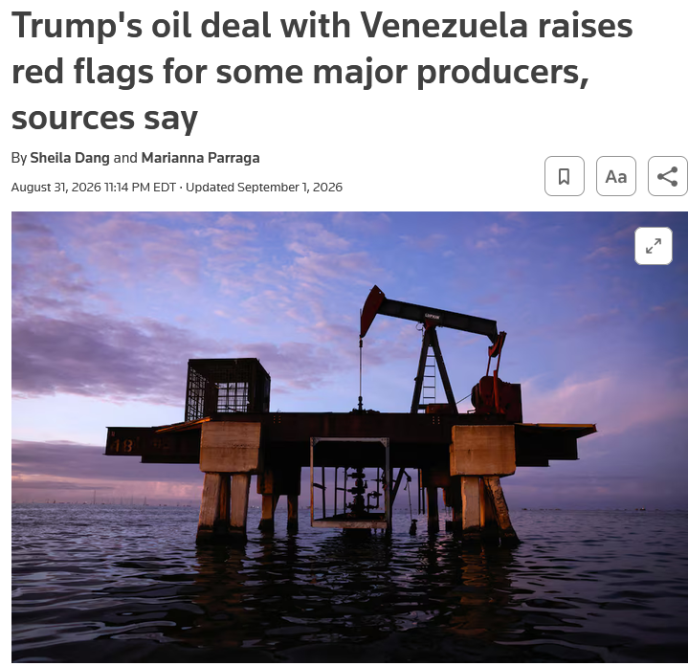
Reuters (9/1/26): ExxonMobil and ConocoPhillips “have repeatedly said that their requirements of legal certainty and contract sanctity have not yet been met.”
Alongside their exceptionalist expectations about “democracy,” legacy outlets also focus on those they consider the true victims of Trump’s neocolonial offensive in Venezuela: multinational oil corporations.
According to Reuters (9/1/26), the recent oil deal “raises red flags for major producers,” who fear having their reputation sullied by being “seated at the same table with Betancourt,” as well as the prospect of the US government becoming a “competitor.”
Bloomberg (8/30/26) raised concerns that the agreement “reprises [the] neocolonial past” of Venezuela’s oil industry. The warning stems not from apprehension that the Venezuelan people’s future is being determined by a foreign nation, but from fear that the US’s “out-sized power” might lead to “popular unrest.” This could create conditions for what the business mouthpiece views as a catastrophic outcome: the nationalization of foreign-owned oil assets.
“The troubled history of Venezuela’s oil offers a cautionary tale,” Bloomberg’s Kevin Crowley and Patricia Garip wrote:
The country was once dominated by US and European operators and was among the world’s largest producers. But assets owned by ExxonMobil Holdings Corps. and ConocoPhillips were seized and nationalized during political upheaval in the 2000s.
Corporate media present companies that made massive profits in Venezuela for decades as victims, because the Chávez government wanted them to comply with new laws and accept minority stakes in joint ventures.
The New York Times (9/1/26) complains that the two corporations “have spent years trying to get the country to repay them for their seized assets, with little success.” The statement conceals the fact that the Venezuelan government, when it enacted the 2007 decree imposing state majority in all Orinoco Oil Belt projects, offered to compensate ExxonMobil and ConocoPhillips for their transition to minority partners, or to buy out their assets altogether. However, both corporations rejected the offers in order to pursue international arbitration. The former has already recouped most of what it was granted, while the latter will eventually collect on a significant award.
Despite the fact that Chevron, BP, Shell and other energy giants have signed deals in recent months taking advantage of the reformed hydrocarbon law (Venezuelanalysis, 9/3/26), pundits complain that ExxonMobil and ConocoPhillips remain “hesitant” (CBS, 8/31/26) and need to be “lured” (Reuters, 9/1/26). Still, the Western corporations are likely to return to the country with favorable deals (Reuters, 9/16/26).
The victor and his spoils
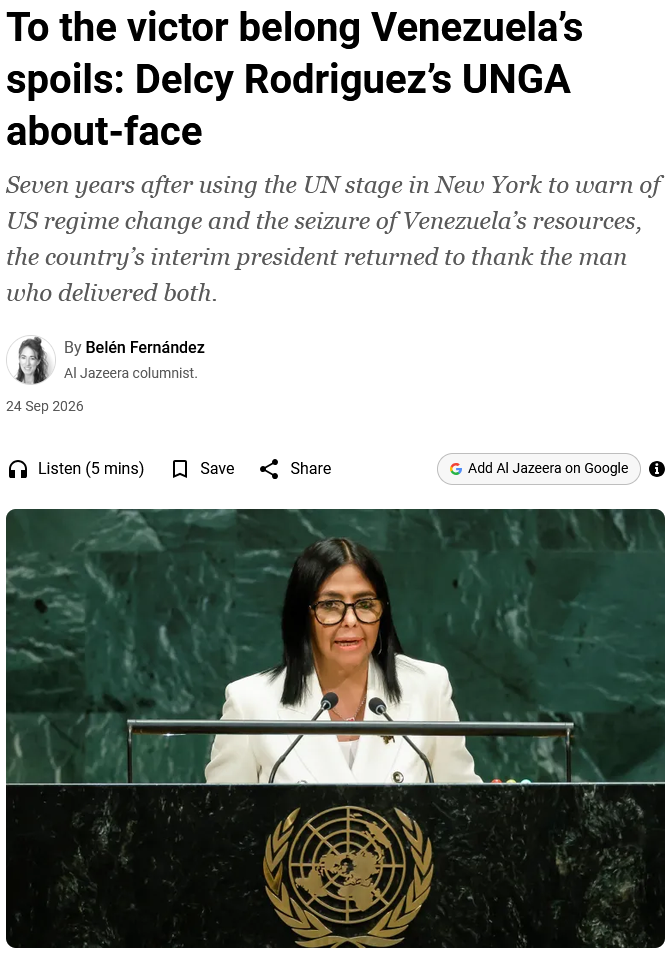
Belén Fernández (Al Jazeera, 9/24/26): “You’re not technically supposed to admit that you attacked a country just to get its oil.”
Faced with strategic defeat in West Asia, Trump has clung to his Venezuela success, stating on multiple occasions that “to the victor belong the spoils,” in reference to the US hijacking the Venezuelan oil industry following the January 3 attacks and presidential kidnapping (Al Jazeera, 9/24/26; Guardian, 9/26/26).
Furthermore, Trump has not been shy in boasting about the US winning a “war” against Venezuela (Financial Times, 9/18/26; New York Times, 6/26/26). Corporate journalists have rarely pointed out that this stance directly contradicts the administration’s official position that the kidnapping of Maduro and Flores was a “law enforcement” operation (New York Times, 1/6/26; PBS, 1/8/26) in order to justify bypassing congressional approval.
The US president has likewise claimed to have recovered the costs of the military operation “many times over” (Al Jazeera, 3/3/26; Guardian, 6/28/26), a fact confirmed by Luigi Pisella, a business sector spokesperson with close ties to the acting Rodríguez administration (Venezuelanalysis, 8/10/26). Pisella stated that the US has retained $4.7 billion from the Venezuelan export revenues it controls to cover the costs of its military operation.
In spite of their ostensible hostility to Trump, corporate outlets have historically been complicit with his Venezuela policies, from whitewashing a deadly sanctions program (FAIR.org, 6/13/22) to endorsing a military buildup over debunked “narcoterrorism” accusations (FAIR.org, 11/19/25). The New York Times and Washington Post went as far as to withhold information in order to not jeopardize the January 3 operation (FAIR.org, 1/13/26).
Now, with a semi-colonial regime in place, the only concerns are about procedural transparency, democratic appearances and the well-being of multinational corporations. The Venezuelan people always get the short end of the stick.
From FAIR via This RSS Feed.