

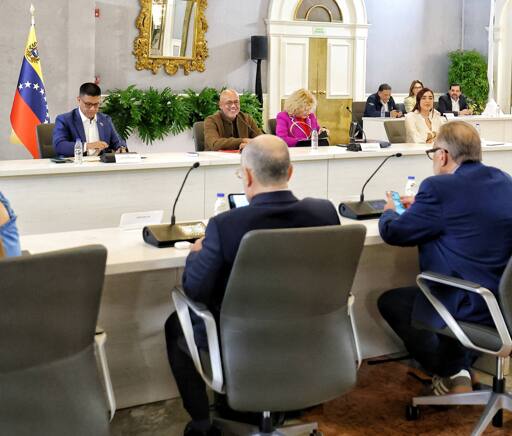
The third phase of dialogue between representatives of the Venezuelan government and former deputies of the fictional “2015 National Assembly” has begun, with both parties agreeing on methodology, work cycles, and an agenda of topics to be addressed. Debates and agreements on the restructuring of the Judicial Power and other topics of interest are expected to continue.
This stage in the dialogue began this Wednesday, October 14, while the negotiation process itself started on August 6. At that time, the dialogue coordinator for the Venezuelan government and president of the National Assembly, Jorge Rodríguez, had reported on the formal start of the dialogue process with the delegation of the so-called 2015 National Assembly.
The negotiations centered on earthquake recovery and changes to judicial and electoral institutions. The institutional agenda includes reforming the justice system, renewing the Supreme Tribunal of Justice (TSJ), and addressing the restructuring of the National Electoral Council (CNE), alongside political rights and guarantees. The first agreements established concrete steps toward selecting new TSJ magistrates, while CNE reform remains an objective for subsequent rounds, without a publicly announced agreement on a new board or appointment timetable.
The recovery agenda prioritizes housing, electricity, healthcare, and debris removal following the June 24 double earthquake. Both delegations agreed to pursue the recovery of Venezuela’s gold held by the Bank of England to support affected communities, with transparency and auditing mechanisms. Venezuelan authorities have also made lifting illegal sanctions and recovering assets seized abroad central demands, linking access to those resources with reconstruction and the population’s needs.
The first round of negotiations was held at the Simón Bolívar Park Convention Center in La Carlota. The Venezuelan government delegation was composed of the president of the National Assembly, Jorge Rodríguez, along with Ana María San Juan, minister for university education, and deputies Jorge Arreaza, América Pérez, Génesis Garvett, and Pedro Infante.
The far-right opposition’s former deputies participating were Dinorah Figuera, Marco Aurelio Quiñones, Ramón López, Juan Miguel Matheus, Sergio Vergara, and Desiree Barboza.
After declaring themselves in permanent session, the first round of conversations concluded on August 12; two technical committees were set up, focused on addressing the emergency caused by the double earthquake on June 24 and on strengthening democracy, the Judicial Power, and the Electoral Power, according to the communiqué issued.
A new nomination process for the renewal and appointment of all magistrates of the Supreme Court of Justice (TSJ) was agreed upon. This process is currently underway.
Últimas Noticias Survey: Bolívar Continues to Dominate Payment Methods in Venezuela
Second round
The second round concluded on August 25, comprising seven working sessions, two plenaries, and five technical committees, according to the joint communiqué issued then.
According to the communiqué, it was agreed to support the lifting of administrative blockade against websites and to review legal instruments related to freedom of expression. It was also agreed to form a Council for the Review of Credentials and Requirements for Supreme Court of Justice Nominees, among other points.
(Últimas Noticias) by Aura Torrealba with Orinoco Tribune content
Translation: Orinoco Tribune
OT/JRE/AU
From Orinoco Tribune via This RSS Feed.