

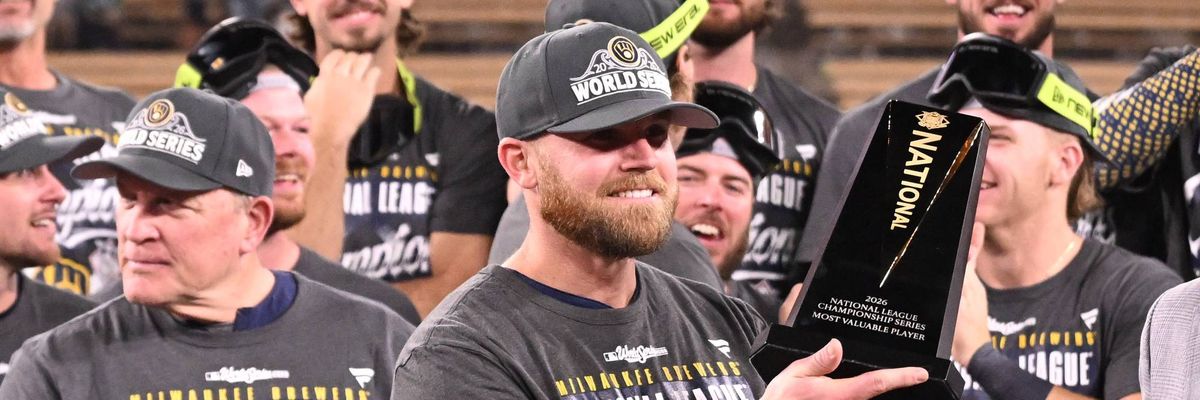
First baseman Jake Bauers of the Milwaukee Brewers helped his team end a 44-year drought Thursday night as they won the National League Championship Series to place them in the World Series, but in the process he kicked off a discussion—whether intentionally or not—about the role of employer-based health insurance that undergirds the for-profit system in the US.
While generating headlines throughout the pennant race due to his outstanding hitting and field play, Bauers’ journey to the top of Major League Baseball has Cinderella elements. Just two years ago, the Wall Street Journal reported Thursday, Bauers was ready to retire from the sport’s highest level.
“He had been playing professional baseball since he was just 17, spending more than a decade bouncing across seven different organizations with little success,” the paper reported. "After batting .199 for the Milwaukee Brewers in 2024, he was frustrated, burned out, and ready to move on.”
Life outside of baseball intervened, however, but in a way that is familiar to millions of American families, not just those of pro athletes who can garner millions in lucrative contracts and endorsement deals.
“Bauers’ wife, Lauren, learned she was pregnant with the couple’s second child," the WSJ explained. “Suddenly, Jake’s plan to become a stay-at-home dad while Lauren returned to her teaching job no longer seemed viable. They needed health insurance—so Bauers begrudgingly decided to give his floundering athletic career one last chance.”
After battling the Los Angeles Dodgers to a defeat on Wednesday, taking a 3-0 lead in the series his team would ultimately win in a clean sweep the following night, Bauers brought up that decision regarding his second child and his family’s healthcare needs in a post-game interview.
Hahaha! What an awesome country! https://t.co/IYJmu5ZP0y
— Darkwoke Duck (@DylanTweetin) October 15, 2026
While the group of sportscasters conducting the interview laughed about the explanation, others who witnessed Bauer’s explanation recognized something more profound in what he described.
“If even a professional athlete is saying this, maybe healthcare should just be universal and free,” said Luke Savage, a columnist for the left-wing magazine Jacobin.
In a subsequent Substack post published Thursday, Savage expanded on his thoughts about Bauer’s situation, writing:
This obviously doesn’t rank anywhere near the top when it comes to horror stories about America’s healthcare system, but I still can’t get over how completely insane it is to hear. This is an elite professional athlete talking! And it’s the guaranteed outcome of a system that links health insurance so tightly to employment. In this case, that meant that a young couple’s desire to start a family was conditional on [squints] the ability of one partner to secure a contract with a professional baseball team (and, to a lesser extent, be good enough at the sport to work his way back up from the minors).
There are only so many ways to repeat the obvious here, but tying health insurance to employment is a Dickensian horror show. It gives employers tremendous power over their workers and forces people to stay in jobs they hate or want to leave. The same is true of private health care in general. It devastates families, burdens them with crippling medical debt, and limits their ability to have children. It stops them from seeking treatment when they’re sick and makes going to the hospital an economic decision. Even among those who can afford insurance, it creates different tiers of care and inevitably means that rich people get it faster and at higher quality — which is just another way of saying the American healthcare system ascribes your life greater or lesser moral weight depending on your bank balance.
Wendell Potter, a former health insurance executive turned whistleblower who now leads the nonprofit Center for Health & Democracy, agreed that Bauers, though his status as a professional athlete makes his situation seem exceptional, is incredibly normal within the nation’s broken healthcare system.
“Sometimes it takes a high-profile sports figure or celebrity to help Americans understand how absurd and unfair our healthcare system is,” Potter explained to Common Dreams. “If Jake Bauers did everything he could to stay in baseball primarily because he and his wife were terrified of losing health insurance that was tied to his job, imagine how many other Americans stay in jobs they would leave if it weren’t for their employer-sponsored coverage.”
While Bauers may have been lucky to stay in the major leagues, said Potter, and even luckier to help his team make it to the World Series, the reality is that he—like millions of American workers—could have potentially been cut at any time, losing his job and his access to the health coverage he received through his employer.
“Millions of Americans are not so lucky. Many get laid off or have their jobs eliminated,” Potter continued. “They lose not only their jobs but their family’s health insurance. No other developed country has a system in which their citizens are locked into a job they’d like to leave or are scared to death of losing. I wish more prominent people in sports and entertainment would speak up as Bauer did about how vulnerable so many of us are to losing both our jobs and our health insurance.”
“The reality,” said Potter on Friday, “is that almost all Americans who are not covered by traditional Medicare are in danger of losing our health benefits and access to care because of a layoff or cuts to Medicaid that force millions into the ranks of the uninsured.”
In 2019, a Business Insider poll showed that most Americans with employer-sponsored health coverage support switching over to Medicare for All, undermining the often repeated right-wing narrative that the US workers are wedded to the for-profit insurance plans provided to them.
As Common Dreams reported at the time, the survey showed that 59% of respondents who have employer-provided insurance “said they would support switching their employer-based health insurance to a government plan under Medicare for All” as long as the quality of their coverage was maintained or improved.
In a post on his Health Care Un-Covered blog last month, Potter detailed how nearly 40% of Americans admit they’ve stayed in a job longer than they wanted for the very specific reason that they or a family member needed the health coverage that came with it. The term for this dynamic is called “job lock,” he notes. And nothing about this “is new to anyone who’s been paying attention,” he writes. “What’s changed is how much sharper and more current the evidence has gotten” in recent years.
While there was nothing political or partisan in the way Bauer has shared his story about healthcare, the fact of the matter is that the scale of the employer-based system in the US is deeply tied to the anxieties that individuals and families experience. With Republicans actively undermining and attacking the floundering system that already exists, Savage in his column bemoans leaders from both parties who fail to embrace what has long been recognized by experts and progressives as the only viable solution to the crises: a universal, single-payer model best expressed by the Medicare for All legislation put forth by Sen. Bernie Sanders (I-Vt.) in the US Senate and Rep. Pramila Jayapal and others in the US House.
Exasperated by a political system that has denied US workers and families a better healthcare system, Savage asks the question: “What does one even say at this point?”
The so-called “debate” over healthcare system in the US, he said, “is nothing of the kind.”
“The leaderships of both major parties oppose healthcare that’s free, universal, and public because they’re as addicted to dead market dogmas as they are to donations from a powerful industry,” he writes. “The dumbest people alive will tell you that healthcare is best delivered by the marketplace and that the ability to purchase it as a commodity like any other is, in fact, the essence of freedom. Nothing could be further from the truth.”
In his column from last month, Potter notes that critics of the employer-based system have long existed on the ideological right and left and argues that as long as health coverage remains “tethered to a single employer, job lock isn’t a glitch in the system,” but rather “the system working as designed.”
“The fact that people across the political spectrum have recognized that for decades,” he concludes, “is exactly why it’s worth pressing the case again now.”
Go Brewers!
From Common Dreams via This RSS Feed.