

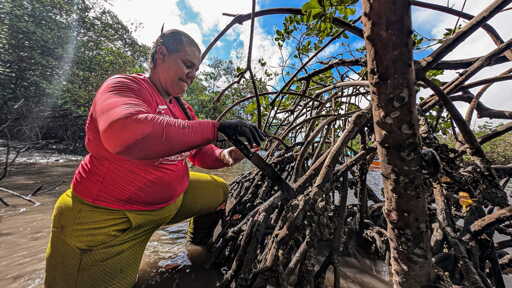
Adriana Hora dos Santos stands waist-deep in the water. Her dark hair is tied in a single braid; her arms and torso covered by a pink Lycra shirt. The thick mangrove mud reaches her thighs. Using a machete just over 40-centimeters (16-inches) long, she pries dozens of oysters from the twisted roots with a steady cadence: Not too fast, not too slow. Across the Vaza-Barris river, the buildings of Sergipe’s state capital Aracaju seem otherworldly. Here, one hears the lapping of the water, the strike of the blade and Santos’s voice: “I am, I am a shellfish gatherer / Queen of the mangrove, I am a warrior! / I am, I am a shellfish gatherer / A fighting woman, a striver / It’s the wind that gives it to me / It’s the river, it’s the mangrove, it’s the sea / My chest aches, enclosed river / My chest aches with no fish caught / Come, woman, fight, emancipate yourself / We are Sergipe’s shellfish gatherers!” This is the anthem of the Movement of Women Shellfish Gatherers of Sergipe (MMS), a grassroots collective that has resisted continuous environmental degradation and cultural erasure for decades. Acting as guardians of the mangrove, they do environmental protection work while facing pressures that put their own survival at risk. To hear one of these women is to hear many: Their verbs almost always come in the plural. “We are always in a flock,” Santos says. And it was as a flock that they introduced…This article was originally published on Mongabay
From Conservation news via This RSS Feed.