


Bullets:
China will spend nearly $5 trillion by 2030, on new and upgraded infrastructure projects.
“Six Networks” comprise water, power grids, underground utilities, computing, telecom, and logistics.
Inside China / Business is a reader-supported publication. To receive new posts and support my work, consider becoming a free or paid subscriber.
Report:
Good morning.
China is budgeting trillions of dollars for key infrastructure spending over the next five years. These data come from the newest Five-Year Plan. And the focus for Beijing is on what they call the “six networks”. Over a trillion USD will go in this year. More than two trillion dollars will be invested just in those three sectors: water, power grids, and underground pipes and utilities. Also big investments are coming in computing, communications, and logistics.

The new outlays for water networks will create 3 million new jobs. China’s water system is the biggest in the world, and the water management network covers four fifths of the country with nearly a hundred thousand dams and reservoirs. One of the most ambitious projects already underway and pretty far along is the South-to-North Water Diversion project, which we plan a couple of stand-alone reports on.
Six trillion RMB, or about $900 billion USD, will be invested across China’s water systems by 2030.
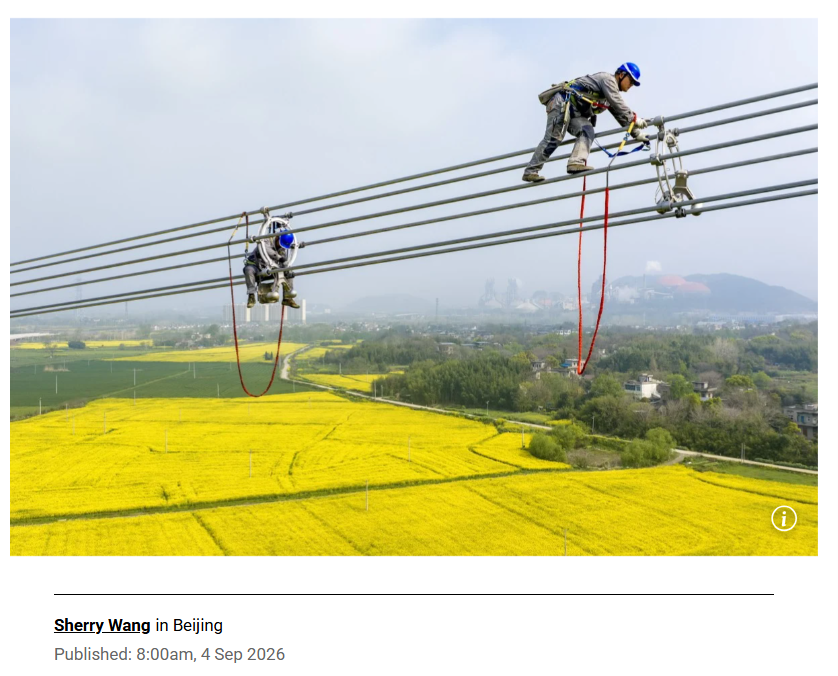
Next up is a large expansion and upgrades to the Chinese power grids and distribution systems. The backbone is the Ultra-High Voltage transmission lines, which take the power generated in China’s West and North and hauls it across the country to the population and industrial centers in the East.
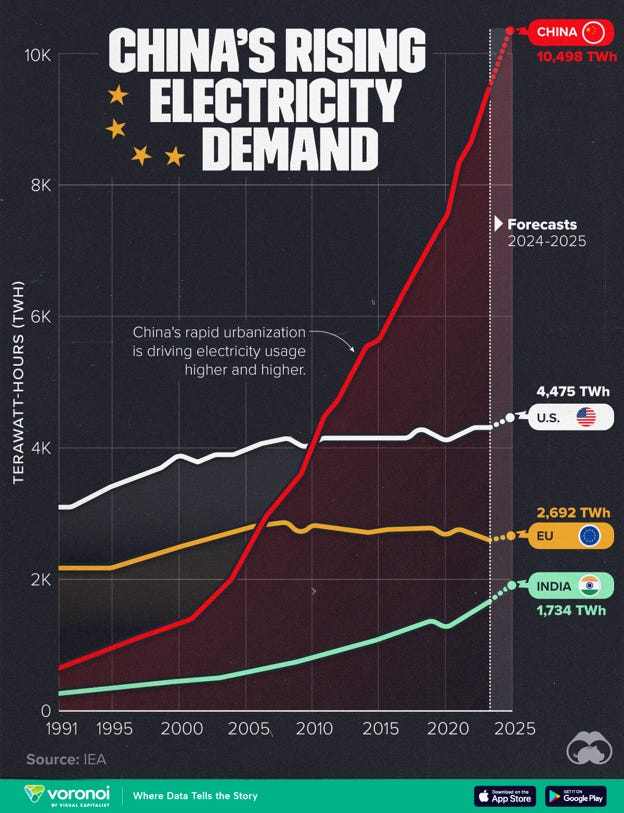
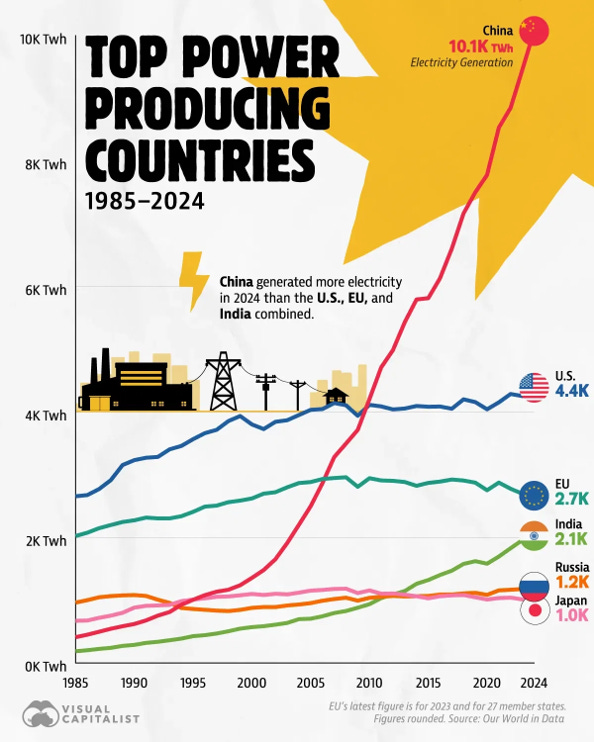
It’s that network that makes these data possible: Chinese power consumption is going vertical, almost a straight line up, while electricity production is growing even faster. And so more capital is going into that sector: 5 trillion RMB is about $750 billion, in the next five years.
Then come underground pipelines. That too is the biggest in the world. But the system is struggling to keep up, and needs constant upgrade and repair and maintenance.
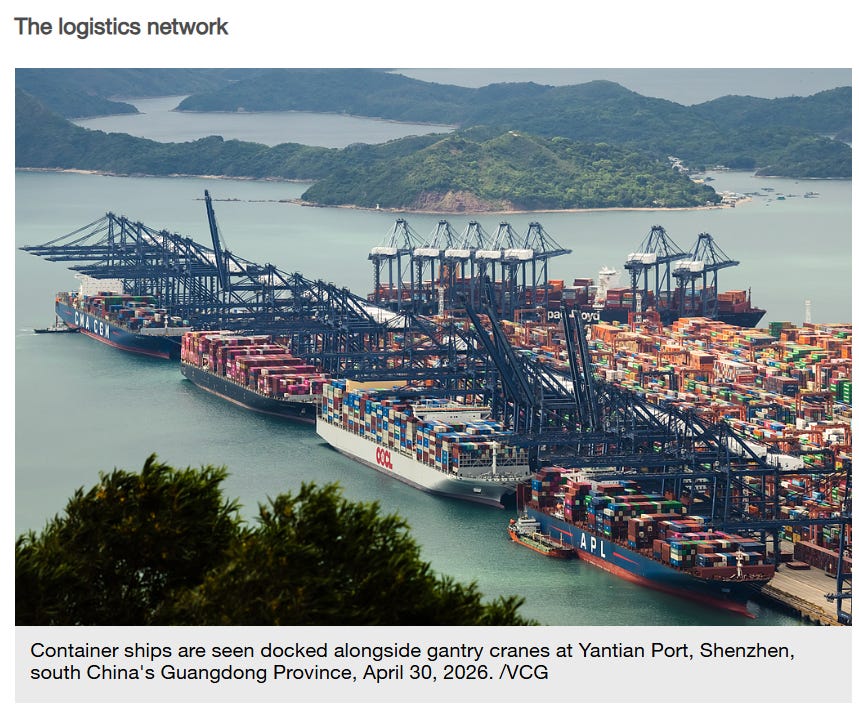
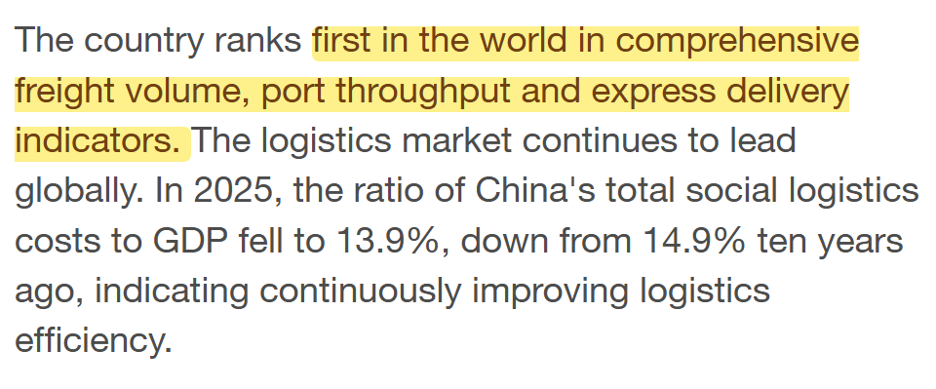
Logistics is number four, and China’s logistics is the largest in the world, again. We’ll take a moment to explain that metric, which is quoted often their official reports. Total Social Logistics Costs to GDP is a measure of a country’s logistics efficiency—a lower number is better. For the United States, that figure was around 9% or so in 2024, but energy and transport prices are a lot higher today. Chinese officials want their number under 10, and are driving new investment that way.
The computing power network is the fifth network, and we’ve devoted a lot of research to this already.
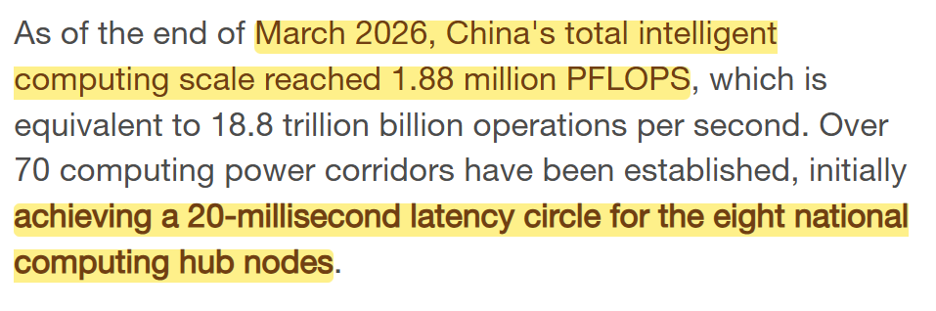
We think that might be a decimal translation error in the source document—1.88 million petaflops is 1.8 trillion billion operations a second—not 18.8. That is a common mistake that comes from China’s number grouping system—they use ten thousands and hundred millions.
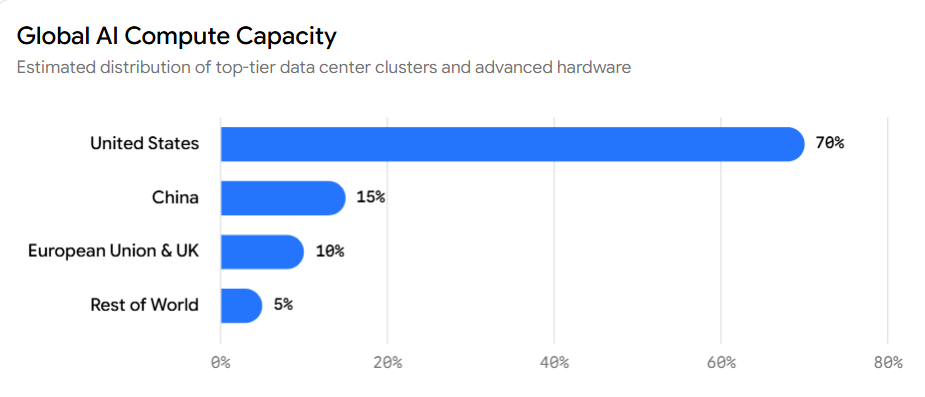
Officially, China is second in the world for AI compute capacity, but still far behind the United States. What’s notable though is that none of that blue bar for China was supposed to happen, at all. The express purpose of the export bans on chips and hardware was to deny the Chinese the capability to build AI networks.
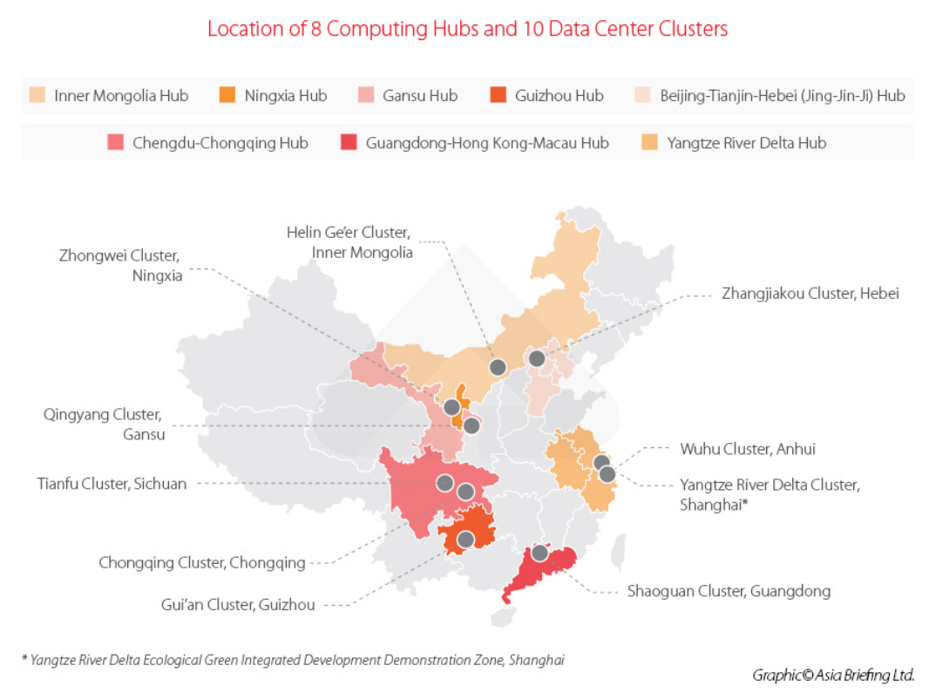
It’s also surprising that on that Chinese network—which wasn’t supposed to exist—the system-wide latency is just 20 milliseconds. Data zipping back and forth across their 8 national computing hubs means that China has erased the physical distance between them. Doesn’t matter if the compute is happening in data centers in the deserts of Xinjiang or in Nei Mogu, or on a server in the next room. Summing up, China may or may not have caught up on microchips and GPU’s, but they’ve managed to build a hyperefficient and hyperfast AI compute network that maximizes all the tech they do have.
China’s AI token volume today is a thousand times higher than just two years ago. The investments for the next five years will go to address the imbalances region-to-region, and to build up AI capacity in different industrial sectors that are lagging now.
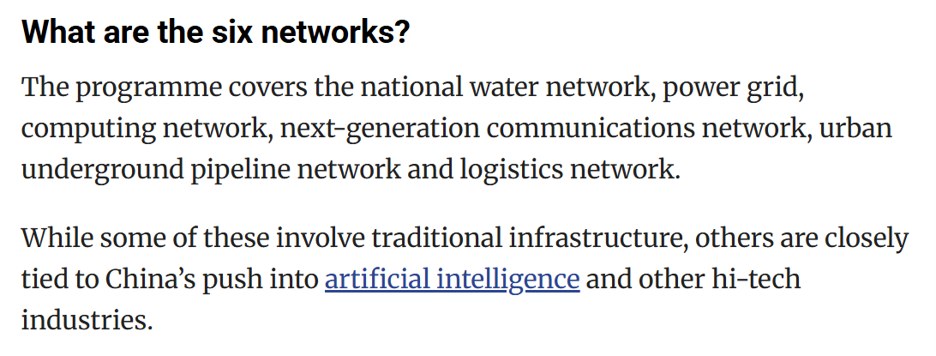
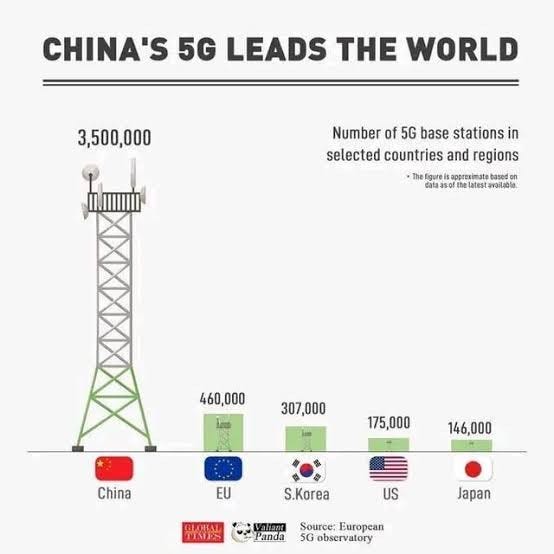
The last of the “Six Networks” is next-generation communications, where China is indisputably the global leader, and again wasn’t supposed to be, given decades of bans and restrictions on companies like Huawei and ZTE that build the telecom towers and hardware. Developments here involve the transition from 4G, to 5G, then to 5.5G, and then on to 6G. 5.5G and 5G-A are different names for the same thing. And this race may be effectively already over. China has over 5 million 5G base stations, and has rolled out 5.5G to 330 cities.
But this part is key, and the Chinese are on this path mostly by themselves: the dual-gigabit network is moving to a dual-ten gigabit.
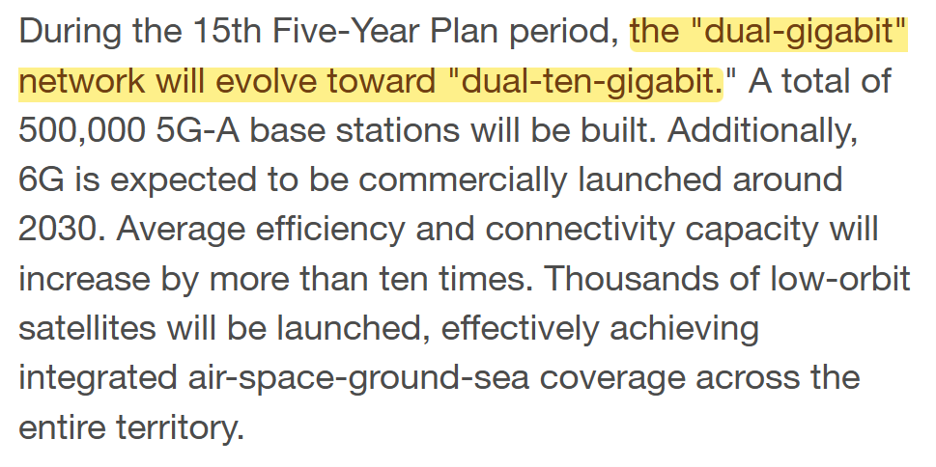
Another half a million 5G-A stations will be built in the next five years. And 5GA is necessary to enable the 10 Gigabit transmission speeds, and 10 Gigabit systems are necessary to power intelligent machines, AI, and industries and entire industrial zones. Picture those fully automated manufacturing centers and “dark factories”, and autonomous driving networks across whole cities.
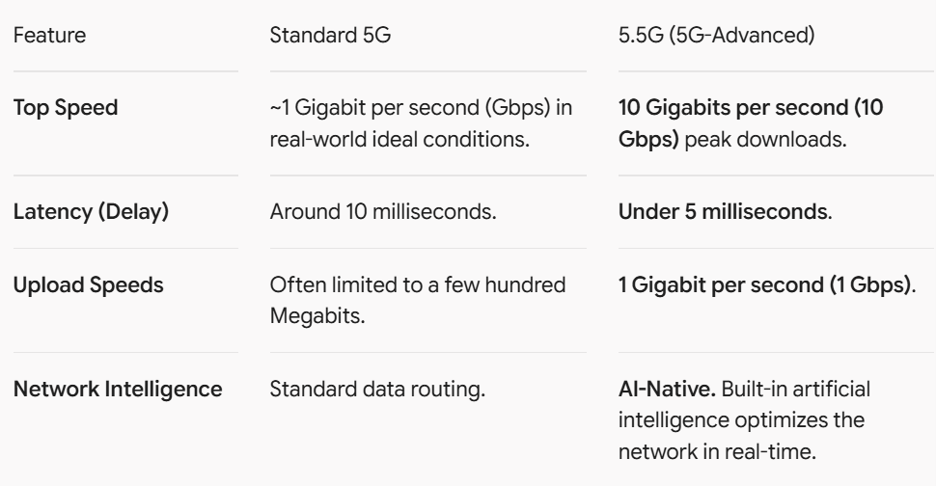
The data transmission volumes and speeds are an order of magnitude higher than for regular 5G, and almost impossible to do at all on 4G, let alone fast. And there is another almost unimaginable jump in capability and speed, again, on the rollout of 6G, which will be rolled to China’s mass markets by 2030:

Thousands of new communications satellites means hundreds of rocket launches to get them up there, and which will fully integrate communications and computing, blanketing sea, air, land, and space.
Be Good.
Resources and links:
Explainer: What are the ‘six networks’ of China?
https://news.cgtn.com/news/2026-06-15/Explainer-What-are-the-six-networks-of-China--1O06rorq3OU/p.html
Pipes, power and petaflops: what’s behind China’s massive ‘6 networks’ investment
https://www.scmp.com/economy/china-economy/article/3366211/pipes-power-and-petaflops-whats-behind-chinas-massive-6-networks-investment
5G Base Station Growth: How Many Are Active?
https://patentpc.com/blog/5g-base-station-growth-how-many-are-active
World records set by South-to-North Water Diversion Project
http://english.scio.gov.cn/m/chinaprojects/2018-05/08/content/_51532477/_2.htm
China’s Bullet Train for Power
https://www.bbc.com/future/article/20241113-will-chinas-ultra-high-voltage-grid-pay-off-for-renewable-power
Charted: China’s Energy Needs Keep on Rising
https://www.visualcapitalist.com/charted-chinas-energy-needs-keep-on-rising/
China Generated More Electricity in 2024 Than the U.S., EU, & India Combined
https://www.voronoiapp.com/energy/-China-Generated-More-Electricity-in-2024-Than-the-US-EU--India-Combined-5260
US Tightens Export Controls by Blocking Export License Renewals for China’s Huawei
https://www.bipc.com/us-tightens-export-controls-by-blocking-export-license-renewals-for-chinas-huawei
Location of China’s planned computing hubs and data center clusters
https://www.china-briefing.com/news/china-data-centers-new-cross-regional-plan-to-boost-computing-power-across-regions/
Joint Strider, SCSP Report Reveals PRC’s Expansive, State-Directed Effort to Gain Enduring Asymmetric Advantage in AI
https://striderintel.com/newsroom/joint-strider-scsp-report-reveals-prcs-expansive-state-directed-effort-to-gain-enduring-asymmetric-advantage-in-ai/
China’s factories are in another world
U.S. Export Controls and China: Advanced Semiconductors
https://www.congress.gov/crs-prouct/R48642
Inside China / Business is a reader-supported publication. To receive new posts and support my work, consider becoming a free or paid subscriber.
From Inside China / Business via This RSS Feed.