

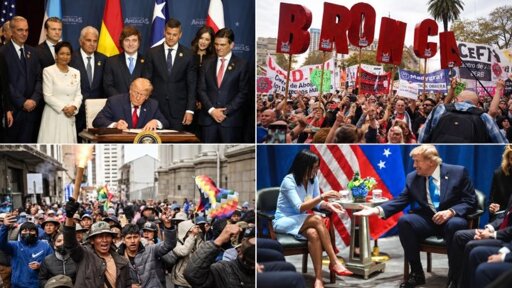
The Shield of the Americas, the establishment of a neocolonial protectorate in Venezuela, and the offensive against Cuba are examples of a renewed imperialist offensive in the region. However, rather than reflecting unchallenged hegemony, these developments also reveal the difficulties the United States faces in maintaining its global dominance. Far-right governments are advancing largely due to the failure of progressive movements. When they attempt to implement their agenda, they quickly spark popular discontent. As the Current For Permanent Revolution — Fourth International (CPR-FI), we are fighting in various countries against imperialist plans, and in this context, we are publishing this international statement calling for the strengthening of an anti-imperialist and anti-colonialist internationalist response.
Latin America and the Caribbean are experiencing a severe escalation of the U.S.-led imperialist offensive, aimed at reestablishing political, military, and economic domination over the region. The Trump administration seeks to regain and deepen its dominance over the continent through a combination of economic pressure, trade blackmail, control of strategic resources, political interference, militarization, and threats of direct intervention, relying on submissive local bourgeoisies and governments willing to act as subordinate partners serving its interests. In its attempt to regain absolute control of its “backyard” under Donald Trump, Washington seeks to displace its competitors, particularly China.
However, this renewed aggressiveness should not be confused with unchallenged hegemony or unlimited power. It also reflects the United States’ difficulties in maintaining its global dominance, the setbacks in its foreign policy, and the contradictions of a superpower that seeks to compensate through force for what it can no longer guarantee by other means. The war against Iran is an expression of those limits: despite its enormous military superiority and the intensity of its bombings, Washington has failed to impose its strategic objectives. Iranian resistance has raised the costs of the conflict and turned the war into a strategic defeat for the United States — a war of attrition whose outcome remains uncertain. Added to these difficulties is the dispute with China, which has a massive presence in Latin America — one that is difficult to reverse, despite the servile allies Washington has found in recent far-right governments. Compounding matters are deep domestic polarization, Trump’s political decline, a potential defeat in the November midterm elections, and divisions within his own MAGA movement, all of which restrict the scope of his policy options.
Currently, the Far Right is boasting of a whole string of electoral victories. However, these victories are largely due to the failure of progressive governments and the “lesser evil” alternatives that, without breaking with imperialism or affecting the interests of big capitalists, ended up implementing austerity measures and even subordinating themselves to the right-wing agenda. The Far Right capitalizes on this frustration, but without being able to consolidate its power through the defeat of the masses, far-right governments reveal their enormous weaknesses. Furthermore, they appear tied to a Trumpism that is not at its best. These are weak governments that, in seeking to implement their agenda, generate resistance and mass popular unrest. This is already giving rise to grassroots resistance, such as the massive class struggle that unfolded in Bolivia, where the United States seeks to prop up a government like Paz’s, which is sustained only by a state of emergency. In Argentina, the Land Law sparked widespread outrage on August 6, and young people in Chile once again led major days of struggle, such as the one on October 1. These processes are also reflected inside the United States, as seen in the large mobilizations that have erupted — such as in Minneapolis against ICE and, previously, in support of Palestine in many U.S. cities.
In this context, Trump needs to showcase victories, reaffirm his authority, and demonstrate that he can still impose his will. Latin America and the Caribbean thus appear as a region where Washington believes it can make progress at relatively lower cost. But this display of power contains an inherent contradiction: the more the U.S. needs to resort to coercion and force to sustain its hegemony, the more it exposes the difficulties of exercising that hegemony and the more it risks fueling resistance among workers and the oppressed, as well as the very tensions it seeks to contain.
The complicity of the Latin American bourgeoisies and the inability of progressive forces to meaningfully confront Washington confirm that the defense of sovereignty cannot be left in the hands of the ruling classes or of governments subordinated to capital. Nor does the solution lie in aligning with other capitalist powers — such as China — that are competing for markets, resources, and territories. While the local bourgeoisies subordinate themselves to Washington and progressive forces prove incapable of offering a coherent alternative, the aggression against Venezuela and the blockade of Cuba reveal the scope of this resurgent wave of recolonization.
It is within this context that we publish this international declaration and call for the strengthening of an anti-imperialist and anti-colonialist internationalist response, based on the independent mobilization of the working class and oppressed peoples, capable of confronting plunder, defeating imperialist intervention, and opening up a path toward social emancipation for Latin America and the Caribbean. We must follow the example of the youth who are rebelling in Spain, France, Germany, Brussels, and many other places.
As the Current For Permanent Revolution — Fourth International (CPR-FI), we are fighting in various countries against imperialist plans and their consequences in the form of new attacks, cuts, and the deterioration of living conditions for young people and working people. In France, Révolution Permanente is playing a prominent role in the historic youth rebellion. It is no coincidence that various leaders of Le Pen’s Rassemblement National are publicly calling for the dissolution of our organization, outraged by the role of the Trotskyists in the demonstrations. In Spain, the youth group Contracorriente is being highlighted by various media outlets as one of the main organizers of the encampments at Puerta del Sol. In Latin America, we are on the front lines of the struggle against the Far Right. In Argentina, Myriam Bregman has become a national political phenomenon, ranking as the highest-rated politician in various polls, precisely because she represents a militant and consistent opposition to Milei, backed by the PTS. In Bolivia, we played an active role in the rebellion against the attacks by the Rodrigo Paz administration, and in Chile, we are a prominent part of the student mobilizations against the Kast administration.
Down with the Shield of the Americas and the Continental Plan!
The revival of the so-called “Monroe Doctrine” and the explicit idea of transforming the continent into the United States’ backyard are not mere rhetoric. The so-called “Shield of the Americas” is not simply a partnership agreement to combat drug trafficking. It is part of a continental architecture of political, economic, and military subordination. Behind the diplomatic language of “security” and “cooperation” lie agreements on intelligence sharing, military coordination, joint operations, border control, the pursuit of organizations declared “narco-terrorist,” and a growing U.S. military presence. Washington’s new doctrine seeks to normalize the presence of U.S. troops, intelligence agencies, and commanders operating on Latin American soil under the pretext of defending hemispheric security. These policies are already being implemented in Mexico and Central America, which occupy a central place in the White House’s regional policy. There, even under “progressive” rhetoric such as Sheinbaum’s, and under the pretext of fighting drug trafficking, militarization is intensifying, as is subordination in economic, security, and immigration policy.
On September 22, fifteen governments signed the “Shield of the Americas” declaration in New York. The declaration is quite clear about its aims of control and plunder: to explore mechanisms for screening investments, to safeguard supply chains for critical minerals, and to promote “trusted supplier” regulations for digital infrastructure. But in case there was any doubt about the scope of the text, Donald Trump and Marco Rubio made sure to dispel it.
The declaration invokes mutual respect for the sovereignty and self-determination of each nation, but that same day, in front of the signatories, Donald Trump explained how he views the sovereignty of other nations: if a government does not eliminate the groups that Washington designates, the United States will do so on its own. In March, at the founding summit held in Florida, he was even more direct: the heart of the agreement, he said, is the commitment to use lethal military force. The “humanitarian and messaging assistance” supposedly intended to “defend the will of the people” serves as a cover for the most obscene form of electoral interventionism. At the same table, Trump celebrated the shift to the right among the participating countries and boasted that all the candidates he endorsed won their elections. The will of the people that the Shield promises to protect is the one that votes for Washington’s candidates.
This is a reactionary political, economic, and military agreement reminiscent of the infamous “School of the Americas,” which trained military dictatorships during the 1960s and 1970s. Today, it takes the form of a joint task force under Southern Command that coordinates intelligence and operations with eighteen countries; training commitments for police and military personnel; U.S. tactical units in Bolivia; joint operations in Colombia and Ecuador; and multinational exercises in Panama. At the southern tip of the continent, it conducts military exercises with Argentina, and there are even plans to establish a military base in Ushuaia. The “internal enemy” enables every government to treat internal social and political conflicts as military threats. That is why any labor, student, peasant, indigenous, or popular organization that challenges the established order can become a target. It has already happened: in May, the governments of the “Shield” backed Rodrigo Paz amid protests in Bolivia and condemned the “government of the mob.”
The Offensives in Venezuela and Cuba
Military intervention in Venezuela and the country’s subsequent transformation into a neocolonial protectorate under U.S. control represent the most brutal escalation of this policy and signal a qualitative shift in the imperialist plan for the recolonization of this Caribbean nation. Amid threats, acts of aggression, and sanctions, a decisive threshold was crossed on January 3: Washington moved from threatening military force to employing it directly to impose a new political order of domination over a Latin American country.
This is a country that has been bombed, its president kidnapped and its oil plundered, and all of its resources managed by Washington. Donald Trump went to the UN General Assembly to flaunt that outcome as a trophy and repeated the old colonial maxim that the spoils belong to the victor. It is the largest heist currently underway on our continent, one in which not only oil but also gold and other minerals, as well as all of its offshore assets, are controlled by the United States.
What was done to Venezuela is what will be done to Cuba; that is why Cuba is at the center of this imperialist offensive. The economic, commercial, and financial blockade imposed by the United States for decades continues to serve as a tool to suffocate the Cuban people and is part of a strategy of pressure aimed at provoking economic collapse, weakening the state, and completing an ongoing capitalist restoration subordinate to Washington. Currently, in addition to sanctions and trade restrictions, Cuba is facing a squeeze on energy supplies, difficulties in accessing fuel, and a deliberate policy of economic isolation that primarily punishes the working class and the popular sectors. In March, and more recently in his speech at the UN, Trump said that the Cuba we know is living out its final moments.
If imperialism has been able to transform its relationship with Venezuela by force, it may attempt to use similar mechanisms — military, economic, political, or a combination thereof — wherever it encounters obstacles to its interests. Washington seeks to demonstrate that it can intervene militarily, impose political conditions, control strategic resources, and dictate the course of governments — and even replace them — when it deems that its interests or what it calls its “national security” are at stake. This applies at least to countries north of the Equator, as reflected in its “Greater North America” strategy, although further south the contradictions and limitations are greater for adventures of the kind it is carrying out in its more immediate “backyard.”
The Servility of the National Bourgeoisies and the Failure of Progressive Movements
The signing of this shameful and humiliating agreement is evidence not only of the servility of right-wing governments in the region, but also of the fact that the Latin American bourgeoisie has no interest in defending national sovereignty. Governments such as those of Milei, Kast, de la Espriella, Rodrigo Paz, and Keiko Fujimori present themselves as subordinate enforcers of the order dictated by Washington. Flávio Bolsonaro is doing the same in his campaign in Brazil. They are competing to see who can be Donald Trump’s most loyal servant.
They implement the IMF’s anti-worker policies and religiously pay off a scandalous foreign debt. In Bolivia, the Shield has already shown its true colors. Following the U.S. visa ban, Attorney General Roger Mariaca was arrested; the Assembly approved legal changes during a session in which the presence of Shield officials was denounced; and the IMF disbursed $214 million out of an approved package of $1.9 billion after the operation. Paz’s puppet government has struck a blow against the judiciary in the service of Trump. In Argentina, Milei sought to open up unrestricted land sales to tycoons like Peter Thiel or Elon Musk. Street protests forced him to back down in August. The Supreme Court, relying on legal technicalities, had reopened the door in line with imperialist dictates, though it quickly had to maneuver — following massive public outcry — to try to prevent the entire decree on which much of Milei’s austerity program rests from being overturned along with the provision on land. However, the court ruling merely suspends the attack. The fight against this pro-imperialist advance remains ongoing. In Chile, Kast sought to create, through constitutional reform, a state of emergency for territories he declared “captured” by organized crime. Like Milei, he had to back down: he failed to secure consensus even within his own camp, is falling in the polls, and is facing a student movement.
For their part, progressive governments — such as those of Lula in Brazil, Sheinbaum in Mexico, and Orsi in Uruguay — have offered no serious resistance to this arrogance. When the United States attacked Venezuela, Lula condemned the attack without mentioning Trump or the United States by name. When Claudia Sheinbaum’s government suspended oil shipments to Cuba, Mexico ceased to be a lifeline in the face of the blockade and became part of it. Governments such as those of Evo Morales in Bolivia, Gabriel Boric in Chile, Gustavo Petro in Colombia, and Alberto Fernández in Argentina ultimately handed over the presidential sash to far-right figures aligned with Donald Trump.
Even the sectors that took the most confrontational stance against the United States — such as Chavismo — ended up managing Venezuela’s new neocolonial status. Their policies ultimately contributed to politically disarming the working class and the Venezuelan people in the face of imperialism. Today, the entire apparatus of the ruling Chavismo plays the sad role of propping up the government headed by Delcy Rodríguez, which merely obeys orders from the empire and carries out the most infamous surrender of the country’s strategic resources — its economy, its finances, and, with them, its national sovereignty.
This is a failure of progressivism on a historic scale that speaks volumes about how these factions positioned themselves toward Donald Trump.
Down with Imperialism in Latin America and the Caribbean!
The U.S. offensive in Latin America has been accompanied by a strengthening of the Far Right across the continent. A potential victory for Flávio Bolsonaro — following four years of Lula’s class-conciliation government, during which many of the right-wing attacks were allowed to stand — would reinforce these trends and have regional implications. However, this advance is not unstoppable. The imperialist offensive, the genocide in Palestine, the rise of the Far Right, and the crisis among progressive forces are driving new sectors and new generations to become politically engaged on the Left. The rebellion in Bolivia, the resurgence of the student movement in Chile, and the mobilizations in Argentina against Milei’s plans are just a few examples. In Brazil, our organization (Movimento Revolucionário de Trabalhadores) and Esquerda Diário are — and have always been — at the forefront of organizing the struggle against Flávio Bolsonaro and the Far Right, with complete political independence from the PT. The political phenomenon represented by our comrade Myriam Bregman shows that an anti-imperialist, socialist, and class-independent program can serve as an alternative for millions of people in confronting the Far Right.
It is essential to put anti-imperialism at the center and launch a major campaign against the “Shield of the Americas,” calling for the expulsion of imperialism from the region. Today, any consistent anti-imperialist and anti-colonialist position must begin by calling for resistance to the imperialist offensive, an end to neocolonial subjugation in Venezuela, the expulsion of imperialism, and measures to prevent Cuba from suffering the same fate — starting with an end to the economic and energy blockade against the island. We unconditionally defend the Cuban people against imperialism and, at the same time, uphold their full right to self-determination, as well as the right of Cuban workers and the Cuban people to fight on their own terms and decide their own destiny. Cuba must become a cause for workers, youth, and the peoples of the entire continent. Our opposition to imperialism does not imply any political support for the Cuban government or the PCC bureaucracy.
We demand the withdrawal of U.S. troops, ships, and aircraft, and the dismantling of military bases in the region. We fight against budget cuts and austerity measures aimed at funneling more money to the Armed Forces and repressive forces under the pretext of “narco-terrorism.” The militarization of the continent and competition among great powers increase the danger that the peoples will be dragged into conflicts that serve the interests of others. We defend the right of the Latin American peoples to determine the use of their territories and resources. We defend Argentina’s sovereignty over the Malvinas Islands against British imperialism.
Only the independent mobilization of the working class and oppressed peoples can defeat the imperialist offensive and open up a path to emancipation for Latin America and the Caribbean. The Latin American working class possesses enormous social power. Unions, students, women, indigenous peoples, peasant movements, environmental movements, grassroots organizations, and migrants can turn the struggle against imperialism into a continental force.
We in the Current For Permanent Revolution — Fourth International (CPR-FI) reaffirm our commitment to the internationalist anti-imperialist struggle and call on trade union federations, militant unions, social movements, and student, feminist, indigenous, grassroots, and human rights organizations to advance this anti-imperialist and anti-colonialist campaign.
We also call on the self-proclaimed anti-imperialist Left in Latin America, the United States, Europe, and the rest of the world to jointly launch an active international campaign. Today, millions of young people are mobilizing in Europe — especially in Spain, Germany, and France — and we call on them to join this great campaign, since their governments are also plundering our continent through the large transnational corporations that operate in our countries.
The working class and the American people bear an enormous political responsibility and are great allies in our struggle; millions have mobilized over the past year. Unions, youth, grassroots organizations, and left-wing sectors within the United States must actively confront their own government’s imperialist policies. We must come together so that resistance spreads across the continent and we can halt this imperialist advance. Our comrades at Left Voice in the United States — in the heart of the beast — declare that the enemy is at home, and we demand: Imperialism, hands off Latin America and the Caribbean!
The struggle against imperialism can only be consistent if it is waged independently of the various factions of the ruling class and the national bourgeoisie, with the aim of developing the self-organization of the working class and the people toward socialist revolution and the establishment of working-class governments. The definitive defeat of imperialism will come through the unity of Latin America under a Federation of Socialist Republics of Latin America and the Caribbean.
The post International Declaration. Down with the Shield of the Americas! Out with imperialism in Venezuela and an end to the blockade of Cuba! appeared first on Left Voice.
From Left Voice via This RSS Feed.