

Accusing leftists and activists of demanding a “useless politics of purity” is a classic liberal defense mechanism designed to shift the burden of moral failure onto the critic.
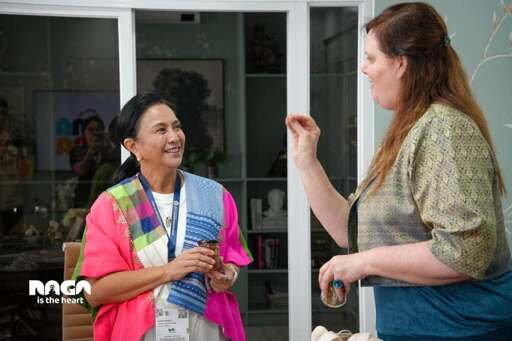
Why did former Vice President and now Naga City Mayor Leni Robredo roll out the pink carpet for the Zionist war machine? When Robredo hosted Israeli Ambassador Dana Kursh for an official courtesy visit, she was not merely performing the routine gestures of local hospitality. She was actively welcoming and legitimizing representatives of the US-Israeli genocidal apparatus. This intervention centers an anti-imperialist analysis to dismantle the liberal apologetics surrounding this act. Rather than an isolated error in judgment, this diplomatic encounter exposes the persistent, foundational tension within the Philippine political landscape: the contradiction between liberal reformism and anti-imperialist national liberation.
Dismissing progressives’ critique of Robredo’s hosting of the Israeli envoy as mere “political purism” is politically and morally impoverished. The underlying mechanism demands a total, systematic critique. To understand why her defenders deploy the “politics of purity” accusation, and why that defense completely falls apart when examining real power dynamics and economic interests, we must lay bare both the liberal class position and the ideological sleight of hand at work.
The class position of periphery liberalism
To make sense of Robredo’s pivot toward imperial hospitality, we must look directly at the liberal class position. Her stance is neither an accidental misstep nor a personal failure of political intelligence but the direct expression of her class character and political alignment. Liberal reformism in the global periphery operates strictly within the legal, institutional, and geopolitical framework dictated by US imperialism.
While Robredo served as a focal point against the overt state terrorism of the Marcos-Duterte dynasties, her opposition was strictly intra-class—a feud over how to manage the neocolonial state, pitting rule-of-law decorum against autocratic violence.
Because her political legitimacy rests upon acceptance by the global capitalist order, her opposition stops at the border of imperial interest. When forced to choose between international solidarity with an anti-imperialist national liberation movement and alignment with the Washington-Tel Aviv axis, liberal reformists invariably side with the imperial core. They cannot critique the drain of value, the extraction of labor, or the military hegemony of US imperialism because their entire political project depends on remaining within that very apparatus.
Anatomy of the “purity” smear
This structural subservience explains why defenders deploy the “purity politics” weapon whenever that alignment is exposed. Accusing leftists and activists of demanding a “useless politics of purity” is a classic liberal defense mechanism designed to shift the burden of moral failure onto the critic. From a materialist standpoint, this argument relies on three ideological fallacies:
First, it replaces a materialist baseline with ideological absolution. Opposition to active genocide, ethnic cleansing, and imperialist aggression is not a performative or elevated ideological standard; it is the absolute baseline of human solidarity and anti-imperialist struggle. Labeling principled opposition to mass slaughter as “purity” redefines baseline morality as an unreasonable demand, attempting to pass off complicity as pragmatic maturity.
Second, it operates on the logic of liberal idealism, which treats political stances as abstract moral choices made in a vacuum. Political actions reflect concrete class interests. Shielding a public figure from accountability for legitimizing a settler-colonial state serves a specific political function: it conditions the middle forces to accept imperial violence as a routine, acceptable feature of global diplomacy.
Third, it trades scientific alignment for unprincipled unity. Transformative praxis distinguishes between principled unity—built on anti-imperialist struggle and mass interest—and unprincipled unity, which colludes with reaction to preserve electoral coalitions. Demanding that the progressive movement remain silent on international solidarity to protect a liberal politician’s image trades human rights and anti-imperialist consciousness for temporary electoral expediency.
The disarray of the middle forces
This dynamic reveals the distinct role of the middle forces—segments of the middle-class progressives and social-democratic elements whose reactions betray a deep-seated fear of losing mainstream respectability. For these forces, Robredo represented a comfortable alternative to overt tyranny, allowing them to feel progressive without questioning the Philippines’ neocolonial subordination to the US.
When Robredo acts as an agent of normalization for foreign atrocities, it shatters the illusion that liberal reformism can deliver liberation. The attempt to police the speech of critics via the “purity” label is a desperate move to protect that illusion and avoid confronting their own complicity.
Palestine and the anti-imperialist horizon
Striking at liberal opportunism on Palestine is not an exercise in academic gatekeeping or moral perfectionism; it is an essential task of political education. Genocide is the ultimate expression of imperialist violence, and no movement can claim to defend freedom at home while remaining silent on liberation abroad. We must not allow the hegemony of liberal ideology to confuse anti-imperialist principles or frame Palestine as an optional advocacy.
Ultimately, we are forced to return to the question of Leni’s pink carpet. Just days after her polite handshake in Naga City, the world watched as former ICC judge Navi Pillay—who headed the UN Commission that explicitly ruled Israel guilty of committing genocide in Gaza—was awarded the 2026 Nobel Peace Prize.
This timing leaves liberals and their apologists with a sharp dilemma. Could someone operating strictly within liberal political interests alter their course when the very international institutions they revere formally name and condemn genocide? It leaves them with only two real possibilities: either we confirm the classic Marxist formulation—that in times of crisis, liberalism unmasks itself to reveal its underlying affinity with fascism and imperial violence—or liberal figures like Robredo must stop being tone-deaf, abandon their electoral opportunism, and recognize the real balance of forces today. Across the globe, from international tribunals to the streets, the peoples of the world are standing firmly for Palestine. Any continued alignment with imperial genocide is not pragmatic diplomacy but a moral and political dead end.
The post On liberal opportunism and the “purity” smear appeared first on Bulatlat.
From Bulatlat via This RSS Feed.