

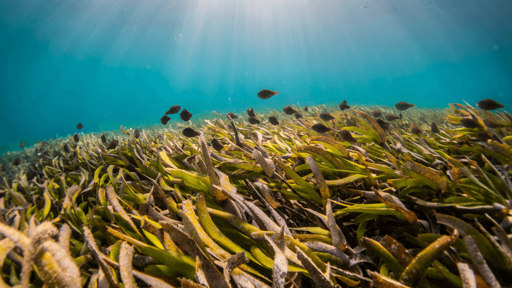
Researchers surveyed 40 sites along the East African coastline from Kenya to Mozambique, studying seagrass and coral reef ecosystems. They found that when it comes to benefits for coastal communities, seagrasses bring something important to the plate. In a paper published in Cell Reports Sustainability, they write that while reefs support “greater fish biomass, abundance, and richness overall,” fish communities living in seagrass meadows may provide a richer mix of nutrients when seen from the perspective of human sustenance. These marine habitats have gained prominence in recent years not only as fish nurseries but as carbon sinks and acting as the first line of defense against floods and storms. “Protecting seagrass meadows should therefore be seen not only as biodiversity conservation but also as a public health and food security priority,” the study authors write. Rabbitfish in a seagrass meadow. Image courtesy of Benjamin Jones. Lead author Benjamin Jones, a Ph.D. student at Stockholm University at the time of the research, said the study isn’t about comparing ecosystems, but rather about applying a new lens to marine conservation. Often, a marine ecosystem’s value is determined by fish production. But for vulnerable coastal communities, “the reliability of catching nutritious fish can be just as important as the total number of fish in the sea,” said Jones, who’s now the chief conservation officer at Project Seagrass, a U.K.-based environmental charity. Accounting for fish biomass and depth, the seagrass meadows studied were “1.6 times more nutritionally multifunctional” than coral reefs, according to the…This article was originally published on Mongabay
From Conservation news via This RSS Feed.