


By B. COOPER
According to a new scientific survey of water across the Delaware River watershed, 22 tested rivers and streams are contaminated with microplastics. This watershed flows from the Catskill Mountains in New York State, down south and out to the Delaware Bay, and connects waterways in the states of New York, New Jersey, Eastern Pennsylvania, and Delaware. The researchers tested for four types of particles: Fibers (from synthetic clothing), hard plastic fragments (bottles), plastic film (bags), and plastic beads (cosmetic products). They found that 100% of the waterways were contaminated by fibers, with troublingly high levels of the other tested particles.
Millions of people and countless wildlife species depend on this watershed. We can safely assume that the entire watershed is contaminated. Invisible microplastics, defined as particles smaller than 5 mm (though they could be, of course, much, much smaller) are a pollutant that does not biodegrade because life on Earth never evolved to metabolize it. It may take centuries for these particles to disappear—if ever.
Humans produce more plastics every year. Our society’s over-reliance on and over-production of plastics is an existential threat. Only by stopping the production of plastics and re-organizing the economy to satisfy human needs, instead of corporate profits, can we begin the process of cleaning this pollution.
Municipal responsibility in Philadelphia
This is obviously a global problem that requires global cooperation, as most environmental problems are. But just to focus on the Delaware River for now, every city and town up and down the river (as well as the state governments of New York, New Jersey, Pennsylvania, and Delaware) must stop plastic production, as well as related waste.
For example, the city of Philadelphia’s FDR Park has artificial turf that is made from recycled plastic material. Artificial turf is dangerous material that is harmful to human health and the environment. The small plastic grass blades break into tiny pieces under the consistent wear and tear of athletics, and can also be broken to down from years of rain and sunlight, making its way into the soil, air and water, and of course our bodies. This is an obvious source of microplastics.
This summer, the Richie Ashburn baseball fields, located in FDR Park (and privately managed by the Phillies), replaced their grass fields with this plastic turf. City officials pushed this through to be built in time for the U.S. 250th anniversary celebrations and the baseball All Star Game in July. They scandalously ignored Pennsylvania’s regulatory process to do so, prioritizing city prestige and short-term revenue over environmental viability.
FDR Park also contains the Meadows, where the city has clear cut large swaths of forest and has plans to destroy many more trees in order to construct a number of artificial-turf sports fields. The park has several creeks that flow into the Delaware River. Should the city of Philadelphia be spending millions of dollars making the plastic pollution problem worse? Why should the city destroy a forest, meadows, wetlands, and wildlife habitat in order to construct a huge athletic complex while ignoring the needs of neighborhoods around the city for more, better located, and well-maintained playing fields?
The problem of plastics that is associated with artificial turf fields is compounded by the fact that artificial turf contains PFAS (per- and polyfluoroalkyl substances**)**, known as “forever chemicals” because they resist breaking down. These chemicals can be absorbed into the human body, and scientific studies have linked them to possible reproductive problems, development effects in children, increased risk of some cancers, high cholesterol, and reduced immunity. Now, researchers have found that PFAS are contained in virtually all of the waterways that they tested in the Philadelphia region. Health authorities have signaled the danger of eating fish caught in Philadelphia’s Wissahickon Creek, a major recreation spot, and the city has stopped stocking the creek with trout.
There is also an impending risk of the construction of a polluting data center in Philadelphia, an idea that local residents are actively resisting. Data centers require the monstrous use of water to cool computers that are partially made of metals and plastics. There is no way that a data center wouldn’t add microplastics to the water, in addition to its numerous other hazards. Developers have proposed several centers along the Schuylkill River, but so far these plans have been stalled due to community protests.
Philadelphia is but one example of a national problem. All of this is to say that working people in every city and town need to struggle against the greed of the developers and producers—that is, those who own physical and financial capital and can invest in data centers, plastic factories, etc. We must continue to build movements that place demands on city and state governments to do absolutely everything necessary to protect the health of humans and all other species.
“Producer responsibility”
The city of Philadelphia spends, necessarily, millions of dollars cleaning up trash. The Philadelphia Water Department cleaned 4.6 tons of plastic garbage out of the Schuylkill River, and another 1000 tons from sewer maintenance. Many microplastics still escape these efforts, and besides, plastic producers still generate millions of tons more around the world every year. Cleanup is a futile effort as long as production of plastic is not stopped.
The Philadelphia Inquirer reports on this subject that seven states have passed “producer responsibility laws.” In essence, these laws require producers of plastic products to carry the burden and costs of plastic disposal and recycling of their own products. This is a step in the right direction, but as usual, it is not sufficient.
The flaw is within the very phrase “producer responsibility.” Producers operate for a profit and must maintain a consistent turnover of capital in the form of products, products using either plastic itself (bottles, TV frames, etc.) or with plastic packaging. The oil and chemical producers, manufacturers, and sales entities will continue to produce and market plastic commodities, since plastics are used for every conceivable purpose in daily life. There are thousands of individual actors that are part of a global supply chain that uses and produces plastics.
This is where we see the limitations of well-meaning reforms. Producer responsibility laws posit that if individual producers are the ones who dispose and recycle plastic, this will reduce pollution and production. (We leave aside for now the fact that plastic recycling is mostly a farce, and in any case doesn’t even address the issue of microplastics at all). There is no reason to assume either of these things, unless we also assume that the mechanisms of the market that drive individual consumption and corporate production of plastics is eliminated. Only a planned economy can accomplish this.
These systems have to be radically altered, and entirely new systems of collective waste management constructed. Municipalities and nations have a necessary role to play here. The “freedom” of individual capitalistic producers under market anarchy is no longer a realistic option.
If these incentives and systems are not dismantled, then the costs will be swallowed by industry without affecting the actual amount of plastic generated. Capitalism is competitive. If a given firm or industry cannot swallow the added costs of production, owing to enforced recycling, then they will be put out of business by competitors who can swallow those costs, usually because they operate at a larger scale. Companies could also monopolize, or borrow, to cover costs.
The only solution is workers’ control!
The only people capable of planning the economy and installing these necessary and radical changes are workers. Working people have tremendous power to save the planet by stopping polluting production, but the dictatorship of the rich is an obstacle.
Because we live under capitalism, workers don’t have the right to say, “We should stop making this, its bad for the planet, lets make something else” because they could be fired by the boss who has legal ownership of the workplace. Union leaders, whose responsibility is justly to protect the jobs of workers, could do far more to empower workers to struggle for issues of social justice beyond the shop floor.
Likewise, production must continue in order to fill our paychecks (“producer responsibility” does not address this problem). There is simply no recourse—under current conditions—to support ourselves if we stop working at polluting jobs.
As we have argued previously, only when a government that stands for the unlimited power of the working class (to the exclusion of the money-bags) to take control of our society, will it be possible to take the extreme measures necessary to end plastic pollution, while also guaranteeing full employment to all workers.
What this practically means is full nationalization of all industries, guaranteed employment and income, and a planned economy based on constant consultation with working people about what we actually should be making and how, with full control of the workplace handed to shop-floor organizations, such as unions.
Until then, it is necessary that workers organize collectively over our working conditions, expand the base of the unions, and fight for a class-struggle union movement that struggles for all workers. Paramount among our tasks is the struggle to save the planet from the ill effects of capitalist production.
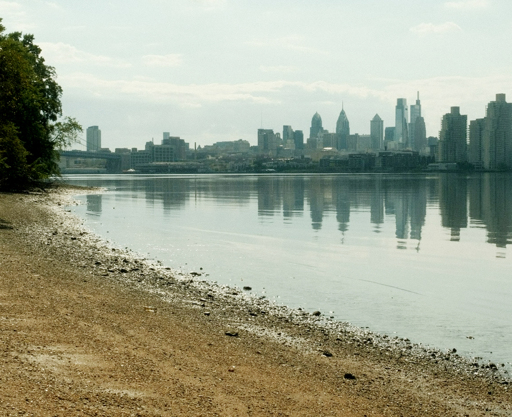
Photo: View of Philadelphia from Petty’s Island in the Delaware River. (Center for Aquatic Sciences)
The post Delaware River watershed study highlights dangers of plastic pollution first appeared on Workers’ Voice/La Voz de los Trabajadores.
From Workers’ Voice/La Voz de los Trabajadores via This RSS Feed.