

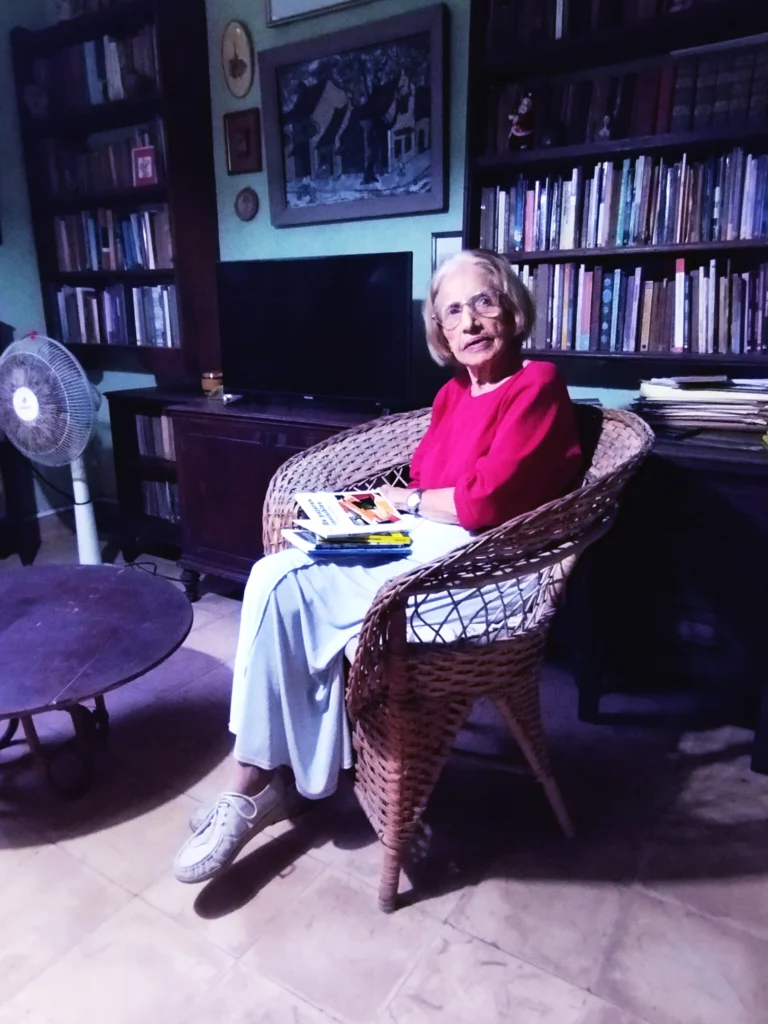
The Cuban Book Institute (ICL) has formally endorsed the candidacy of Cuban writer María Elena Llana Castro for the 2026 Miguel de Cervantes Prize for Literature in the Spanish Language, through a letter sent to the competition’s jury. The institution highlighted her career spanning more than six decades and her contribution to contemporary Cuban narrative.
RELATED:
Swedish Academy Awards Nobel Prize in Literature to Canadian Poet Anne Carson
In the letter, the ICL—the governing body for the publishing, marketing, and promotion of books and serial publications, which operates under Cuba’s Ministry of Culture—described Llana Castro as one of the country’s most significant narrative writers. It noted that she received the 2023 National Literature Prize in recognition of her originality, stylistic skill, keen observation of the social environment in Havana, and her use of irony and humor.
The document underscored the author’s standing within the realm of Cuban fantastic literature and cited more than 15 published books. Among these, it highlighted La reja (Ediciones Revolución, 1965) and Casas del Vedado (Letras Cubanas, 1983)—a work that, according to the ICL, explored the fantastic dimension of the remnants of the former Cuban bourgeoisie.
The ICL also highlighted her work for younger audiences, including titles such as Sueños, sustos y sorpresas (Gente Nueva, 2011), Desde Marte hasta el parque (Gente Nueva, 2014), and Cuentos de viejos (Ediciones Aldabón, 2024).
La escritora María Elena Llana ha sido propuesta al Premio Cervantes 2026. Con esta nominación, se une Fina García Marruz,Dulce María Loynaz quien lo obtuvo en 1992 las únicas cubanas en ser postuladas al galardón constituye una conquista para la cultura cubana y su literatura. pic.twitter.com/Bk6WZNXiFA
— Roberto Jimenez (@Roberto196801) October 11, 2026
The text reads, “The writer María Elena Llana has been nominated for the 2026 Cervantes Prize. With this nomination, she joins Fina García Marruz and Dulce María Loynaz—the latter of whom won the award in 1992—as one of the few Cuban women to be put forward for the honor; this represents a significant achievement for Cuban culture and literature.”
The ICL noted that Llana Castro’s short stories have been included in international anthologies and translated into other languages. Furthermore, it pointed out that her body of work has been the subject of academic study in Cuba, Spain, the United States, and Mexico.
Between 1959 and 1992, the candidate carried out extensive work across newspapers, magazines, radio, television, and the news agency Prensa Latina. According to the letter, this experience enabled her to develop a meticulous command of language—a quality evident in her body of work, which is rooted in philosophical, anthropological, and cultural themes.
The institute also highlighted her contributions to national radio, where she adapted works of world literature for the radio medium. Llana Castro has served as a professor of journalism and the Spanish language in Vietnam, Angola, Mexico, Cuba, and the United States; she is also a founding member of both the Union of Journalists of Cuba and the Union of Writers and Artists of Cuba.
The ICL asserted that the 2026 Cervantes Prize would be a fitting tribute to her more than six decades of literary work, and urged that the significance of her legacy be taken into account.
#Literature | Canadian poet Anne Carson wins the 2026 Nobel Prize in Literature, recognized for her inventive approach to poetry, fiction and classical storytelling.#AnneCarson #NobelPrize2026 #teleSUREnglish pic.twitter.com/lFTqCRomaA
— teleSUR English (@telesurenglish) October 9, 2026
From teleSUR English via This RSS Feed.