

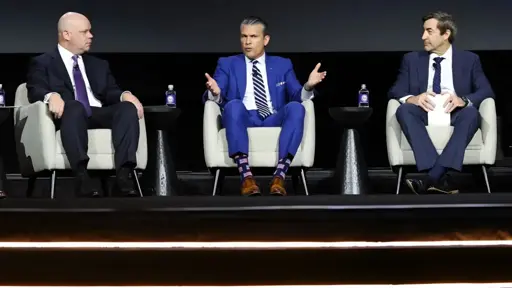
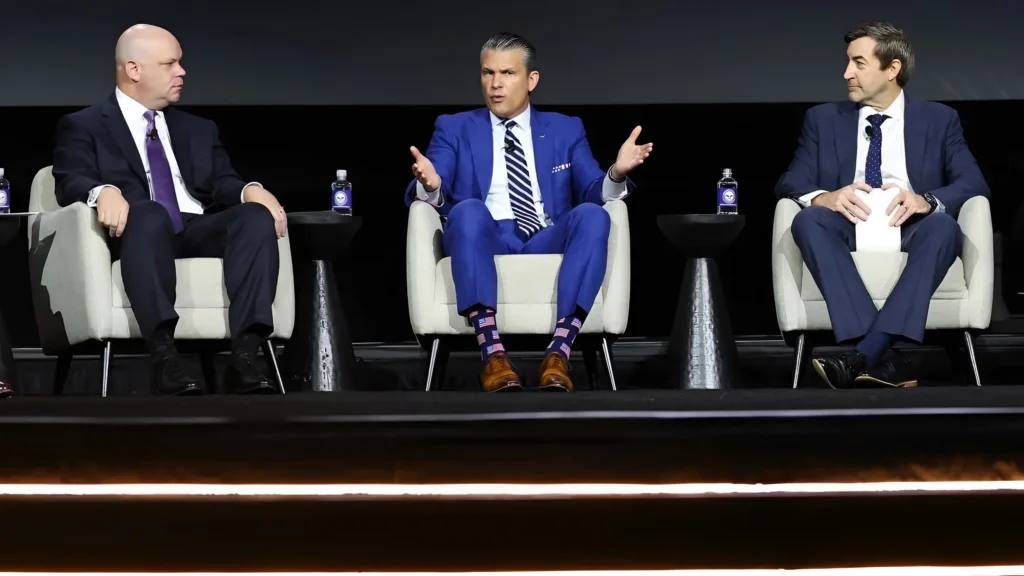
A look inside the annual arms conference where radical religious ideology and corporate interests shape the future of American military policy.
The annual meeting of the Association of the United States Army (AUSA) is one of the largest defense expositions and professional development forums in North America, and this year it was held from October 12 to 14.
RELATED:
Hegseth Seeks More Funding to Attack Iran Despite Anti-War Sentiment
Held annually in Washington, D.C., the AUSA brings together thousands of industry representatives, military personnel, defense contractors, and senior government officials.
The primary function of this convention is to showcase advanced military technology, foster business partnerships between the private sector and the U.S. Department of Defense, and deliberate on future defense budgets and operational strategies.
During the event, major defense corporations display advanced weaponry, armored vehicles, communication systems, and software platforms designed for modern warfare.
Usually, U.S. government representatives attend to outline procurement priorities and communicate strategic defense goals to contractors. This interaction helps set the trajectory for military spending, which accounts for a substantial portion of the federal budget.
Observers note that the discussions held during these annual meetings offer clear indicators of where future U.S. defense allocations will flow, reflecting broader geopolitical strategies and priorities established by Washington policymakers.
Protesters interrupt Pete Hegseth at AUSA 2026 in Washington, shouting “War criminal!” and “Save the children!” during his Project Agincourt panel.#ausa2026 #Hegseth #protest pic.twitter.com/3g8LvlKdzp
— Gianl1974 (@Gianl1974) October 14, 2026
AUSA: Institutional Origins and Systemic Implications
The Association of the United States Army (AUSA) originated in 1950, emerging from predecessor organizations during the early years of the Cold War.
The formation of the association coincided with a significant expansion of the U.S. military establishment and the defense planning that characterized the mid-twentieth century.
Its founders sought to create a unified advocacy group that could represent the interests of the active-duty army, the National Guard, the Army Reserve, and civilian defense industries.
The broader implications of the association’s work involve maintaining continuous alignment between military requirements and industrial capacity. By facilitating close interaction between military leadership and corporate executives.
The AUSA annual meeting provides a structured environment where retired generals, active-duty commanders, and corporate lobbyists negotiate priorities. This environment often features a revolving door, where former government officials and military officers transition into advisory or executive roles within defense contracting firms.
Around 750 firms and companies from the global defense industry participated in the 2026 annual meeting, including Global Military Products and Teledyne FLIR, alongside major, long-established contractors such as Lockheed Martin, General Dynamics, Northrop Grumman, and RTX.
Bipartisan continuity has defined the relationship between successive U.S. administrations and the Association of the United States Army. Democratic and Republican administrations alike have utilized the platform to signal commitments to robust defense budgets, modernization programs, and global military readiness.
War Sec. Pete Hegseth at AUSA (Oct 14): the “arsenal of freedom” means rebuilding America’s defense industrial base like nothing since WWII — going from 5 big prime contractors to 10 or 15 and opening the door to new companies.
On the last administration: "On hypersonics, they… pic.twitter.com/8aOgVWYUu5
— Spectre Nation🇺🇸🏴☠️ (@SpectreNation1) October 15, 2026
A Blueprint for Escalation and Autonomous Warfare
At the AUSA annual meeting, Defense Secretary Pete Hegseth delivered a keynote address that laid out the administration’s strategic blueprint for U.S. military transformation.
Hegseth centered his remarks on a massive proposed expansion of defense spending, emphasizing a $1.5 trillion investment request aimed at fundamentally restructuring the United States armed forces.
In his address, Hegseth framed this requested spending allocation as a necessary measure to maintain global military dominance and prepare the military for potential large-scale conflicts.
Hegseth pointed specifically to geopolitical competition with China and ongoing military tensions involving Iran as primary drivers requiring accelerated procurement and strategic readiness.
A central focus of Hegseth’s presentation was the rapid integration of autonomous systems, robotics, and artificial intelligence into standard combat operations. Hegseth detailed plans for scaling autonomous warfare platforms, highlighting initiatives such as Project Agincourt and the establishment of a dedicated Task Force Autonomous Warfare within Special Operations Command.
Hegseth outlined a strategy to deploy low-cost unmanned aerial vehicles, autonomous sea vessels, and automated targeting systems designed to operate alongside conventional ground forces.
To support this rapid transition, Hegseth called for shifting acquisition methods toward commercial technology marketplaces, urging defense contractors to speed up manufacturing or risk losing federal contracts.
During the panel, anti-war demonstrators interrupted the proceedings to protest U.S. foreign policy and military aid decisions. Demonstrators raised concerns regarding humanitarian crises, citing conditions in Gaza and opposing military escalation toward Iran.
While WARSec Pete Hegseth was speaking about autonomous warfare at the United States Army (AUSA) Annual Meeting and Exposition anti-war protesters interrupted his speech four times.
They were shouting "We fucking hate you! You’re a fucking war criminal!"
I want to take a… pic.twitter.com/0ltbd0Xu12
— Feisty is proud to be a Democrat! (@FeistyLibLady) October 14, 2026
Christian Nationalism and Hegseth’s Advocacy for Arms
Pete Hegseth’s public career reflects a commitment to expanding weapons production and dereglating military procurement. Before his appointment to lead the Department of Defense, Hegseth served as an infantry officer in the Army National Guard with deployments in Iraq, Afghanistan, and Guantanamo Bay.
Following Hegseth active service, he led conservative advocacy organizations, including Concerned Veterans for America, and spent several years as a television host on Fox News.
Throughout his media and political career, Hegseth consistently advocated for larger defense budgets, streamlined regulations for weapons manufacturers, and a rollback of internal administrative oversight within the Pentagon.
Hegseth’s political philosophy intersects significantly with explicit religious frameworks rooted in Christian nationalism. In public appearances, writings, and keynote speeches, he has frequently referenced historical religious concepts to describe military service and national defense.
The U.S. War Secretary bears tattoos associated with historical Crusader symbolism, including the Jerusalem Cross and the Latin phrase Deus Vult.
In his address to military personnel and defense leaders, Hegseth emphasized spiritual health alongside physical readiness, stating that the military is putting on the full armor of God to fight what he described as a fundamental spiritual battle between good and evil.
Analysts note that integrating explicit religious rhetoric into defense policy discussions serves to legitimize high levels of defense spending and aggressive foreign posturing.
By framing international relations and military conflict through an absolute moral binary, this perspective positions armaments production and technological military dominance as central elements of national defense strategy.
Pete Hegseth, the so-called Secretary of Defense, announced today: “At my direction, I’m establishing the Office of Religious Affairs. It will report straight to the top, a direct line to the secretary.” He then quoted Psalm 33:12: "Blessed is the nation in which God is the… pic.twitter.com/LbReRdqHJF
— Aprajita Nafs Nefes 🦋 Ancient Believer (@aprajitanefes) September 30, 2026
The Real Cost of Imperial Modernization
The annual gathering of the Association of the United States Army highlights the structural connections between corporate arms manufacturing, federal fiscal allocation, and political ideology.
The event serves as an operational forum where state actors and private defense contractors align around shared priorities, securing multi-billion-dollar trajectories for military procurement and autonomous weapons technology.
Pete Hegseth’s address encapsulated this alignment, bridging massive spending proposals with an ideological campaign designed to reshape the internal culture of the armed forces.
Internationally, the acceleration of autonomous warfare and expanded force projection elevates the risk of regional conflicts and global instability.
The integration of radical religious nationalist rhetoric and traditionalist warrior doctrines further complicates diplomatic efforts, reducing complex geopolitical issues to binary operational imperatives.
Ultimately, examining the AUSA convention and its key addresses reveals how modern U.S. military expansion operates as both an economic driver and an ideological platform. The convergence of commercial defense interests, far-right cultural politics, and state power creates a durable apparatus focused on permanent war readiness.
Sources: teleSUR – Al Jazeera – Al Mayadeen – TRT World – Anadolu Agency – Press Tv – Xinhua – CGTN – BBC – CNN – Los Angeles Times – NYT – El País – EFE – DW – Democracy Now – The Guardian.
From teleSUR English via This RSS Feed.