

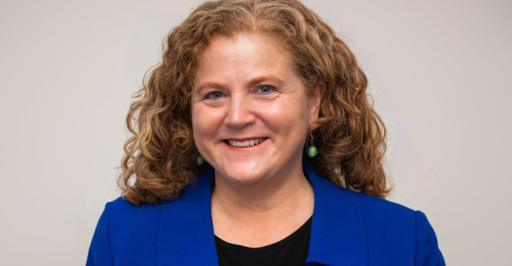
Janine Jackson interviewed the NYU Wagner Labor Initiative’s Terri Gerstein about gig workers’ rights for the October 9, 2026, episode of CounterSpin*. This is a lightly edited transcript.*
https://media.blubrry.com/counterspin/content.blubrry.com/counterspin/CounterSpin261009.mp3
Fortune (9/13/26)
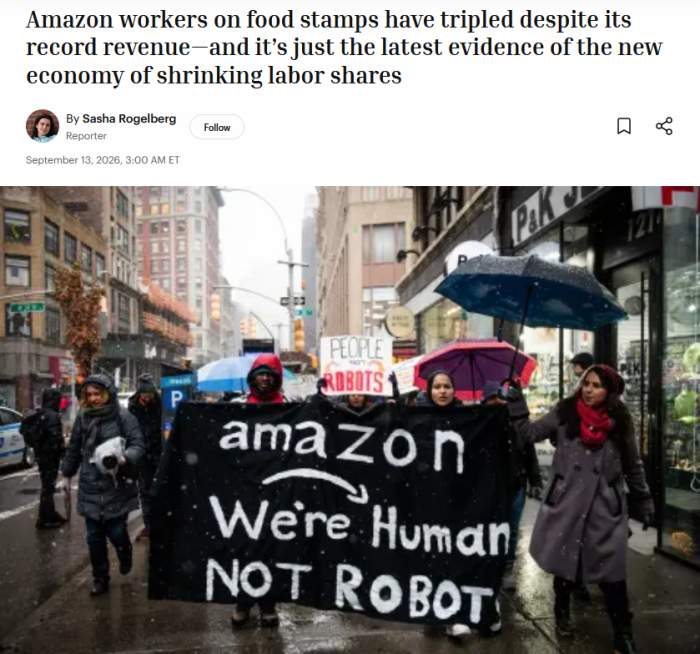
Janine Jackson: When Fortune magazine is telling you “corporations are raking in cash, but American workers are reaping less and less of the rewards,” something is afoot. The not-notoriously capitalist-critical magazine reported recently on the measurable fact that working people in this country are taking home the smallest percentage of economic output since the Bureau of Labor Statistics began tracking it in 1947. And they didn’t try to separate that from the fact that, at the same time, corporate profits have, in their word, “exploded.”
Simple acknowledgement is welcome, but how different would public conversation be if we always understood that the corporations corporate news media lionize are getting to those wonderful profits by abjectly exploiting their employees—and those they won’t even deem employees—such that those workers need government assistance to stay alive? And then the corporations attack government assistance? Can we talk about how this isn’t a sustainable model for a humane society?
Terri Gerstein is a longtime labor watcher. She’s director of the NYU Wagner Labor Initiative, at NYU’s Robert F. Wagner Graduate School of Public Service. We’ll hear from her today on the show.
***
Talking Points Memo (9/28/26)
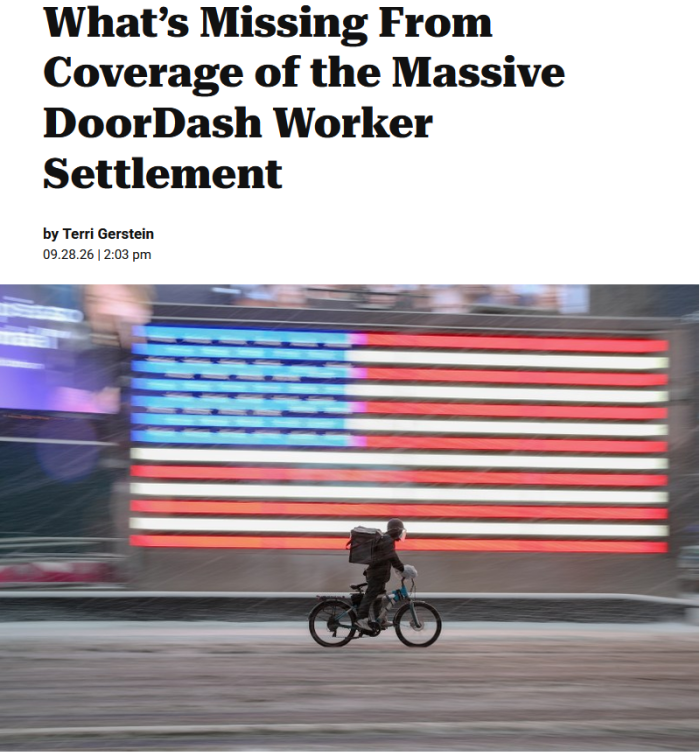
A new report from the Government Accountability Office shows that the number of Amazon workers that need federal assistance to make ends meet nearly tripled between February 2020 and September 2025. And app-based car and food delivery companies like Uber, Lyft, DoorDash, Instacart were among the top employers with workers receiving aid.
But corporate news media’s investment—excuse me, argument—that there must always be two sides to everything, and one of them must always be corporate capital, has us at a point where we’re debating whether the most profitable corporations in the world should pay their workers enough that they aren’t so poor that they qualify for government support, at the same time that these news outlets would have us celebrating Amazon and Uber et al. as “successful businesses.”
Well, why should we imagine that the journalists that define business success that way have regular working people’s lives or interests at heart on anything? That’s a live question, but we’ll stick with gig workers’ rights for right now.
Terri Gerstein has spent a long time enforcing labor laws, including a stint as labor bureau chief for the New York State Attorney General’s Office. She’s director of the NYU Wagner Labor Initiative at NYU’s Robert F. Wagner Graduate School of Public Service. And she previously directed the Project on State and Local Enforcement at the Harvard Law School Center for Labor and a Just Economy.
She wrote recently about New York City’s largest resolution in the city’s history, a $131.5 million settlement with DoorDash. And she joins us now by phone. Welcome to CounterSpin, Terri Gerstein.
Terri Gerstein: Thank you. Thank you so much for having me. I’m excited to talk about these subjects today.
New York Times (9/22/26)
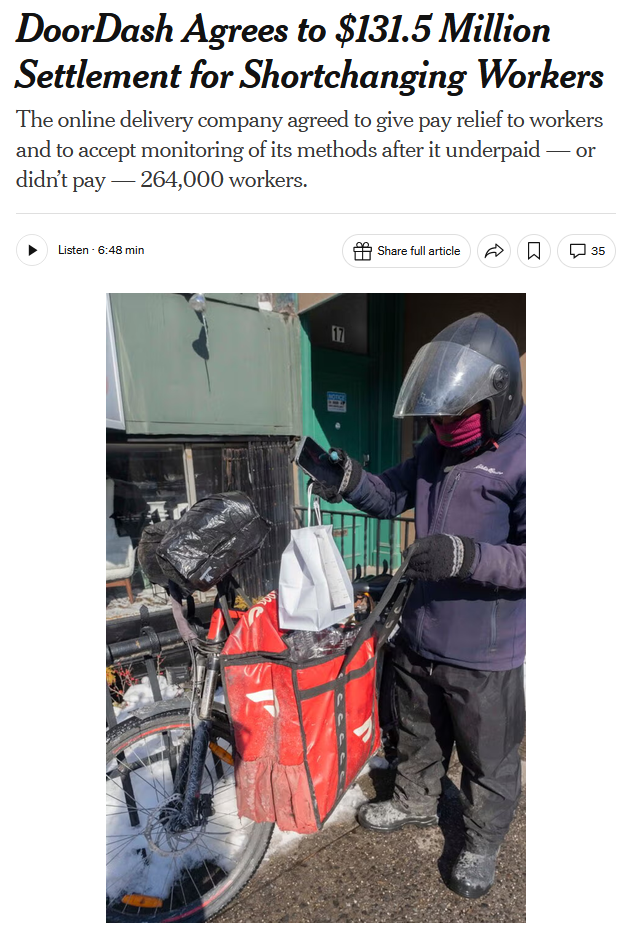
JJ: Well, sure. Let’s start with the DoorDash settlement, $131 million, and that’s for some 260,000 workers who were paid late, or their pay just straight up stolen.
Now, I’ve already seen video of workers saying, “Don’t raise our wages; that will kill our jobs.” And it breaks both my heart and my brain, because we know where that’s coming from. But if we didn’t see pushback, what even happened, right? So talk about what you see as the importance of this DoorDash action, including what it took to make it happen.
TG: One of the things that struck me the most about this DoorDash case, as I wrote in the piece, was just how brazen it was that DoorDash committed these acts at the time that it did. It’s important to understand that throughout most of the country, there are really no minimum floors for DoorDash workers. The company takes the position, as a lot of gig companies do, that their workers are independent contractors, each running their own very, very small business, as opposed to employees who have rights.
And this distinction matters, because basically all of our workplace laws, whether it’s minimum wage or unemployment insurance or safety and health, all of these laws protect employees, but they don’t protect independent contractors. And so DoorDash and its peers, Uber Eats and others, they treat their workers as independent contractors. And that means that, throughout most of the country, no one is calling them on this very much. And there’s no minimum wage, really, that is being applied to these workers.
New York City and Seattle are the two cities in the country that have set a minimum pay rate, or a minimum pay standard, for delivery workers like DoorDash and Uber Eats workers. It’s interesting, the background of what happened in New York City, because first the city passed this law setting a pay standard, and then DoorDash, amazingly, responded. What they did was they changed the app to make it really hard for customers to tip.
So before that, you could tip ahead of time, like when you’re placing the order, and it was really easy to see how you would tip. And then they changed it so that you could only tip after you got your order, and you had to hunt for the option to tip. So then the city council passed a law saying you have to let people know about the ability to tip upfront when they’re placing the order. And DoorDash challenged that, saying that to make it clear where the tip was upfront, that that was a First Amendment violation, and other kinds of legal claims, and they lost that.
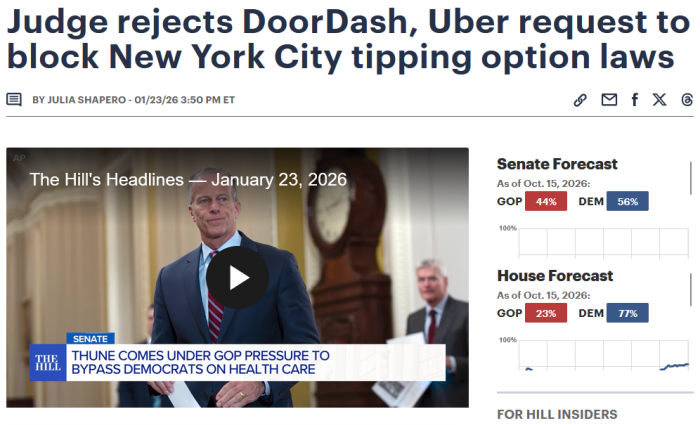
The Hill (1/23/26)
And so then the law, the minimum pay standard, has been in effect, and the city was very clear that they were keeping an eye on DoorDash. And this was even before Mayor Mamdani took office, that some of these things were happening.
But then once Mayor Mamdani took office, his commissioner of DCWP, Department of Consumer and Worker Protection, Sam Levine, sent out notices and said, “Look, be careful about compliance. We’re going to be really looking at this.” And that whole history—and even knowing that the city had this activist new administration that was specifically looking at them, and knowing this whole history—the fact that DoorDash wasn’t completely meticulous about making sure all workers got paid, to me was something that was very, very telling. Because these companies are very sophisticated, and if they value something, they will focus on it. Yet even though they knew they were under scrutiny, they still hoped that this would go under the radar.
JJ: And it speaks to what they imagined the context was, or would be. It’s the brazenness, as you put it. And I think part of the context they’re relying on is this perspective that we see out there, which is kind of like, if you can get away with it, it’s good. I think about Margaret Thatcher: “There is no society.” It’s just kind of, I got mine, let the devil take the hindmost. And these are the kind of company strategies that are lionized, that are celebrated. So I kind of understand why DoorDash would think, “Eh, we’ll get away with it. It’ll still work.”
TG: What’s extraordinary to me about it, though, is that throughout most of the country, they have literally no pay floor. They can just make up whatever amount of money they want to pay to people. And to be clear, also, all the laws regarding workers’ tips, and workers having a right to their tips, again, come from our minimum wage laws, which cover “employees.”
Courthouse News Service (2/24/25)
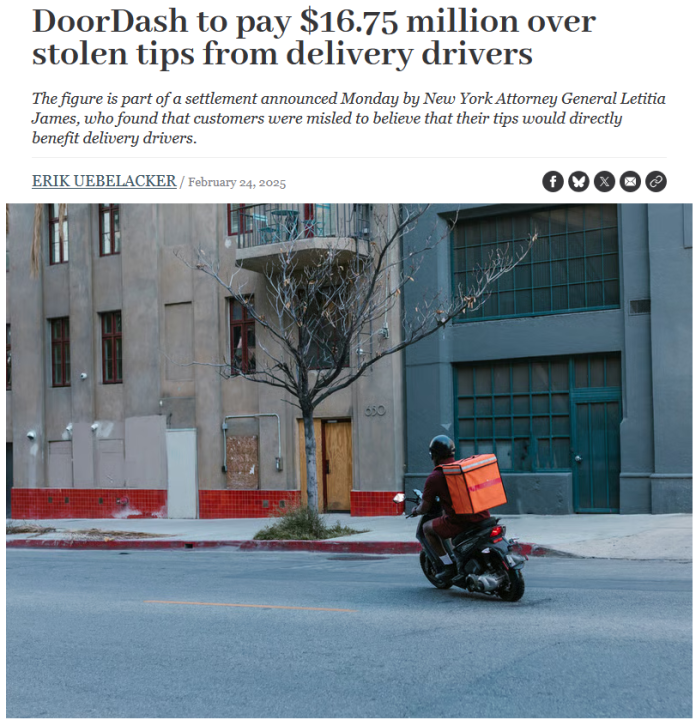
And so there have been cases that have been brought, the DC attorney general’s office, the New York attorney general’s office, and the Illinois AG’s office, they all brought cases, because DoorDash was allegedly retaining workers’ tips. And they were basically using a formula that if the customer [tipped], they would have an amount they were going to pay to the worker. They’d say, “We’re going to pay you, delivery worker, $10 for this delivery.” (I don’t know if it was $10, I’m just saying that to make the math easy.) And if the customer tipped $8, DoorDash would pay two. If the customer tipped $10, DoorDash would pay zero. They were keeping the tips by using the tips to subsidize their own obligations towards the workers.
And so DoorDash paid $30 million in these three cases for keeping workers’ tips, but those cases were all brought on a consumer theory, on the theory that consumers intended these tips to go to the workers; they weren’t trying to further enrich DoorDash. And so to me, you’re getting away with this in the entire rest of the country. And New York City and Seattle have passed these minimum pay laws, and that they wouldn’t just comply in those places, when they’ve been given such a lack of guardrails everywhere else, is just very, very striking.
JJ: Well, they’re playing a long game. They’re skating where they figure the puck’s going to be, is my feeling.
And let’s just talk about gig economy. Gig economy: We hear that, and we see it presented as if it was just about picking up some spare cash, that that’s what folks are doing.
And that’s like gaslighting. We know from our lives that this isn’t kids saving up for summer break. It’s people who need work, and yet somehow they’re not real workers, which is just what you’re talking about.
But the gig economy is the economy. And that’s why we have to look at these structural problems that you outline, and you’ve started on it with just the simple misclassification of workers. But there are structural problems when we kind of elide “gig economy” as if it were a side thing, when in fact it’s becoming the thing for a lot of people.
Roosevelt Institute (12/17/24)
TG: Yes. One of the things that I’m very concerned about right now is the spread of this gig model. Already it’s problematic enough that it’s so prevalent in the transportation and food delivery sectors, but it has begun to spread to other sectors as well.
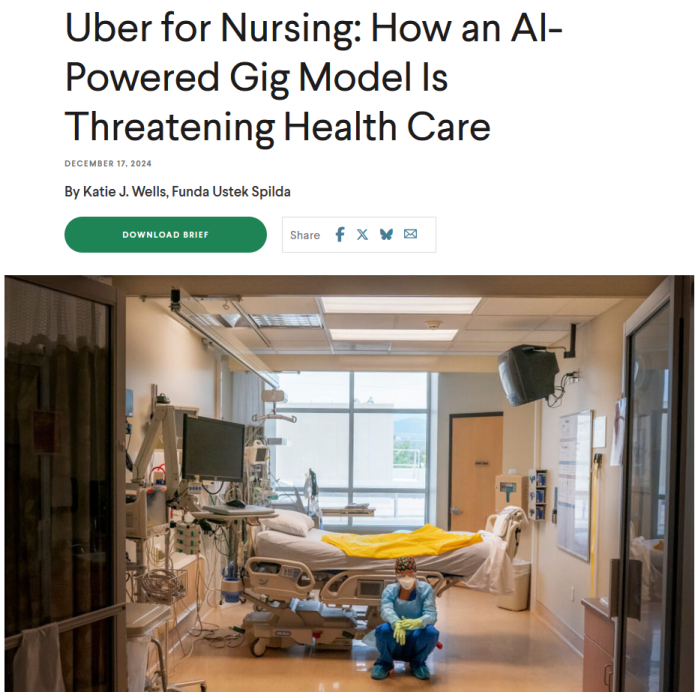
For example, Katie Wells, who now works for AI Now, wrote a report, and then a follow-up report, about Uber for nursing, Uber for nurses, and companies that are using this kind of gig model where they hire people, nurses and others in the healthcare industry, and they hire them as allegedly 1099 independent contractors, and not as employees with rights. And this obviously has all kinds of implications for patient care, because people are not necessarily having the continuity. You might have a different person who is not familiar with that hospital. The fact that they don’t have rights to protect them against retaliation if they complain about unsafe conditions, for example, because the protection against retaliation for whistleblowing, that applies to employees, and not to independent contractors.
So the spread of the model is very concerning. There are a number of enforcement offices; Denver Labor and the San Francisco City Attorney’s Office have done great work, specifically among the two of them, where they’ve done a few cases involving gig staffing agencies. And these are businesses that are basically sending people to work as a dishwasher in a restaurant, or stocking shelves at a supermarket, or working in a warehouse. Jobs that have never, ever, ever been independent contractor types of jobs, just like the healthcare jobs have never been independent contractor jobs.
And Denver Labor and the San Francisco City Attorney’s Office have been quite successful, in a number of cases, in getting these businesses to reclassify the workers as employees, with rights, as opposed to independent contractors, because the argument that they’re running their own business when they’re stocking shelves, or working as a dishwasher, is just on its face completely ludicrous.
JJ: Yeah. Patently absurd. And I think when you say “Uber for nurses,” a lot of folks, a shudder goes through their body, but if you pick up a paper, you might be told, this is where we’re at, this is where we’re going, get with it.
And I just want to ask again, the crucial questions have to do with this misclassification of workers as independent contractors, but also the wholesale wage theft that often goes along with that. And then the entities that might be looking out for people in that situation are being starved of resources. So we’ve got a kind of pincer move going on here.
TG: Absolutely. First of all, the media coverage of the gig industry has been really striking, in that they have repeatedly promoted the idea that this is what workers want: Workers want flexibility. And the only way you can get flexibility is by stopping being an employee, and not having any rights.
And I’ve been a labor and employment lawyer for over three decades: There’s nothing in the law that says that you can’t have flexibility as to your shifts or hours and still be an employee. That is a choice that these companies are making. The thing that is so sad to me about this is they could create really great jobs that they could be proud of, and instead they choose this low-road model.
But the other point that you made about the starving of government agencies that are enforcing these laws is very much true. The federal government, even in better times, the Wage and Hour Division, which enforces the minimum wage and overtime laws, had really diminishing staffing over recent decades. Right now I think they have somewhere between 600 and 700 investigators for minimum wage/overtime/child labor enforcement for the entire country. And then many states barely have, will have a skeletal staff for enforcing these laws, five or six people at most.
Florida doesn’t even have a state labor department. Literally nobody at the state level in Florida enforces the minimum wage laws there.
And then even in places that are more worker-friendly, and states that are less hostile to workers’ rights, there’s still this longstanding austerity and operating from scarcity, and thinking of public safety in a very narrow way, and not thinking of public safety as wage theft, as something that really affects public well-being, even though it leads to housing instability, food instability and a lot of harm to communities.
JJ: Yeah. I think it’s important to lift up the way that these problems that we’re talking about, they might seem like they’re on paper, they’re behind the scenes; it’s not a boss coming out and saying, “Hey, you particular people, we’re not going to pay you.” It’s structural things that they’re allowed to get away with based on classifications, based on line items that many people may never see, may never be given to understand.
And I guess that’s where I would like journalists to step in to say, “This is what is happening,” and this is why, even though somebody on the news might say, ‘Look at this chart, the economy’s doing great,’ you’re still struggling,” and make those connections for people. I guess I want more from journalists in this moment, when we see, as you’re saying, corporations being very clever about obscuring what it is that they’re doing.
TG: Yes. I’ve long felt, as people talk about defunding the police, and there’s that whole conversation, we have already 100% defunded the police that address corporate abuse of workers.
JJ: Say it.
In These Times (6/8/18)
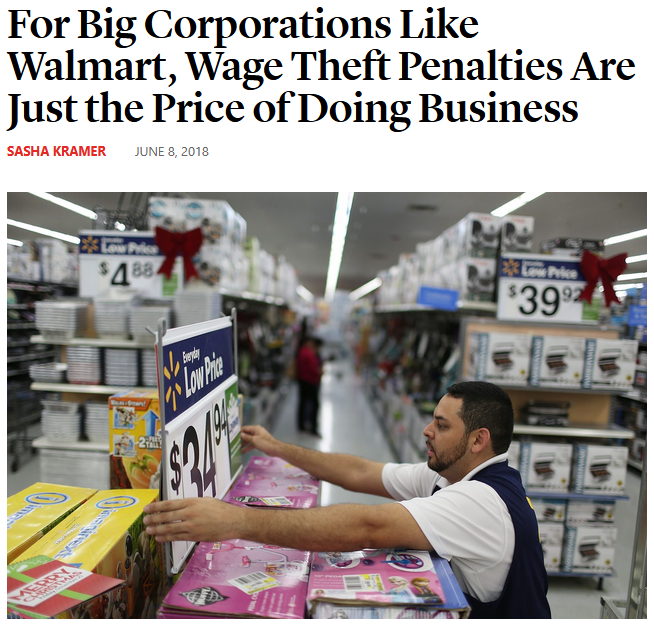
TG: We have OSHA, the federal Department of Labor, state labor departments, and there’s research out there showing that wage theft, the dollar amount involved, is as great as all other kinds of theft combined.
So it’s just a question of—often we’ve seen, in the past few years, a lot of focus, a lot of law enforcement focus, on retail theft. And obviously that’s bad. I 100% do not support retail theft, and I know that it has broader societal impacts. But it has been striking to me to see the extent to which resources have been found on that retail theft, on a scale that is very different from wage theft. And it just makes you think about why is that, and who has access to decision-makers about where resources go, and who doesn’t have the same level of access.
So there’s just really a lot more need for government to—there are wonderful people in government who are doing the best that they can–but we really, really need a lot more commitment to having government serve working people’s needs.
JJ: And I think that journalists, and the light that they can shine, play a role in that. But you do, in the piece that we’re talking about—which I saw at the New School Center for New York City Affairs; I know it also ran earlier in another variant on Talking Points Memo—but in that piece, you do talk about an upsurge of action in some cities and states. So there is recognition of what’s going on here, an attempt to resist it, right?
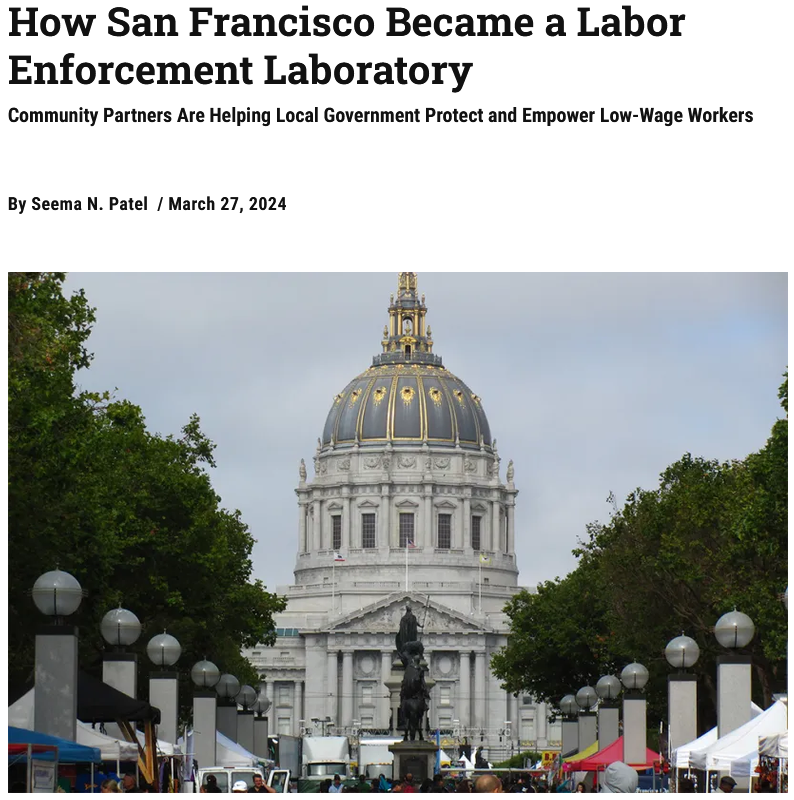
Zocalo Public Square (3/27/24)
TG: Yes, I think that’s true. I think there are some offices that are very focused on this, some attorney general offices. There are some local governments that have really stepped up.
And it’s worth noting, as well, that this is all pretty new. State AG’s were not very involved in workers’ rights until about 10 years ago. There were a few offices, but most did not really have a footprint in this area. Similarly, right now there’s maybe two dozen or more cities and counties that have their own dedicated offices of workers’ rights or labor standards. And historically, that has not been a thing that cities have done.
That’s a new function for cities, again, that really started about 10 years ago. The very first office of labor standards at the city level was started in San Francisco 25 years ago. But then there really wasn’t much more action on it until 2015 or so, when Seattle was the next. And since then there’s been a real mushrooming.
So I think that as there is stagnation at the federal level—obviously it’s been worse the last four years, and it was worse from 2016 to 2020. But even in a best-case scenario, it’s just much harder to move certain things, like the minimum wage or paid sick leave, at the federal level.
I think there’s been a real understanding, by worker advocates and organizers, that focusing on making change at the local level or the state level is really promising. And there have been leaders, elected leaders, public servants at the state and local level, who have taken this on as something that they really want to focus on.
JJ: Well, and it shows it can be done.
So, finally, I’ll just bring us back to where we started, with this New York City DoorDash agreement, which everyone would’ve said it couldn’t be done. And we’ve already seen an Amazon-backed group come out to say, “This is a terrible thing, you shouldn’t do it.” But it is an example of how, if you care about it, if you want to do it, you can work for it, right?
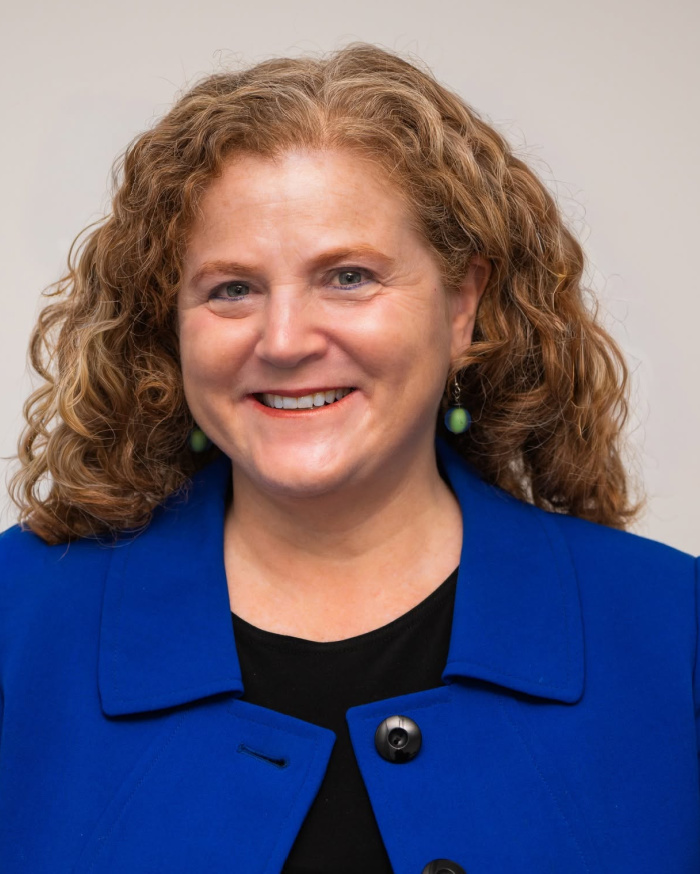
Terri Gerstein: ‘If this is the scope of wage theft that is happening just by these two companies, over a short period of time and two places, what is happening everywhere else?’
TG: I think that is very much true. And one thing that had not happened when I wrote the piece, that happened the week or so afterward, is that California announced a settlement with Lyft for underpaying drivers from 2016 to 2020. So this is before Proposition 22, which was a ballot initiative in California that stripped drivers and delivery workers of certain rights in California. But before then, the state AG’s office and several other players had sued Uber and Lyft for misclassifying workers. And I think it was just last week or so, they announced a settlement of, I think, $272 million.
And so what strikes me about all of this is like, OK, so that’s $400 million just in the last couple of weeks, of these settlements. And that’s with one company in one state for four years in the California Lyft case, and one company in one city for a similarly compact time period.
And it just, for me, raises the question that I think policymakers and enforcers and journalists should be asking, is that if this is the scope of wage theft that is happening just by these two companies, over a short period of time and two places, what is happening everywhere else? What is the denominator that is out there of how many people are being really mistreated and ripped off in terms of their wages that is not getting addressed? And so that was my big takeaway from these big numbers, was what is happening everywhere else that is not being addressed at all? And we need to do more to make sure that this is not happening to people.
JJ: We’ve been speaking with Terri Gerstein. You can find her work at TerriGerstein.com. The DoorDash piece that we’re talking about is up at the website of the New School Center for New York City Affairs, which is CenterNYC.org. Terri Gerstein, thank you so much for joining us this week on CounterSpin.
TG: Thank you.
From FAIR via This RSS Feed.