

David Camfield and Charlie Post’s recent conversation in Tempest, “Party Time?,” raises one of the most important strategic questions facing the socialist Left: What kind of revolutionary organization is possible today? Both Camfield and Post reject the idea that small groups can proclaim themselves revolutionary parties in miniature, as well as the alternative idea of abandoning revolutionary politics for reformism. Much less defined, however, is their proposal regarding these two poles — as they themselves acknowledge.
Their question is important, but answering it requires asking another question that receives much less attention in their discussion: What exactly is “our time”? Any debate over revolutionary organization today cannot be determined solely by the defeats and adaptations that shaped the end of the 20th century. It must also begin from the changes in working-class and youth consciousness, the crisis of political representation, and the new anti-capitalist phenomena that have developed since 2008.
For a generation entering political life today, the formative historical reference is increasingly not the fall of the Berlin Wall or “end of history” triumphalism but the collapse of Lehman Brothers and the prolonged crisis of capitalism that followed it. This does not mean that we are witnessing a revolutionary radicalization comparable to that of the 1960s and 1970s (yet). But neither are we living in the same conditions produced by the neoliberal defeats of the late 20th century. Today, new possibilities for political recomposition have been created by the crisis of capitalism, the weakening of traditional political institutions, and the growing openness to socialist ideas.
Moreover, in discussing the revolutionary Left, Camfield and Post assert that Left Voice follows the “micro-party” model. We disagree with this characterization, but the debate goes deeper. It concerns how revolutionaries should intervene in the political openings of the present period and contribute to rebuilding working-class political subjectivity and organization.
What Period Are We Living Through?
The Great Recession opened a new period of capitalist crisis, political polarization, and instability, dealing a decisive blow to the neoliberal order. We are now living through an interregnum in which the United States confronts not only an organic crisis at home but also a crisis of imperialist hegemony internationally.
Trump’s imperialist offensive against Iran is increasingly taking the shape of a strategic defeat for the United States, with consequences that extend far beyond the current conjuncture. After six months of bombardment, Trump has failed to achieve his strategic objectives. Iran has turned the Strait of Hormuz into a “center of gravity” affecting the world economy and eroding U.S. dominance in the region. The competition between great and emerging powers is dragging the world into a new cycle of crises and wars, with renewed tendencies toward militarism. These conditions have opened new episodes of class struggle and mass uprisings.
Since 2008, there have been three successive waves of class struggle, each of which has progressively eroded the passivity inherited from the neoliberal defeats. The first marked the return of mass mobilization after the Great Recession, from the Arab Spring to the Indignados movement. A second cycle of revolts began in 2018, one that included the Yellow Vests in France and the massive mobilizations in Chile. A third, postpandemic wave has seen these processes increasingly intersect with strikes, workers’ organization, and youth radicalization. The student movement and the general strike in solidarity with Gaza represented another leap in this process.
In the United States, we have seen Occupy Wall Street, Black Lives Matter, the teachers’ strike wave, the reformist Sanders campaigns, the growth of DSA, the experience of the pandemic (in which millions of workers came to see themselves as “essential”), the 2020 uprising following the murder of George Floyd, new union-organizing campaigns at Amazon and Starbucks, renewed strike activity, the Palestine movement, the fight against ICE, and increasing opposition to U.S. militarism.
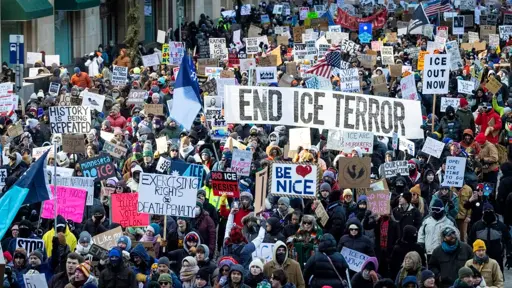
The recent Minneapolis uprising revealed something particularly important. It demonstrated how rapidly consciousness and embryonic forms of self-organization can develop when thousands of people enter into struggle — in this case, a deeply progressive struggle to defend immigrants against ICE and Trump’s attacks. The movement for Palestine has produced a rupture in the ideological consensus around Zionism among significant sectors of young people and broader layers of society, creating a serious political problem for the Democratic Party.
Les Leopold’s recent work provides another indication of the possibilities developing beneath the surface of U.S. politics. His polling in Michigan, Ohio, Pennsylvania, and Wisconsin points to significant support among working people for policies confronting “corporate power” and for the possibility of an independent political organization representing working-class interests.
More significantly, a substantial majority of those polled indicated they would support an independent working-class political organization if one existed. As Leopold concludes, “The Democratic brand is so tarnished that Democrats face a severe electoral penalty even before starting their campaigns. Working people are ready to support a new political organization with a very progressive economic platform that respects basic human rights and freedoms.”
None of this means that working-class subjectivity today is revolutionary or comparable to that of the first decades of the 20th century, or even to the radicalization of the 1960s and 1970s. The working class in the U.S. remains politically fragmented. Union organization remains historically low. Revolutionary socialist ideas have limited influence, and there is no developed workers’ vanguard comparable to those of earlier periods. But consciousness is not static.
The conditions produced by the defeats and diversions of revolutionary processes and the global extension of neoliberalism in the 1990s no longer adequately describe the present. Capitalism is increasingly questioned, especially among younger generations. The degradation of living conditions, the rise of the Far Right, the deterioration of public services, and other consequences of the capitalist crisis have produced not only growing disenchantment with the system and an increase in class struggle but also a change in how millions think about socialism. The idea of socialism — however vague or reformist its current meaning may be — has returned to mass political discussion. According to a recent Gallup poll, “Forty-three percent of Americans now have a positive view of socialism, marking the first time this figure has exceeded 39 percent in Gallup’s trend since 2010.”
At the same time, traditional political institutions have entered into a deep crisis. The question of who represents working people is now debated on national television, in mainstream newspapers, inside unions, and throughout the Left. While this process is still incipient, the situation is different from what it was 40, 20, 10, or even six years ago. The Far Right attempts to channel working-class anger toward nationalism, racism, attacks on immigrants, and an anti-worker agenda. The Democratic establishment seeks to contain that discontent within the same political order that produced the crisis and the process of realignment of the working class from the party. DSA and a new layer of social-democratic elected officials and candidates respond in a reformist fashion to genuine grievances through an “affordability” agenda while remaining strategically committed to the Democratic Party and an electoral strategy.
This creates an increasingly sharp contradiction. Significant sections of workers and youth are becoming disillusioned with the political establishment, but no independent mass political force exists that can organize that dissatisfaction on a working-class basis.
The Space to the Left of Social Democracy
Post is right to emphasize the profound consequences of the defeats of the late 20th century. The neoliberal offensive, capitalist restoration, and the collapse of the old workers’ movement weakened working-class organization, confidence, historical continuity, and revolutionary subjectivity. Many of the institutions through which workers accumulated political experience were destroyed or hollowed out. Revolutionary organizations themselves were weakened, fragmented, or disappeared altogether.
But this process had another side.
The 20th-century workers’ movement was dominated by enormous Stalinist and social-democratic apparatuses with deep authority among millions of workers. Again and again, those bureaucracies co-opted, contained, diverted, or helped defeat revolutionary processes.
As Matias Maiello points out,
Not only were the bureaucracies of the degenerated workers’ states at the head of restoration and transformed themselves into capitalists, they were, in many cases, those that implemented the plans of the IMF. In the capitalist states, Social Democracy, which from the outbreak of World War I had repeatedly demonstrated its politically counter-revolutionary nature yet had maintained a reformist role in the social sphere, now became a direct agent of the employers’ offensive as the one implementing neoliberal counter-reforms. The Communist Parties followed a similar course, being on several occasions part of “social-liberal” governments in alliance with the Socialist Parties.
Their weakening, therefore, created a contradictory situation. The working class became weaker in organization and revolutionary subjectivity, but the apparatuses that had exercised enormous control over its political life were also weakened or destroyed.
This does not automatically favor revolutionary politics. Bureaucracies remain strong in social and labor movements, and where they are weak, the space can be occupied by bourgeois populism or by new forms of reformism. But it does mean that political recomposition may be more fluid than in previous periods.
There is space for new organizations, united fronts, new layers of the vanguard, and struggles over political leadership. That such a space exists is demonstrated by the emergence of renewed political and social phenomena to the left. This space is being occupied by social democrats and neoreformists like Die Linke in Germany, LFI in France, and DSA in the United States, among others. An exception to this is Argentina, where this phenomenon is being led by Trotskyist organizations.
Leninism Today
This is where the discussion of Leninism becomes essential. Lenin’s conception of the revolutionary party has often been either applied dogmatically or revised until little remains of it.
David Camfield argues that Left Voice follows what he calls “the micro-party model” and what he “would call building a Leninist organization, while recognizing in some sense that they’re not yet what they see as a party.” But we are far from equating the concept of a Leninist organization with the “micro-party model” described by Hal Draper.
In his essay “The Myth of Lenin’s ‘Concept of the Party,’” Draper describes two types of organization: the “sect” and the “mass party.” In doing so, he creates a false dichotomy between an organization defined primarily by its program and another defined primarily by its role in the class struggle — not as a clearly delineated organization but as a kind of political center.
For us, Leninism is not fundamentally an organizational formula. It is a method for constructing an organization based on the relationship between revolutionary Marxism, the most advanced sectors of the working class and youth, and the broader masses.
A revolutionary organization seeks to fuse revolutionary theory with the living experience of the vanguard. That fusion develops in the heat of class struggle, political crises, ideological battles, movements against oppression, anti-imperialist struggles, and experiences of workers’ self-organization.
This is very different from the logic of a sect. A sect places its own organizational growth at the center of its politics. It sees movements primarily through the lens of whether they can produce recruits or confirm positions it already holds. It fails to recognize moments when sections of workers or youth begin moving leftward and when new forms of organization, collaboration, or political experience become possible.
Programmatic and strategic clarity are not what make an organization sectarian.
The Bolsheviks had extraordinary programmatic clarity. They built cadres, maintained an independent organization, developed a strong press, and continually fought over questions of strategy. The question, therefore, is not simply whether revolutionaries should maintain their own program and organization; it is what they are trying to accomplish with them.
A revolutionary organization should not exist simply to reproduce itself. It should accumulate forces that can intervene in broader processes of class formation and political differentiation, constantly searching for ways to engage broader layers, participate in their experiences, and find new organizational forms appropriate to changing circumstances. This means working through a logic of concentric circles and promoting the self-organization of the working class.
Revolutionary influence is not acquired only through recruitment, union activism, or elections. It must also develop through rank-and-file organizations, workplace assemblies, coordinating bodies, and other forms through which workers exercise their own power.
This is one of the fundamental ways that a revolutionary organization can begin to develop elements of broader or mass influence. As Post points out, “A revolutionary socialist party is an organization that actually organizes a substantial portion of the most militant and radical working-class people in a given society and an organization that has the ability to influence the course of social and class struggles.”
In that sense, Trotsky did not conceive of revolutionary organization as the simple linear growth of a small group until it eventually acquired mass influence. His interventions were full of tactical proposals designed to transform the relationship between revolutionary organizations and broader layers of workers.
The united front, transitional demands, tactics for relating to social-democratic and Communist parties, discussions of a labor party in the United States, and his advice to the Socialist Workers Party — all this shared a common logic: maintaining a revolutionary program and organization while building bridges toward the masses, whose consciousness remained contradictory.
This method avoided two opposite dangers: dissolving revolutionary politics into reformism and treating organizational independence as self-sufficiency.
Our relationship to social-democratic forces should not be reduced to ideological denunciation, nor should revolutionaries adapt themselves to their electoral horizons.
The strategic alternative has to be demonstrated politically and through class struggle: fighting alongside workers and youth attracted to reformist phenomena, supporting their demands, exposing through experience the limits imposed by the Democratic Party and the capitalist state, and proposing forms of struggle and organization that go beyond what reformist leaderships are prepared to organize.
Political Representation and Concrete Experiments
In a recent article by Fernando Rosso and Juan Dal Maso, they explain how they understand the current political moment and the neoreformist phenomena:
When we speak of a “populist moment” or “left-wing populism,” a new version of the “illusion of the political” emerges. This consists of expecting that institutional politics can, through its own mechanisms, generate the social force it needs to alter power relations. Much of contemporary left-wing politics can be understood from this perspective. The fragmentation of the working class, the weakening of trade unions, the defeat of revolutionary movements, the decline of class consciousness, and the expansion of precarious forms of employment are real phenomena. But recognizing a defeat is one thing; transforming it into a permanent premise of politics is quite another. In many debates, an almost imperceptible shift occurs: the absence of the working class as a political subject ceases to be a problem to be solved and becomes a condition of the world to which one must adapt. Some schools of thought explain this absence by historical defeat; others by fragmentation; still others by cultural transformation, the crisis of old identities, or the dispersion of forms of work. The explanations may be correct and yet lead to a conservative conclusion if they imply that the left should organize its strategy assuming that this situation cannot be reversed.
With that in context, we also have to consider that the absence of a stronger movement for an independent workers’ party cannot itself be treated as proof that no social basis exists for one when almost none of the organizations with sufficient social weight to test that possibility are willing to fight for it.
The progressive wing of the labor leadership still largely refuses to call for a break with the Democratic Party. The DSA counts thousands of militants in its ranks who sincerely want working-class politics, yet its dominant strategy remains tied to the Democratic ballot line.
This produces a circular logic: workers are said to be unprepared to break with the Democrats, while the forces capable of organizing an experience of political independence refuse to fight for such a break.
The DSA has more than 120,000 members, a national presence, elected officials, public figures, and organized work within the labor movement. This raises an important and very concrete debate: What could the DSA do with that force? One option is to focus primarily on electoral politics, mobilizing people to canvass every two or four years and electing candidates on the strength of progressive sentiment and the growing openness of younger generations to socialism. But those candidates can then become detached from the base that elected them — as when AOC supported imposing a contract on rail workers, Bowman supported funding for Israel’s Iron Dome, or Mamdani backed Governor Hochul while she confronted the historic nurses’ strike or arrested activists while they protested Netanyahu in NYC.
How different would it be if those forces were instead directed toward organizing struggle in the streets and unifying the working class, immigrants, and oppressed people?
For example, DSA has the strength to put forward an independent workers’ candidate, whether in the races this November or in future elections, including for the presidency. Such a campaign would need to be linked to a program that truly represents the aspirations of the social base voting for socialists and demanding profound change: a program that ensures that the rich and the bosses pay for the capitalist crisis rather than workers, and one with a clear anti-imperialist perspective. Such a program would be fundamentally incompatible with the Democratic Party.
You might be interested in: Which Way Forward Towards a Workers’ Party?
The task of revolutionaries is not simply to predict when the conditions for a workers’ party will become mature; it is to find tactics that can help those conditions develop. A workers’ vanguard is not a sociological category that either exists or does not exist independently of political intervention. It develops through struggles, victories and defeats, ideological battles, political differentiation, and the interaction between spontaneous developments and conscious organizations attempting to generalize their lessons.
Revolutionaries cannot manufacture that vanguard, but they are not external to its formation.
This is why the transformations since 2008 matter. The strategic question is not whether the “human material” for a revolutionary party already exists in a completed form; it is how revolutionary currents intervene in the processes through which new militant layers may emerge.
An experience on the other side of the hemisphere, the PTS in Argentina, offers a concrete example.
The political influence achieved by the Left Front and Myriam Bregman has created a challenge that cannot be addressed simply through the gradual recruitment of individuals into the existing revolutionary organization. The PTS has therefore promoted broader initiatives (including committees) aimed at organizing layers attracted to Bregman and the Left Front around fighting the Far Right and defending the perspective of building a party of the new working class.
You might be interested in: The Revolutionary Left in Argentina and the Question of Self-Organization: An Interview with Emilio Albamonte
For example, on Saturday, September 19, tens of thousands took to the streets in more than 70 cities across Argentina in a March of Anger (Marcha de la Bronca). Bregman, a member of the Party of Socialist Workers (PTS), floated the idea of organizing the “March of Rage.” Across the entire country, over 350 organizations of workers, students, and leaders from cultural, human rights, and political spheres planned grassroots rallies. The event gained so much traction that every media outlet in Argentina had to cover it. The over 200 “committees for a party of the new working class” also played a key role, spreading the word far and wide and ultimately forming the largest contingents in the March of Anger.
This experience is not a model that can simply be transplanted to the United States. Its significance lies elsewhere. It shows that a revolutionary organization does not have to choose between proclaiming itself the finished revolutionary party and passively waiting for the social forces necessary for such a party to emerge.
It can maintain its program and revolutionary organization while promoting initiatives deliberately designed to extend beyond its present organizational boundaries.
The Party Will Not Simply Arrive
Camfield and Post are right that the emancipation of the working class must be the act of the working class itself and that no revolutionary party can exist without organizing a substantial layer of militant workers.
But this describes the destination more clearly than the road toward it.
The defeats of the 20th century produced a profound crisis of working-class subjectivity. Revolutionaries have to begin from that reality. But subjectivity is not fixed.
Nor can its development be separated from the subjective problems of the Left itself: strategic retreats, adaptation to reformism, organizational conservatism, weak roots in the working class, and the inability to imagine initiatives larger than the gradual growth of existing organizations.
The central contradiction of our period is that the crises of capitalism, imperialism, war, technological transformation, and the development of organic crises are advancing faster than the working class is rebuilding the political organizations and consciousness necessary to confront them.
Closing that gap is a strategic task.
It requires forming revolutionary cadres rooted in the working class, the student movement, democratic rights movements, and anti-imperialist struggles. But it also requires united fronts, workers’ self-organization, intervention in new political phenomena, struggles for class independence, and initiatives capable of reaching broader layers of workers and youth.
The organizational form through which a revolutionary workers’ party will emerge in the United States will not simply be an enlarged version of one of today’s small revolutionary organizations. On this, we agree. But neither will it spontaneously appear once the necessary “human material” is ready.
Revolutionaries cannot manufacture that process. But they can — and must — fight to become an active part of it.
In this context, Left Voice, a socialist publication that is part of the La Izquierda Diario International Network and the Current Permanent Revolution — Fourth International, aims to act as a “collective organizer” for comrades engaged in different sectors and struggles: among teachers and students at CUNY, in the movement against ICE and anti-immigrant policies, in campaigns against state repression and the persecution of activists (such as the Minneapolis 15), in the fight for Palestine, in the new organizing in the labor movement, and within the Black movement, especially in cities such as Los Angeles, Detroit, and NYC. We want to be part of a left pole in the United States that fights imperialism and stands in solidarity with the exploited and oppressed peoples of the world.
Through this work, Left Voice seeks to contribute to building a new working-class, anti-imperialist, and anti-capitalist party, politically independent of the Democratic Party, based on class struggle, with a socialist perspective and capable of breaking with the long history of the co-optation of social movements and working-class struggles by the Democrats.
The post Party Time? From Political Openings to Revolutionary Organization appeared first on Left Voice.
From Left Voice via This RSS Feed.