

By Maureen Clare Murphy – Oct 13, 2026
The Palestinian health ministry in Gaza registered 111 fatalities from Israeli attacks in the territory during September. Among them were 74 men, 23 children, 10 women and four older persons.
According to the health ministry, nearly 1,440 people in the occupied Gaza Strip were killed and more than 5,000 injured since the start of a nominal ceasefire in October last year, as of the end of September, including 938 men, 324 children, 140 women and 38 older persons.
At least 74,040 people in Gaza were killed between 7 October 2023 and 1 October 2026, according to the ministry, which recorded more than 175,000 injuries during the same period. More than 830 bodies have been recovered from the rubble, according to the ministry.
Palestinian Civil Defense teams had recovered 96 bodies and human remains from a single site in al-Zaytoun, near Gaza City, which was bombed in November 2023, the UN human rights office stated on 15 September.
“Of the bodies and remains recovered, 58 were children and 23 women,” the UN office added. “Most of the remains have been recovered using bare hands.”
One year into a supposed ceasefire, Israel is still conducting airstrikes in densely populated areas on a daily basis and “restrictions on the entry of critical humanitarian items continue to impede the scale-up of the humanitarian response,” Ramiz Alakbarov, a senior UN official, told the Security Council in late September.
A report published by UNCTAD, the UN trade and development agency, during September states that Gaza has experienced “the world’s most severe economic crisis on record.”
According to the agency, annual economic output per person in Gaza stood at just $212 in 2025, equivalent to 58 cents a day and 83 percent below its already depressed 2022 level – far below the World Bank’s international extreme poverty line of $3 per person per day.
The UN Special Coordinator for the Middle East Peace Process stated during September that “nearly one year after the ceasefire in Gaza, early recovery remains well below the scale required, while essential services and infrastructure remain severely damaged.”

Palestinians inspect the site of Israeli airstrikes and gunfire west of Gaza City on 1 September amid damage to tents and vehicles in the area. Bilal Osama/APA images
During the month of September, the Israeli military announced the killing of more than 50 people in Gaza who it claimed were members of armed groups or engaged in militant activities at the time that they were targeted. Among those killed, according to the Israeli military, were three of five regional battalion commanders in the armed wing of Hamas and several people who it said participated in the 7 October 2023 attack or were involved in the holding of captives in Gaza.
Israeli media, including The Jerusalem Post, claimed that the arrest of a senior Hamas security official at the beginning of September “provided Israel with detailed intelligence that assisted in the location and assassination of top Hamas operatives, funds and weapons.”
The Israeli military has openly declared a campaign of retribution against those it says were involved in the October 2023 attack.
In May, The Wall Street Journal reported that Israel has a “list of thousands of names” to capture or kill for their alleged involvement on 7 October 2023. The paper said that Israel was using facial recognition technology, location data from cell tower lots and interrogations of detainees from Gaza to “mark men for death without trial.”
The Times of Israel reported in August that “Israeli officials have invoked the aftermath of the 1972 Munich Olympics as a precedent for the retribution campaign … pointing to the years-long and largely unsuccessful Mossad-led effort to track down and eliminate anyone linked to the massacre of 11 Israeli athletes during the Games.”
The publication added that the post-October 2023 retribution campaign had been seemingly ramped-up in recent months, with Israel attempting to justify the deadly strikes during a supposed ceasefire “by portraying them as defensive measures against terrorists who posed a threat to troops.”
Israel Katz, Israel’s defense minister, claimed at the beginning of October this year that of the approximately 6,000 “terrorists [who] crossed the border into Israel and carried out the atrocities” on 7 October 2023, 4,000 have been killed, The Times of Israel reported.
The publication added that Katz said that he and Benjamin Netanyahu, Israel’s prime minister, “have instructed the military and all other security bodies to kill all of those who took part in the onslaught, ‘without limitation and under any circumstances, from the senior ranks to the junior ranks.’”
During September, several civilians were killed in strikes in which Israel claimed to have targeted alleged members of armed groups in Gaza, as well as during an operation during which the senior Hamas security official was abducted by undercover forces.
Other Palestinians killed in Gaza during September were hit by bullets fired from Israeli positions in the more than 60 percent of Gaza’s territory under full Israeli military control.
Two Israeli soldiers were killed in Gaza during September. The soldiers were operating a drone that crashed and when they picked it up, it detonated, killing them.
According to Haaretz, they were the first soldiers killed in Gaza since February, when a staff sergeant was killed in what the military said was a friendly-fire incident.

Palestinian women and a boy sit amongst their possessions after Israeli forces demolished the entire village of al-Taban in the Masafer Yatta area of the southern West Bank, 2 September. The demolitions left 70 residents, including 28 children, homeless, and mark a sharp escalation in demolitions in the area. Omri Eran Vardi/ActiveStills
Israeli forces and settlers killed at least eight Palestinians, including two children, in the occupied West Bank during September. Additionally, the Israeli military announced it had “eliminated” an alleged attacker without releasing identifying information.
An Israeli man was shot and killed in the West Bank during the same period.
“Surging violence, increasing restrictions on movement and an acceleration of settlement expansion are causing serious harm to civilians across the West Bank, making everyday life untenable for the civilian population,” the International Committee of the Red Cross stated in September.
“This year alone, dozens of Palestinians have been killed, hundreds injured and many more displaced. Homes and property have been damaged or destroyed, leaving many without shelter or livelihoods,” the Red Cross added.
Israel was “rapidly and systematically dismantling all the foundations of Palestinian existence” in the West Bank, the Israeli human rights group B’Tselem stated in a landmark report published during September.
This “logic of elimination” was laid out in a plan published years earlier by Bezalel Smotrich, Israel’s finance minister, according to B’Tselem, and is being waged through “violence and intimidation, movement restrictions, economic strangulation, social and political destruction, and ethnic cleansing and territorial takeover.”
The current crisis in the West Bank is “an accelerated and explicit phase in an ongoing project of elimination that operates within the Israeli apartheid regime and is driven by a settler-colonial logic of dispossession, displacement and the establishment of Jewish-Israeli sovereignty,” according to B’Tselem.
As of mid-September, settler attacks and access restrictions had driven 2,600 displacements in the West Bank this year, according to the UN Office for the Coordination of Humanitarian Affairs (OCHA). “During the same period, more than 1,600 settler attacks resulting in casualties, property damage or both have been recorded across 275 Palestinian communities.”
More than 1,100 Palestinian-owned structures in the West Bank have been demolished on the grounds that they were built without an Israeli-issued permit so far this year, OCHA said in mid-September. More than 1,500 people were displaced during those demolitions – “over a third of the more than 4,300 Palestinians displaced so far this year.”
Israeli demolitions displaced nearly 150 Palestinians across the West Bank during one week in September alone, “more than three times the 2026 weekly average,” OCHA said. The displaced included 58 people from a Bedouin community “near the area designated for the E1 settlement expansion plan” in the Jerusalem area.
On 23 September, a demolition in Khirbet Jinba – one of more than a dozen communities located within an Israeli military “firing zone” in the Masafer Yatta area of the southern West Bank – “displaced eight families comprising 55 people, including 32 children, who remained in the community sheltering in caves,” according to OCHA.
“Over the past 15 years, Israeli authorities have demolished about 400 structures across these communities in Masafer Yatta, displacing 969 Palestinians, some more than once,” OCHA added. “Nearly half of these structures were demolished since January 2025, including 151 during six mass demolition incidents.”
After the demolitions in Khirbet Jinba, the UN human rights office said “Israel must immediately halt the mass destruction of Palestinian villages in Masafer Yatta … and the forcible transfer of the residents, compounding fears of ethnic cleansing in the occupied West Bank.”
“The forcible transfer of a civilian population from their land by an occupying power is a war crime,” Ajith Sunghay, the head of the UN human rights office in the occupied Palestinian territories, said.
“The case of Masafer Yatta also raises serious concerns of deepening Israel’s violation of international law’s prohibition of racial segregation and apartheid,” Sunghay added.
The UN human rights office issued a thematic report on Israel’s destruction of Palestinian refugee camps in the northern West Bank on 4 September.
Israel launched military operations in several refugee camps and their surrounding areas in January 2025 following a series of operations by the Palestinian Authority targeting Palestinians wanted by Israel. The UN human rights office said that it had “monitored and documented serious human rights violations” by both Palestinian Authority forces and the Israeli military, including “unlawful killings and serious injuries.”
An estimated 33,000 Palestinians remain forcibly displaced from Jenin, Nur Shams and Tulkarm refugee camps, where the Israeli military has “destroyed hundreds of homes, roads and other civilian infrastructure, indicating that the displaced population would not be allowed to return.”
The UN human rights office said that the forcible transfer of people from the camps and the wanton destruction of infrastructure raise concerns that the “camps were being reengineered to consolidate and prolong Israel’s unlawful presence” in the West Bank.
The UN office noted that the destruction of the camps “has eroded the social fabric of these communities, whose residents had been forcibly displaced in the late 1940s during the Nakba and have a recognized Palestine refugee status, entailing the right to return.”

Mourners attend the funeral of Khalil Shihadeh, 16, and Omar al-Nassan, 17, killed in an Israeli settler and military raid on the West Bank village of al-Mughayyir, 3 September. Oren Ziv/ActiveStills
Four people were killed, including a woman and two children, during an attack by Israeli special forces in a crowded area of Gaza City the morning of 1 September.
According to the Palestinian Center for Human Rights, individuals armed with machine guns and pistols emerged from a civilian vehicle and began “firing at people and vehicles traveling through the area.”
“Following the shooting, Israeli drones fired approximately 15 missiles within 15 minutes,” PCHR added. The armed individuals raided a building “and opened fire at Samah al-Arabeed, killing her and injuring several of her children.”
The 49-year-old woman’s husband, Muin al-Arabeed, was injured and detained. Video of the incident shows al-Arabeed being shot by gunmen firing from the back of a van while he was attempting to take cover.
Abdullah Hamoudah, 13, Lama Habib, 3, and Abdullah al-Hayyah, 32, were also killed during the operation, which lasted for approximately half an hour before the forces withdrew.
The targeted building is only a few meters from a school “where dozens of children and their teachers were present” at the time of the raid, according to PCHR.
“They were forced to lie on the ground and take shelter in internal classrooms before being evacuated by ambulance crews.”
The Israeli military claimed that Muin al-Arabeed, who it said was the head of Hamas’ internal security apparatus, had been working to consolidate the group’s control in northern Gaza and advance attacks on troops.
That same day, an Israeli drone attack targeting a group in front of the Civil Defense headquarters in Jabaliya, northern Gaza, killed Yusif Salem, a 29-year-old fire officer. The Israeli military stated that it had “struck a commander from Hamas’ military wing in the Jabaliya area” on 1 September but did not state that the man had been “eliminated,” suggesting that someone other than the target was killed.
Also on 1 September, Israeli military fire during an incursion near Deir al-Balah in central Gaza injured a woman and a girl inside their shelters. The 10-year-old girl, Israa al-Hissi, later died after being shot in the chest.
During the same incursion, Talal Ziyara, 73, was shot in the stomach while inside his tent and died from his injuries hours later.
The Israeli military stated on 2 September that “in order to remove an immediate threat,” it had “eliminated” Talal Badawi, who it claimed was a commander in the armed wing of Hamas, on 31 August. The military said that Mumin Hawari, who it said was a Hamas operative, was killed in the same strike.
The Israeli military stated on 3 September that it had “eliminated” an unnamed “terrorist” who had approached “troops in a manner that posed an immediate threat” after crossing the so-called yellow line in the northern Gaza Strip.
Meanwhile, Israeli forces “escalated their ongoing crimes against Palestinian fishermen,” the Gaza-based human rights group Al Mezan stated on 4 September. “Since 31 August 2026, these attacks have resulted in the detention of 14 fishermen, who were taken to an unknown location, and the injury of five others.”
The Israeli military claimed on 4 September that it had “eliminated” Muhammad al-Qadi in Khan Younis days earlier, claiming that the slain man was a commander in the armed wing of Hamas who had “infiltrated the Sufa [military] outpost” on 7 October 2023.

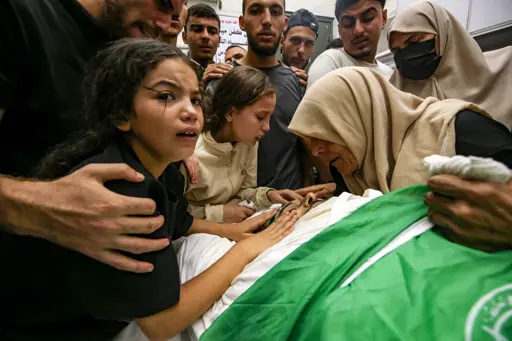
Mourners gather around rows of remains covered with Palestinian flags and illuminated by candles during a farewell ceremony for 106 Palestinians in the al-Zaytoun neighborhood of Gaza City on 5 September. The remains were recovered from beneath the rubble of homes destroyed by Israeli airstrikes during the war. Belal Osama/APA images
The UN’s World Food Program said on 1 September that it had cut food aid in the West Bank by half due to “critical funding constraints.”
“The reduction comes at a time when food needs have more than doubled since 2023,” the agency noted.
The World Food Program provides food assistance to “400,000 of the most vulnerable people” in the West Bank, where an estimated 900,000 people are food insecure.
But starting in September, assistance would be scaled back to 200,000 people.
The agency said that funding shortfalls were also affecting its Gaza operations, where it provides one million people monthly food assistance.
The World Food Program said that over the next six months, it “urgently requires an additional $386 million to serve an estimated two million food insecure people across Gaza and the West Bank.”
At the end of September, the UN Office for the Coordination of Humanitarian Affairs stated that “funding shortages are increasingly affecting the entire humanitarian effort” in Gaza.
“For example, food security partners warn that, starting in October, underfunding will significantly reduce daily cooked meal production and monthly household food parcel distribution.”

Workers operate machines in a juice and ice cream factory in Khan Younis, southern Gaza Strip, on 7 September. The factory resumed production with limited resources after being badly damaged during the war. Located a few meters from the “yellow line” marking the areas of Gaza under full Israeli military control, the factory’s operators are seeking to restore production and help revive economic activity in the city despite major challenges. Tariq Mohammad/APA images
On 2 September, Israel Katz, the Israeli defense minister, said at a conference hosted by Yedioth Ahronoth, an Israeli newspaper, that Israel would expel Palestinians from Gaza “by any means” as soon as Donald Trump, the US president, allows it.
“There is no real solution for Gaza in the end without this migration,” Katz said. He added that if other countries agreed to take in people from Gaza, the Israeli government “is organized and prepared to get them out — by sea, by air, by every way possible.”
The Palestinian Center for Human Rights said that Katz’s statements “amount to an official acknowledgment and admission, at the highest levels of Israeli decision-making, of Israel’s intent to forcibly displace Palestinians from the Gaza Strip.”
The rights group added that Katz’s comments confirm that the nominal ceasefire and Trump’s “peace plan” are merely “political cover for a parallel course” aimed at depopulating Gaza.
“Forced expulsion is not emigration. It’s ethnic cleansing,” the Euro-Med Human Rights Monitor said.
In its weekly atrocity alert published on 9 September, the Global Center for the Responsibility to Protect warned that Israeli officials had begun a new push for “voluntary migration” from Gaza, “placing atrocity evidence at risk.”
The center cited the comments from Katz as well as a plan unveiled by Itamar Ben-Gvir, Israel’s national security minister, and renewed discussion of an earlier proposal to forcibly displace some 2 million Palestinians from Gaza over the next seven years.
“Against this backdrop, recovery and reconstruction deliberations progress with negligible Palestinian participation or ownership,” the Global Center for the Responsibility to Protect said.
“Despite more than 10,000 Palestinians believed to be buried under the rubble, Israeli authorities are engaged in the removal, crushing and relocation of rubble in areas of Gaza under their control.”
The New York-based organization said that states must pressure Israel to “halt any attempts at forcibly displacing Palestinians from Gaza, mobilize pressure to allow independent investigators into the enclave and ensure Palestinian agency and ownership in recovery and reconstruction efforts.”
“Accountability for Israel’s atrocities must remain central to coordinated multilateral action, including measures to deter future crimes and prevent the deepening of Israel’s unlawful occupation,” the center added.
The New York Times reported on 15 September that “the Trump administration [had] approved a $2.8 billion sale of heavy bombs to Israel … in what would be among the largest deliveries of US munitions there even as American public support for the country declines.”
The paper added that “the proposed sale would include 40,000 one-ton bombs whose use by Israel in Gaza and Lebanon has drawn international anger because of the civilian harm caused by their wide blast radius.”

A relative of Wafaa Aqila, 7, mourn while displaying her belongings, including schoolbooks damaged in the strike that killed the girl and her father, Gaza City, 8 September. Wafaa was killed along with her father in an Israeli strike the previous day. Bilal Osama/APA images
Israeli soldiers shot and killed two Palestinian boys – Khalil Shihadeh, 16, and Omar al-Nassan, 17 – during a settler raid in al-Mughayyir, a village near Ramallah, the seat of the Palestinian Authority in the West Bank, on 2 September.
Amin Abu Alia, the head of al-Mughayyir’s village council, told the official Palestinian news agency Wafa that Israeli army snipers positioned on buildings opened fire on Palestinians as they attempted to confront settlers as they stole sheep, hitting the two boys.
The UN human rights office in Palestine said that Israeli forces and settlers have killed nine Palestinians, five of them boys, in al-Mughayyir since December 2024.
“Surrounded by eight settler outposts, al-Mughayyir has been a target for incessant settler and state violence to force Palestinian residents to leave,” the UN office stated. The village has been attacked more than 50 times this year “with the acquiescence, support and participation of Israeli forces.”
On 3 September, Palestinian authorities received the body of 15-year-old Jadallah Jadallah, who was shot and killed by Israeli soldiers in al-Faraa refugee camp near the West Bank city of Tubas in November last year. Soldiers prevented medics from treating the boy and confiscated his body.
On 4 September, Israeli police shot and killed Ibrahim al-Hindi, 33, near Damascus Gate in East Jerusalem. Israeli authorities claimed that al-Hindi was shot after attempting to stab soldiers; no Israeli injuries were reported.
On 6 September, Omar al-Toubasi, 27, was shot in the head and killed by settlers during a raid in Hajja, a village near Qalqilya in the central West Bank, Wafa and Haaretz reported.
The following day, Israeli forces shot and killed Muhammad Muhsin, 34, following a manhunt in Ithna village after Muhsin allegedly stabbed and injured an Israeli man at a settlement outpost.
On 8 September, Israeli forces shot and killed Abdulkarim Khader, 29, after besieging his home in Aqraba, a town near Nablus in the northern West Bank. Al Jazeera reported that Israeli forces targeted the building with an Energa antitank rifle grenade and “used a bulldozer to demolish sections of his home.”
The Israeli military claimed that when soldiers arrived, “the terrorist hurled an improvised Molotov cocktail and an improvised explosive device toward them. No injuries were reported.”
When troops entered the home, they “identified the terrorist armed with a knife, which he intended to use to attack the soldiers, and eliminated him,” the military added.

Residents inspect the damage several hours after Israeli forces demolished the northern part of Khirbet al-Fakhit in Masafer Yatta in the southern West Bank, 8 September. Al-Fakhit is located in an area that Israel designated as Firing Zone 918 in the 1980s. Israel has used the designation to force Palestinian residents off their land. Mosab Shawer/ActiveStills
UN Women said in a data brief published on 8 September that nearly one in four households in Gaza was now headed by a woman –“which is double the pre-October 2023 rate of one in nine.”
An estimated 86,290 households were headed by women, including “widows and women whose husbands are missing, detained, severely injured, forcibly disappeared or whose fate remains unknown.”
“Women-headed households in Gaza experience even greater hardship than male-headed households,” UN Women said.
A greater percentage of women-headed households lack adequate shelter and women-headed households are more likely to have had their homes rendered uninhabitable and have been displaced more frequently than those headed by men.
“The financial pressure on women heading households is immense,” according to UN Women, which noted that at least 137 women and 109 girls have been killed in Gaza since the October 2025 ceasefire, as of 28 July.
In a separate analysis published on 15 September, UN Women said that an estimated one in eight households in the West Bank were headed by women, though the agency said “this figure is likely an underestimate.”
More than 20,000 women and girls are among the more than 41,500 people displaced in the West Bank. Women-headed households are more likely to be displaced than male-headed households.
More than half of the women who head households interviewed for the analysis said that Israeli movement restrictions block their access to livelihoods and all women who head households “reported avoiding checkpoints altogether.”
“One in four women-headed households receives no humanitarian assistance at all, compared to nearly half of male-headed households,” according to UN Women.

Displaced Palestinians pick olives beside their tents in Deir al-Balah, in the central Gaza Strip, on 9 October. Hassan al-Jedi/APA images
Ten Palestinians, including a couple and their two children, were killed in Israeli attacks in Gaza between 7 and 10 September, the Palestinian Center for Human Rights said.
Mumin Ahmad, 39, and his wife, Hanin Saleh, 35, and their daughters Lana, 10, and Bana, 8, were killed in a missile strike on a home near Kamal Adwan hospital in northern Gaza on 10 September.
Farah Hamed, 48, was killed in an Israeli missile strike on a motorcycle in the Sheikh Ajleen area west of Gaza City on 9 September. PCHR said that Hamad was from the West Bank village of Silwad and was deported to Gaza as part of a prisoner exchange deal in 2011.
The Israeli military claimed that Hamad was a Hamas operative “responsible for multiple deadly attacks against Israeli civilians and … soldiers.” Israeli forces stormed a tent for paying condolences in Silwad following the killing of Hamad and opened fire at youths and shot tear gas towards the mourning tent, according to Wafa.
The previous day, Muhammad Abu Reida, 40, succumbed to injuries sustained in a strike in the Khan Younis area on 4 September.
Also on 8 September, Fathi Abu Ayyada, 69, was killed by Israeli troops while preparing breakfast near his tent south of Khan Younis, according to PCHR.
Obeida Eid, 10, was killed after he was shot in the chest by Israeli troops near al-Mawasi in the Khan Younis area. A pregnant woman was shot in the head and seriously injured in the same 8 September incident.
Also on 8 September, Khamis Saed, 36, was killed in an Israeli drone strike on a tent north of Nuseirat refugee camp in central Gaza.
Ismail Qandil, 39, was killed in an Israeli drone strike on a motorcycle northwest of Khan Younis on 7 September, according to PCHR. The Israeli military claimed that Qandil was involved in the armed wing of Hamas and had “infiltrated Israeli territory” on 7 October 2023 and participated in the killing of a commander in the Israeli military.
Al Mezan said that Israeli forces opened fire on fishers off of the coast of Gaza City at dawn on 7 September, injuring three. “Israeli warships continue to open fire towards the western Gaza shoreline,” the rights group added.
The Israeli military stated on 7 September that it had “eliminated” Subhi al-Batrihi and Ahmad Khalas in separate strikes in the preceding days. The military claimed that al-Batrihi was an operative in the armed wing of Islamic Jihad, a Palestinian resistance faction, and that Khalas was an operative in the armed wing of Hamas.
That same day, the military said that it had killed Yusuf Aqila in the Gaza City area, claiming that the slain man was a commander in the armed wing of Hamas and was “eliminated” “after posing an immediate threat.”
Aqila’s daughter, 7-year-old Wafaa, was killed in the same strike. The Israeli military did not acknowledge killing the girl in its statement but claimed that “steps were taken to mitigate harm to civilians.”

Ibrahim Abu Saraya, a 16-year-old Palestinian with severe cerebral palsy, increased electrical activity in the brain and acute malnutrition, sits inside a tent for displaced people in Nuseirat refugee camp in central Gaza on 15 September. His mother says she travels long distances to obtain the food he needs and is appealing to international organizations to facilitate his evacuation from Gaza for urgent medical treatment abroad. Hassan al-Jedi/APA images
The main generator at Gaza City’s Al Ahli Arab Hospital, which serves 1,000 people daily, stopped working due to mechanical failure on 9 September. The shutdown of the generator forced “suspension of CT scanning services, sterilization services, the oxygen station and several other departments,” Al Mezan stated.
The hospital’s comprehensive care services “are at risk of being suspended due to the scarcity of spare parts and the lack of necessary oils,” Al Mezan added.
Meanwhile, Gaza City’s sewage system was on the verge of collapse, the municipality warned, with an “estimated 24,000 cubic metrmeterses of untreated sewage flow into the sea every day,” Al Mezan said.
The deterioration of the city’s sewage system “threatens to turn the city and its marine environment into an increasingly severe hotspot for health and environmental risks.”
Al Mezan added that Israel’s restrictions on the entry of equipment, spare parts, machine oil and fuels were hindering recovery of bodies from under the rubble.
Francesca Albanese, the UN special rapporteur on the West Bank and Gaza Strip, said that Israel’s removal of rubble from Gaza was potentially destroying evidence of international crimes and preventing “the recovery and identification of human remains.”
“The recovery and dignified identification of human remains, systematic documentation of sites and materials, preservation of potentially relevant evidence and an unbroken chain of custody under independent oversight must take place,” she added.
On 17 September, Ramiz Alakbarov, a senior UN humanitarian coordinator, allocated $2 million for fuel support over four months “to sustain dozens of critical health services with back-up generators while the electricity grid is down,” OCHA said.
Qatar announced during September that it would be granting 1.3 million liters of fuel for “critical health services and essential humanitarian operations” in Gaza.
“The latest funding for fuel is a stop-gap measure that will keep life-saving services from being further interrupted,” OCHA stated. “But fuel-consuming back-up generators are not a sustainable solution to power critical services.”
“Israeli approvals to import solar energy equipment and restart operations at the Gaza Power Plant are urgently needed,” OCHA added.
Staff at Kamal Adwan Hospital suspended services at the facility in northern Gaza on 3 September due to heavy gunfire in the vicinity, endangering patients and healthcare workers.
Medical Aid for Palestinians, a UK charity, noted that “Kamal Adwan Hospital had only just resumed services in March, providing primary healthcare and emergency care for adults and children to between 100 and 120 patients a day, including children, women and the elderly.”

Mourners attend the funeral of Nael Abu Obeid, commander of the Rafah Brigade of the Qassam Brigades, the armed wing of Hamas, at Nasser Medical Complex in Khan Younis, southern Gaza Strip, 16 September. Abu Obeid was killed in an Israeli airstrike in the al-Mawasi area the previous night. Tariq Mohammad/APA images
On 15 September, Israeli forces shot and killed Ziyad Jaber, 54, during a raid on the man’s home in al-Bireh, a city next to Ramallah in the central West Bank. The Israeli military claimed that the man tried to grab one of the soldiers’ weapons.
The slain man’s brother, Ramadan Jaber, told media that Ziyad “was left bleeding in the apartment for about an hour and a half before the army allowed ambulance crews to take him to the hospital.” The man was declared dead upon arrival.
On 20 September, a Palestinian man reportedly opened fire from his vehicle toward a group of Israelis near a settlement in the vicinity of Ramallah in the West Bank, killing an Israeli man.
Hours later, Israeli troops arrested the alleged gunman at a Ramallah hospital, where he was being treated after being shot by Israeli troops as he fled on foot.
Itamar Ben-Gvir, Israel’s national security minister, said that the arrested man “is the first case that meets the criteria of the Death Penalty for Terrorists” law that he championed, adding that the death penalty “is a mandatory sentence.”
The Israeli military said on 20 September that soldiers “eliminated a terrorist who attempted to carry out a ramming attack” against troops in the northern West Bank. No Israeli soldiers were reported injured in the alleged attack and the Israeli military didn’t release information about the identity of the person killed.
On 23 September, Israeli forces shot and killed Mahmoud Suleiman, 29, in Beit Ur al-Fauqa near Ramallah after he allegedly carried out a car ramming attack at a checkpoint, critically injuring a soldier who is the son of Israel’s ambassador to the US.

Israeli forces demolish a Palestinian home in the Khallet al-Hummus area near Yatta, south of Hebron in the occupied West Bank, on 16 September. Mamoun Wazwaz/APA images
At least 16 Palestinians, including a pregnant woman, were killed in Israeli attacks between 11 and 15 September, according to the Palestinian Center for Human Rights.
Yusif al-Zaim, 33, was killed in an Israeli drone strike in western Gaza City on 15 September. The Israeli military claimed that al-Zaim was a commander in the armed wing of Hamas.
The Israeli military claimed on 15 September that it had “eliminated” Nael Abu Obeid in southern Gaza that day and claimed he was the commander one of five regional brigades in armed wing of Hamas and head of its operations array.
The Israeli military also claimed that same day that it had “eliminated an Islamic Jihad cell commander who infiltrated the Kissufim area” on 7 October 2023. The military said that the slain man, Muhsin Abu Hadaf, was killed in Khan Younis days earlier.
The previous day, Ahmad al-Batsh, 48, was killed in an Israeli drone strike in the Saftawi area in Jabaliya, northern Gaza. The Israeli military claimed that he was a commander in the armed wing of Hamas who was “responsible for managing and organizing the northern Gaza brigade’s weapons and coordinated and facilitated the supply of weapons and military equipment to Hamas operatives.”
On 14 September, Rafat al-Zamar, 49, was killed in an Israeli drone strike on a tent in al-Mawasi near Khan Younis in southern Gaza. That same day, Muhammad Ajour, 50, was killed in an Israeli drone strike on a home located next to the maternity ward of Gaza City’s Al-Shifa Hospital.
The Israeli military claimed that al-Zamar and Ajour were members of the armed wing of Hamas. It said that al-Zamar trained fighters and that Ajour was “involved in the production of weapons.”
The Israeli military stated on 13 September that it had killed Hassan Abu Nada and Abdulrahim Khawa, who it claimed were operatives in the engineering unit of the armed wing of Hamas.
Death Toll From ‘Israeli’ Aggression in Gaza Rises to 74,022
On 12 September, Hilal Abu Taha, 13, succumbed to injuries sustained in a drone attack in al-Mawasi two days earlier.
The Israeli military stated on 11 September that it had “eliminated” Mumin Abu Labda the previous day in Khan Younis and claimed that the slain man was the head of sniper cell in the armed wing of Hamas.
On 11 September, Jihad Ismail, 36, was killed in an Israeli drone strike in al-Mawasi. The Israeli military claimed that Ismail was a commander in the armed wing of Hamas who “infiltrated Israeli territory and took part in the abduction of armored corps soldiers” on 7 October 2023.
That same day, the Israeli military announced that it had “eliminated” Muhammad Yazouri the previous night in Khan Younis and claimed that he was the commander of one of five regional brigades in the armed wing of Hamas. The military said that Huthayfa Muammar and Muhammad Rashi, who it claimed were also involved in the military wing of Hamas, were killed in the same strike.
Also on 11 September„ Iman Abu Shalouf, a 25-year-old woman in her seventh month of pregnancy, succumbed to her injuries after she was shot in the head inside her tent in al-Mawasi on 8 September. Her unborn child also died.

The body of a young man is being recovered from beneath the rubble of a collapsed residential building in Gaza City as rescue teams continue searching for survivors and missing people, 16 September. The building housed dozens of displaced families and had previously been damaged during Israeli bombardment. Yousef Zaanoun/ActiveStills
Medical Aid for Palestinians said on 16 September that it was “horrified that a patient was killed today while seeking treatment” at a primary healthcare center supported by the British charity in Jabaliya, northern Gaza.
The facility was targeted by an Israeli military quadcopter drone, MAP added, killing a 65-year-old man.
The targeted healthcare center is located near the so-called “yellow line” marking the some 70 percent of Gaza’s territory under the Israeli military’s full control.
“The attack comes just two weeks after Israeli forces advanced towards Kamal Adwan Hospital, around 150 meters from the ‘yellow line,’” MAP said.
“At the time of the incident, Al-Awda staff were providing medical care, and a UN delegation was visiting the facility to observe health services being delivered to the community,” the charity added.
Days later, Medical Aid for Palestinians said that a woman and her child were seriously injured by Israeli gunfire near a medical point that the charity supports in central Gaza, forcing its evacuation.
Doctors Without Borders said that one of its buses carrying humanitarian staff was damaged in an Israeli airstrike targeting a vehicle two meters away on 13 September.
“One of our colleagues was injured in the strike” on the clearly identified bus, the French charity said. “Once again, Israeli forces have shown a blatant disregard for the safety of humanitarian and medical personnel.”

A family lives among the ruins of a damaged building at risk of collapse in Khan Younis, southern Gaza, on 17 September, amid a severe shortage of housing and alternative shelters. Tariq Mohammad/APA images
In the pre-dawn hours of 16 September, a six-story residential building housing eight displaced families numbering approximately 100 people in Gaza City collapsed due to structural failure.
Twenty-one people whose bodies have been recovered from the rubble were recorded killed, among them 12 children and five women. Another 45 people were injured and 35 people were evacuated, according to Al Mezan.
“The impact of the collapse also extended to tents housing displaced persons adjacent to the building,” Al Mezan said. “Rescue and recovery operations faced significant difficulties due to the lack of equipment.”
The rights group added that “hundreds of thousands of displaced persons are now living in extremely harsh conditions inside damaged and dilapidated houses and buildings that lack even the most basic safety requirements.”
These structures have “become death traps in the absence of safe places to seek refuge.”
Some 2,000 buildings in Gaza are currently at risk of collapse, according to local authorities, jeopardizing the lives of tens of thousands of people who continue to live in the compromised structures or near them.
Save the Children said that “Israeli restrictions on the entry of essential machinery and rescue equipment” hampered efforts to reach people trapped under the rubble of the collapsed building in Gaza City, with some rescuers digging through the debris with their bare hands.
“The building had been bombed previously during the war and displaced families were living there due to a lack of available shelter,” the charity added.
The Norwegian Refugee Council noted that Israeli authorities approved timber and emergency shelter kits for Gaza in August “but rejected their entry on 26 August and 2 September.”

People gather at the site of an Israeli airstrike on a civilian ve