

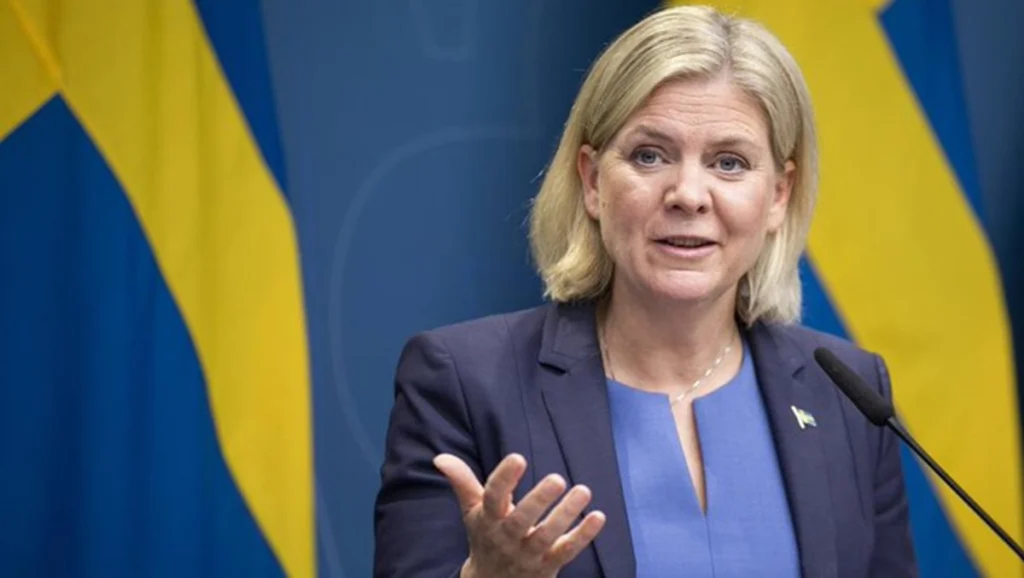
She said that several rounds of voting might be needed before a new government could take office.
On Thursday, Sweden’s parliament rejected Social Democratic Party leader Magdalena Andersson’s nomination as new prime minister (PM), prolonging a political deadlock over government formation following last month’s general election.
RELATED:
Sweden’s SDP Leader Andersson Again Tasked with Forming Government
Andersson, who served as Sweden’s PM from 2021 to 2022, received 99 votes in favor and 248 against in the 349-member Swedish parliament, the Riksdag, according to Swedish Television (SVT).
Following the vote, Andersson told SVT that the Riksdag was facing a difficult situation and that several rounds of voting might be needed before a new government could take office.
The vote came after Parliament Speaker Andreas Norlen nominated Andersson on Tuesday to lead a single-party Social Democratic government, despite the failure of negotiations among four parties that together secured a narrow parliamentary majority in the September election.
The Social Democratic Party, Left Party, Green Party and Center Party won a combined 176 seats, but remain divided over the composition of a new government.
Coalition talks have been hampered mainly by disagreements between the Center Party and the Left Party, with the latter insisting on joining the government and securing cabinet posts, while the Center Party refuses to serve in the same government.
The Left Party, Green Party and Center Party all announced ahead of Thursday’s vote that they would oppose a single-party Social Democratic government.
Latest Sweden Novus Poll modelled out
🌹S: 95 seats (-4)
🔵M: 88 seats (+18)
🟡SD: 66 seats (+4)
🔴V: 27 seats (-3)
🍀C: 25 seats (no change)
🟢MP: 24 seats (+2)
💙KD: 24 seats (+2)
🟦L: 0 seats (-19)🌹S Minority Government
(+/- change from 2026 election) https://t.co/hFkLexQoK7 pic.twitter.com/ZrfTVwgL1q
— Poliwave Europe (@PoliwaveEU) October 15, 2026
On Tuesday, Andersson acknowledged that although progress had been made in coalition negotiations, conditions were still not in place to form a government capable of securing sufficient parliamentary support.
The former PM was first tasked with exploring the formation of a new government on Sept. 18, after outgoing PM Ulf Kristersson requested to be relieved of his duties following the election.
However, she returned the mandate on Sept. 28 after the Left Party backed the Moderate Party’s candidate rather than the Social Democratic Party’s candidate in the parliamentary speaker election. Norlen subsequently reassigned her the task in early October, but negotiations remained inconclusive.
Under Sweden’s system of negative parliamentarism, a PM candidate can take office unless at least 175 of the 349 lawmakers vote against the nomination.
Following Thursday’s rejection, Norlen will have to put forward another candidate. Under Sweden’s constitution, if parliament rejects four proposed PM candidates, an extraordinary election must be held.
teleSUR/ JF
Source: Xinhua
From teleSUR English via This RSS Feed.