

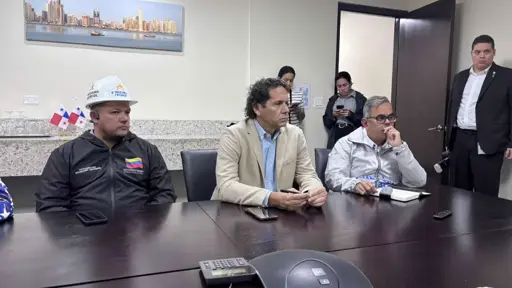
Caracas (OrinocoTribune.com)—A Venezuelan delegation of 34 specialists has arrived in Panama in order to help assess damaged infrastructure, following the earthquake that hit on October 9. The mission will initially focus on schools in the four hardest-hit provinces.
Panamanian Deputy Foreign Affairs Minister Carlos Hoyos received the specialists at Tocumen International Airport this Tuesday, October 13. According to Panama’s Foreign Affairs Ministry, they will determine whether affected schools can be used safely and assist with assessments of roads and bridges. Their expertise also includes inspecting structures at risk, managing debris, and restoring services.
The delegation is headed by Public Works Minister Juan José Ramírez and Transport Minister Francisco Garcés, president of the Presidential Commission for the Habitability Assessment of Housing and Infrastructure. Venezuela’s Foreign Affairs Ministry confirmed that the team will provide technical support for emergency response and recovery.
Delegación del Gobierno Bolivariano se encuentra presente en Panamá, llevando la solidaridad de Venezuela al pueblo panameño tras el sismo registrado el pasado viernes 9 de octubre.
Por instrucciones de la presidenta Delcy Rodríguez, nuestra delegación de especialistas y… pic.twitter.com/OJqMraka9P
— Ministerio de Comunicación e Información (@mippci_ven) October 14, 2026
Later on Wednesday, the Venezuelan delegation presented the Dignified and Safe Clearance Plan at Panama’s Government Palace. Led by Minister Ramirez and Garcés, the presentation covered rapid-response protocols and structural assessment methods used in Venezuela following the June 24 double earthquake.
According to Venezuela’s Communication Ministry, the specialists proposed methods for safely removing debris and restoring conditions that would allow residents to return to affected areas. Panamanian authorities expressed particular interest in applying this experience to protect schools and essential public services, extending the cooperation beyond inspections to the planning of recovery operations.
The deployment followed a telephone conversation on Sunday, October 11, between Venezuelan Acting President Delcy Rodríguez and Panamanian President José Raúl Mulino. Rodríguez reaffirmed Venezuela’s willingness to assist, stating that solidarity and cooperation between the two peoples should prevail in adversity.
The assistance reciprocates Panama’s support after the June 24 double earthquake in Venezuela. Panamanian urban search-and-rescue personnel and canine teams participated in operations in the affected areas.
Hundreds of schools affected
The earthquake struck near Pitaloza Arriba in central-southern Panama at 12:56 p.m. on Friday, October 9. The US Geological Survey’s updated ShakeMap lists its magnitude as 7.7. It prompted evacuations and a temporary tsunami alert, which has now been lifted. Panama declared a state of emergency the following day; authorities reported 27 people injured and no deaths attributed to the earthquakes at that stage.
The absence of a death toll did not mean Panama escaped serious disruption. In its October 12 update, the National Civil Protection System (SINAPROC) reported 619 schools with varying degrees of damage, including collapsed facilities, and 598 people accommodated across 14 shelters so far.
Veraguas alone recorded 420 affected residences and 22 damaged health facilities, while Coclé reported damage to 318 residences. In Los Santos and Herrera, damaged roads, bridges, and landslides left communities cut off. Water infrastructure was also affected, including two collapsed tanks in Chiriquí.
Tocumen airport further temporarily suspended flights before reopening, while the Panama Canal reported normal operations.
Misleading earthquake comparisons
The disaster revived social media discussion among Venezuelans comparing Panama’s damage and casualty figures with those of June 24. Some comparisons treated similar magnitudes as evidence that the earthquakes should have produced similar consequences. However, magnitude measures the size of an earthquake; the disruption and damage at a particular location also depend on the rupture, distance, ground conditions, and the characteristics of buildings.
Venezuela experienced a seismic doublet: two large, shallow earthquakes, of magnitudes 7.2 and 7.5, separated by approximately 39 seconds. A report by the Mexican Society of Earthquake Engineering associates them with the Boconó–San Sebastián–El Pilar fault system along the boundary between the Caribbean and South American plates. The second powerful movement struck structures that could already have been weakened by the first.
The report identifies additional factors in the Venezuelan disaster: the densely populated coastal and metropolitan corridor, Caracas’ sedimentary basin, and soft deposits along the central coast that can amplify shaking. In La Guaira, water-saturated coastal deposits and steep adjacent slopes also create conditions susceptible to ground deformation and slope instability. These mechanisms require site-specific investigation; they cannot be inferred from magnitude alone.
Panama’s epicentral area was comparatively sparsely populated and distant from the capital. Its terrain is also varied: before the earthquake, researchers at the Technological University of Panama had warned about unstable building sites, informal construction, corrosion, and inadequate maintenance. Geological conditions and construction quality must therefore be examined together in both countries.
Misleading footage further confused the online discussion. A verification published on October 13 identified videos from Venezuela’s June earthquakes circulating as images of the Panama disaster, alongside footage from Mexico and Colombia.
Venezuelan experience
Following the June earthquakes, Venezuela organized inspection brigades involving universities, the College of Engineers, and public institutions, with training in post-earthquake assessment and priority inspections of hospitals, shelters, and emergency facilities. Garcés coordinated this work through the presidential habitability commission.
Panama’s education authorities have now explicitly acknowledged the value of that experience. Deputy Education Minister Delia Marcela Herrera said the Venezuelan specialists would help accelerate the response. The mission also gives practical expression to Chavista solidarity through the exchange of technical knowledge needed to protect affected communities.
Special for Orinoco Tribune by staff
OT/JRE/AU
From Orinoco Tribune via This RSS Feed.