

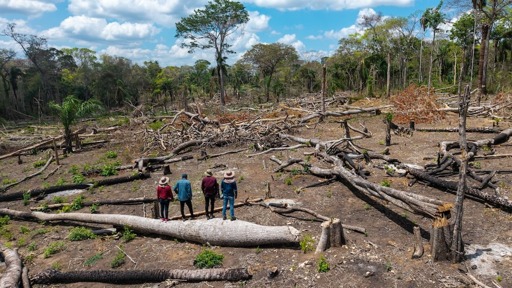
For most Indigenous peoples in the Bolivian Amazon, the forest is far more than a collection of trees. It is the casa grande, Spanish for “the main house”, where communities, rivers, wildlife, spiritual beings and ancestral memories coexist. For them, conserving the forest means conserving life itself. Yet data analyzed by Amazonía Traficada (Trafficked Amazon) — a journalistic collaboration backed by the Pulitzer Center in partnership with Mongabay, Bolivian independent environmental journalism platform RAI Bolivia and the multiplatform newsroom Asuntos Centrales — show that this casa grande is now under siege. According to the analysis, between 2003 and 2023, more than 186,500 hectares (460,900 acres) of forest were cleared across the 48 Indigenous territories of the Bolivian Amazon basin — an area nearly three times the size of Madrid. Of that total, the Bolivian Authority for the Supervision and Social Control of Forests and Land (ABT) authorized only 10%; the remaining 90%, or 168,670 hectares (416,800 acres), was cleared illegally. For Rivelino Segundo, leader of Isoso — the Bolivian Indigenous territory with the largest area of illegal forest clearing, more than 43,000 hectares (106,000 acres) — the deforestation eating into ancestral lands is directly tied to land invasions and an expanding agricultural frontier. Those occupying the land illegally seek to convert forest into farmland, he told Mobgabay: “We are not the ones clearing the land. It is the invaders. [In Isoso], they do it to plant large-scale soy. We, as the Guaraní Indigenous people, coexist with nature.” These findings stem…This article was originally published on Mongabay
From Conservation news via This RSS Feed.