

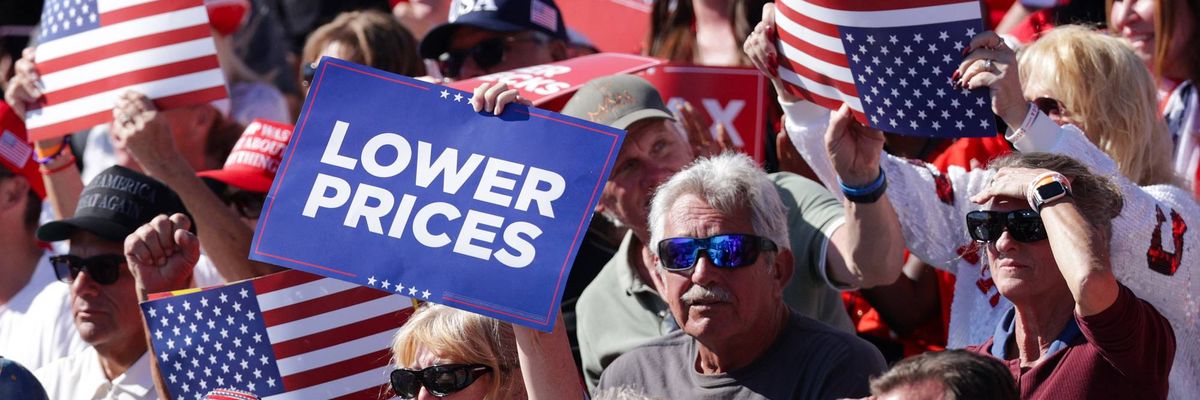
President Donald Trump attempted to spin high oil prices as a boon for the United States at a rally in Arizona on Wednesday, just hours after new federal data showed that inflation reached its highest level in months in September.
“Because of the price of oil, Texas and Oklahoma and North Dakota and all these places, we’re making a fortune,” Trump declared, referring to states that produce large amounts of crude oil. Those states are home to major fossil fuel companies that have reported windfall profits amid Trump’s illegal war on Iran.
Trump insisted that gas prices—currently at an average of $4.33 per gallon for regular gas and $6.32 for diesel—would tumble once the Iran war ends, but his administration has repeatedly given false timelines for the deadly conflict and has shown no indication that it is willing to reach a lasting diplomatic agreement.
Trump, who has profited massively from his second term in the White House, is a major investor in oil and gas companies. According to one recent analysis, the president’s investments in fossil fuel stocks have boosted his net worth by up to $15.5 million since January.
Working-class Americans, meanwhile, are struggling to make ends meet as high gas prices compound a broader affordability crisis that extends to food, housing, and other necessities. A tracker maintained by the Watson School of International and Public Affairs estimates that American consumers have paid an extra $135 billion combined in fuel costs since the start of the Iran war—roughly $1,030 per household.
Wage growth has not kept up with inflation, which rose to an annualized rate of 3.7% last month.
“Workers are losing the race between wages and prices,” Elise Gould, senior economist at the Economic Policy Institute, wrote on Wednesday. “Nominal wage growth continues to decelerate as workers lose bargaining power at work. Workers simply don’t have the leverage to bid up their wages. Reduced leverage and higher prices translated into falling [year-over-year] real wages for six months in a row.”
“Workers have seen zero progress on affordability compared to January 2025,” Gould added. “Real wages are essentially stagnant as workers’ leverage has declined and prices have risen. It’s no wonder workers feel left behind in the current economy.”
A Harris poll published by The Guardian on Thursday shows that three-quarters of US voters are concerned about a recession, and a “vast majority of Americans agreed that there is an affordability crisis, including 96% of Republicans.”
From Common Dreams via This RSS Feed.