

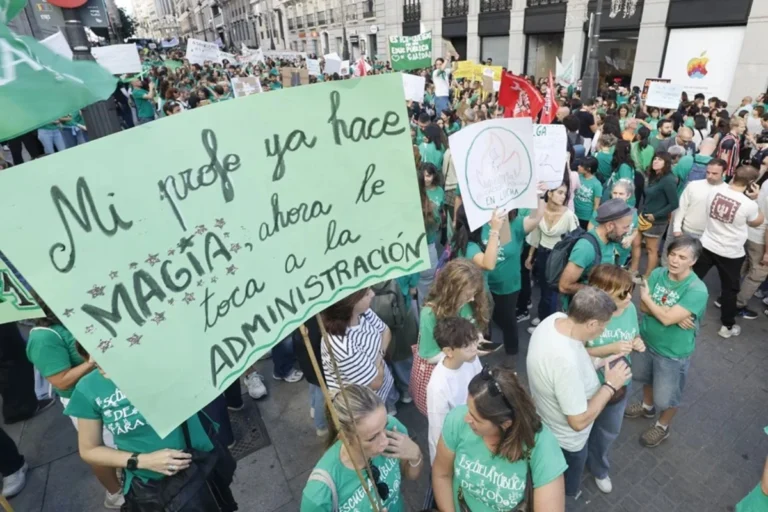
Thousands rally for better-funded public schools as a teachers’ strike in Madrid leaves two people injured and five students arrested.
Five students were arrested and two people injured during police confrontations in Madrid on Wednesday, as thousands of teachers and supporters took to the streets on the first day of a regional teachers’ strike demanding better funding, smaller classes and improved working conditions in public education.
RELATED: Marches in Spain Honor Maricarmen, the Evicted Woman Who Died Amid the Housing Crisis
Demonstrators wearing green gathered at Puerta del Sol before marching through central Madrid towards the regional Education Department. The protests targeted the education policies of regional president Isabel Díaz Ayuso, whom demonstrators accuse of weakening public schools by diverting taxpayer funds to private education and refusing to negotiate with teachers and parent associations, according to teleSUR correspondent Álvaro Fragua.
Police also confronted students at Madrid’s Complutense University during a demonstration in support of the strike. Two people were taken to hospital with injuries. Five university students and a woman participating in a separate demonstration in central Madrid were arrested. No further arrests had been reported at the time of the report.
Text Reads: 📚 Non-university teachers in the Community of Madrid, Spain, began an indefinite strike this Wednesday—called by trade unions—to demand better working conditions and more resources for quality public education. No end date has been set for the stoppage.
🧑🏫 Their demands include better conditions for teaching staff, increased resources for public education, smaller class sizes, and proper care for all students.
📢 Demonstrations have been organized for the initial days of the strike: a march from Atocha to Puerta del Sol this afternoon and a human chain on Thursday at the Department of Education.
Teachers said educational inequality was reflected in disparities between neighborhoods, arguing that children’s access to quality education depended on where they lived, with poorer communities bearing the greatest burden.
The strikers are demanding changes to class sizes, teaching workloads and specialist support for students with additional educational needs. Their proposals include capping classes at 13 students in early childhood education, 15 in primary school, 20 in secondary school, 23 in upper secondary education and 15 in vocational training.
They also want weekly teaching loads limited to 17 periods for secondary school and vocational training teachers and 22 for primary school teachers. The proposed limits would include tutoring, department leadership and coordination duties.
Improving support for students with disabilities and other educational needs is another central demand. Teachers are calling for at least one guidance counselor for every 250 students, one community services professional at each school, one therapeutic education teacher for every eight students and one speech and language specialist for every 12. They also want a compensatory education teacher at every school and additional staffing guarantees for special education.
On pay, the strikers are seeking a €600 monthly increase in the regional general teaching supplement, along with pay parity for vocational training teachers and specialists in community services, therapeutic education, and speech and language support. They are also demanding a special allowance for hazardous working conditions in special education and at least one full-time administrative assistant at every school.
The demands extend to school infrastructure and workplace safety. Teachers want a comprehensive, sustainable climate-control plan for schools, the removal of asbestos, an end to phased construction of public schools and stronger occupational health and safety measures. They are also calling for an equity plan to ensure adequate support for students facing socioeconomic hardship, those with special educational needs and other vulnerable groups.
Teachers announced a larger demonstration for Wednesday afternoon, with a march planned from Atocha to Puerta del Sol, where people were continuing a protest camp in support of the public education movement. The strike’s first day brought demands for changes to staffing, funding, pay and school conditions alongside opposition to the regional government’s education policies.
From teleSUR English via This RSS Feed.