

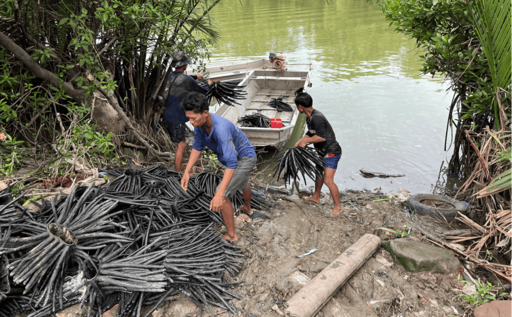
Residents of Phra Samut Chedi, one of Thailand’s most erosion-prone districts, have long struggled against coastal erosion. It’s located in the muddy heart of the Chao Phraya River Delta, where Bangkok’s major watercourse empties into the Gulf of Thailand. Here, roughly 20-60 meters (about 66-200 feet) of land is claimed by the sea annually, eating into farmland and forcing families to relocate their homes. However, a new study suggests a new coastal defense system based on artificial mangrove roots could offer struggling communities some respite. Trialed at 11 sites in Phra Samut Chedi and other parts of Samut Prakan province over 15 months, the nature-inspired system encouraged a varying amount of sediment deposition at 10 of the sites, according to the study published in Ocean & Coastal Management. Success varied by site, ranging from 16-88 centimeters (6-35 inches) of sediment retention, depending on localized conditions. By helping stabilize the shoreline, the researchers say the system could potentially function as an effective hybrid nature-based solution — a mechanism whereby engineered or “bioinspired” structures work in consort with natural ecological processes, such as mangrove restoration. Butsawan Bidorn, senior author of the study and an assistant professor of coastal engineering at Chulalongkorn University in Bangkok, said the dynamic nature of the Chao Phraya Delta means rapid and accessible solutions are key. “Aquaculture farmers sent us a video of the waves hitting their dikes,” Butsawan told Mongabay in an interview. “By the next day, the dike had collapsed and they’d lost everything. They need…This article was originally published on Mongabay
From Conservation news via This RSS Feed.