

This article by Anahí Del Ángel originally appeared in the October 13, 2026 edition of Contralínea, Mexico’s leading investigative journalism magazine.
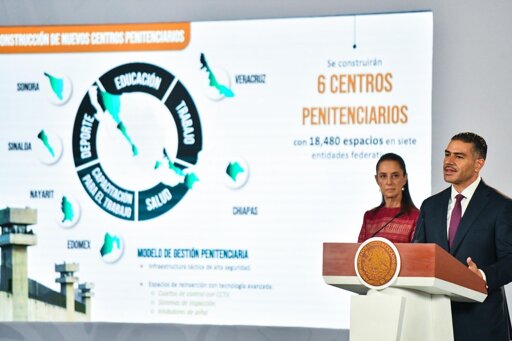
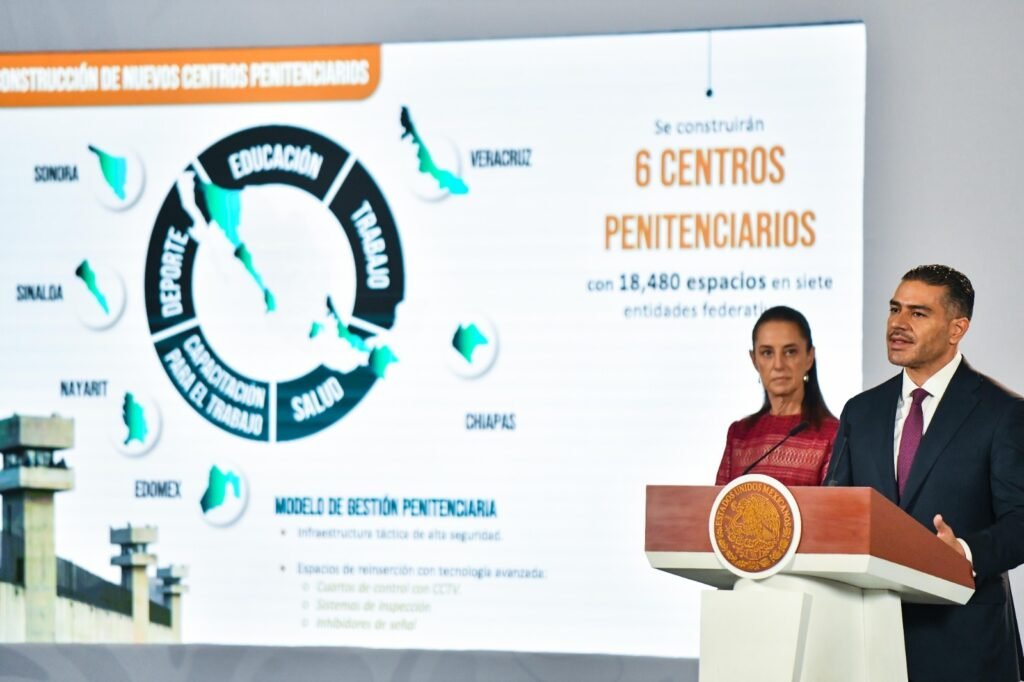
The federal government will support six states of the Republic, Sonora, Sinaloa, Nayarit, the State of Mexico, Chiapas, and Veracruz, in the construction of a prison in each state to reduce overcrowding, announced President Claudia Sheinbaum Pardo, who assured that the new facilities “will not be operated by private companies.”
During her morning press conference on October 13, the president explained that the decision to provide economic resources to the state governments responds to two reasons: respect for the human rights of persons deprived of liberty and reasons of security, since overcrowding makes it difficult to control prisons when the same number of guards is maintained.
She also linked the saturation of some prisons with the arrests carried out during her administration, so she considered it necessary to expand the infrastructure. The security report presented during the conference reported 70,500 arrests for high-impact crimes, from October 2024 to September 2026.
The head of the federal Executive emphasized that the new centers will have a model oriented toward social reintegration and will be operated by the federal Secretariat of Security and Citizen Protection (SSPC) or by the state Security Secretariats.
For his part, the Secretary of Security and Citizen Protection, Omar García Harfuch, detailed the measures adopted in the area of prison security on the president’s instructions.
In the case of Sinaloa, in light of the recent events at the Mazatlán Penitentiary Center, he noted that Sheinbaum instructed that priority be given to the construction of a new prison with federal resources. The complex will have a projected capacity for 2,640 people, modern infrastructure, better surveillance systems, and the personnel necessary to strengthen its operation and control.
While the project is carried out, the Mazatlán Penitentiary Center remains reinforced with members of the National Guard and SSPC personnel assigned to the Decentralized Administrative Body for Prevention and Social Readaptation.
Among the security actions, García Harfuch mentioned the strengthening of surveillance, supervision, and control in federal social reintegration centers to maintain order, prevent criminal activities, and improve security conditions for both persons deprived of liberty and prison staff.
As he explained, from October 1, 2024 to September 30, 2026, 3,275 transfers of persons deprived of liberty were carried out to reduce risks and strengthen prison control, in operations conducted by the decentralized administrative body, in coordination with the National Guard.
He highlighted the carrying out of nine operations in Sinaloa, conducted by personnel of the National Guard and the SSPC, through which 636 persons deprived of liberty were transferred to various federal social reintegration centers.
García Harfuch also reported that, in coordination with state authorities, 614 transfers from local prisons were carried out to address risk situations and strengthen security.
In the same period, 10,513 ordinary inspections and 31 extraordinary operations were carried out, in which more than 306,000 prohibited objects and substances were seized to prevent their use inside the prisons.
He added that emergency codes in federal prisons decreased by 35 percent compared to the previous period, with a reduction in incidents related to fights, assaults, threats, and other risk situations.
He also reported that the capabilities of the federal prison system were strengthened with the addition of 1,192 new personnel and the creation of a prison reaction unit to address risk situations and support the states.
The official noted that this increase in personnel is part of the security strategy promoted by President Claudia Sheinbaum since the beginning of her administration. As part of the strengthening of other institutions, he mentioned the 36 percent increase in the force strength of the National Intelligence Center and a 60 percent increase in the personnel of the Financial Intelligence Unit.
In parallel, he indicated that the federal government is promoting technological modernization and infrastructure improvement projects at the Altiplano federal center and at federal prisons in Veracruz, Durango, and Sinaloa.
In this context, he explained that work is underway on a new national prison management model that contemplates, in addition to expanding infrastructure, improving security protocols, professionalizing personnel, and modernizing administration, surveillance, and control procedures.
-
Mexico Increases Seizures of Drugs and Money
October 14, 2026
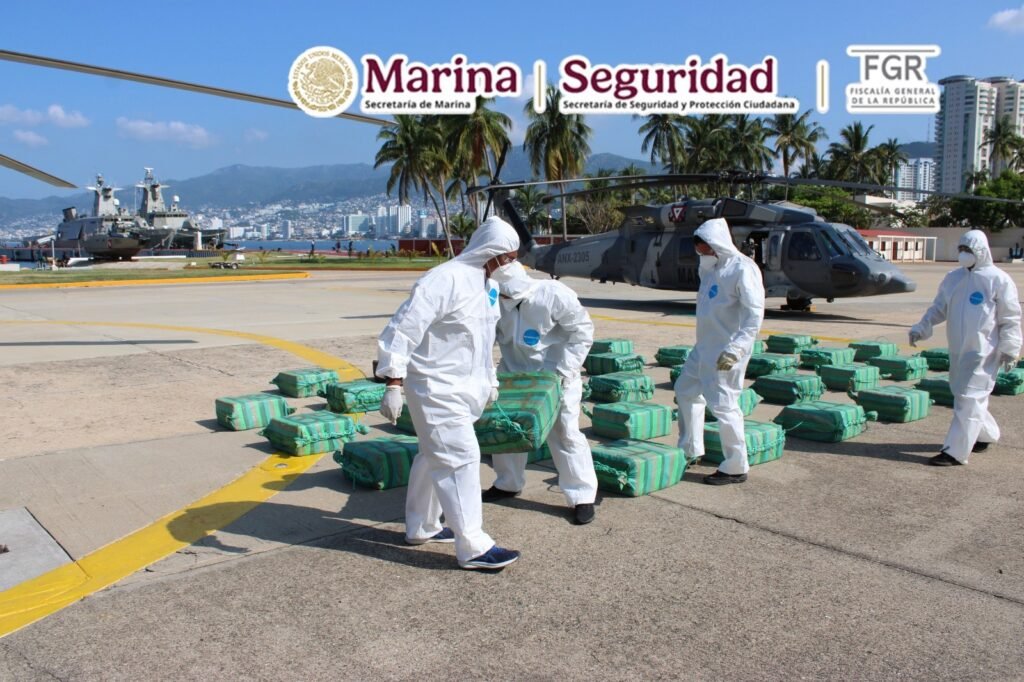
The government’s second report lists 70,500 arrests, 569 tons of drugs seized and higher customs revenue, countering Washington’s claim that Mexico must do more.
-
New State Prisons “Will Not Be Operated by Private Companies,” Sheinbaum Says
October 14, 2026
The federal government will fund a prison in each of six states to ease overcrowding, with priority for Sinaloa after recent events at the Mazatlán prison.
-

People’s Mañanera October 14
October 14, 2026
President Sheinbaum’s daily press conference, with comments on child online safety, Sembrando Vida, housing, IMSS workers, Jalisco, and misinformation.
The post New State Prisons “Will Not Be Operated by Private Companies,” Sheinbaum Says appeared first on Mexico Solidarity Media.
From Mexico Solidarity Media via This RSS Feed.