

Cuba’s foreign minister accused Washington on Wednesday of coercing several governments to change their votes on a United Nations resolution against the six-decade U.S. blockade, days before the General Assembly is set to consider the measure.
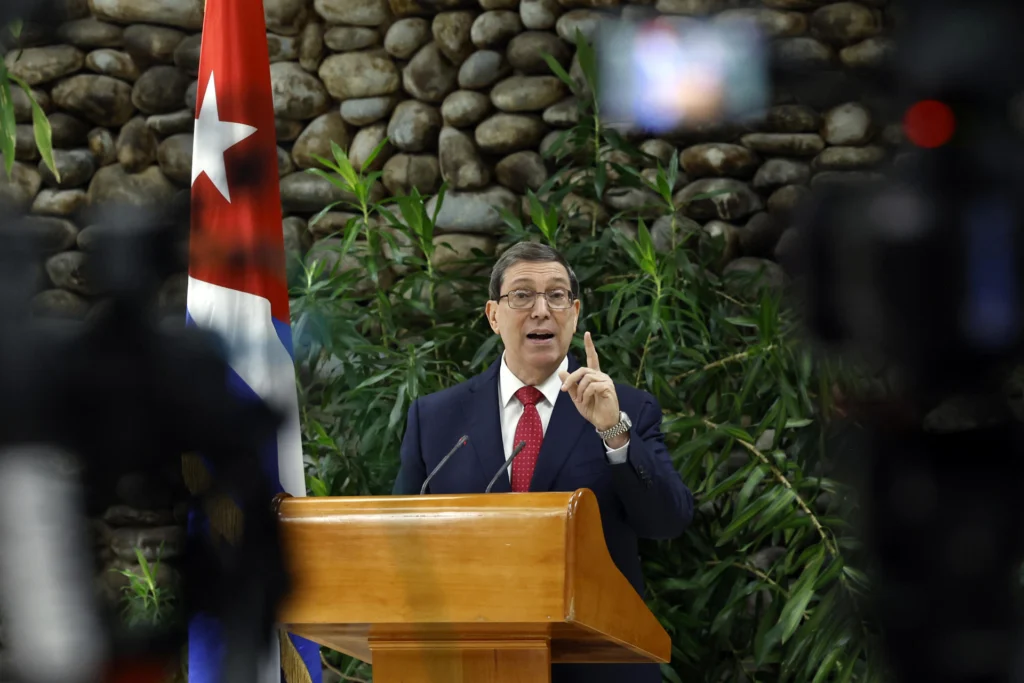
The Minister of Foreign Affairs of Cuba, Bruno Rodríguez Parrilla, denounced this Wednesday that U.S. Secretary of State, Marco Rubio, is exerting pressure on several countries to change their position in the vote on the resolution against the U.S. blockade of the island, scheduled for the end of this month at the United Nations General Assembly.
Cuban FM Bruno Rodríguez Parrilla pointed directly at Secretary of State Marco Rubio. In a post on X, the Cuban diplomat wrote that Rubio, “nervous and anxious in the face of another new defeat at the United Nations, is pressuring and blackmailing heads of State and government of several countries to change their vote against the blockade in the UN General Assembly.“
RELATED: Cuba President Diaz-Canel Denounces U.S. Blockade at World Food Forum
On October 29, the General Assembly will discuss and vote on a resolution calling for the lifting of the economic, commercial and financial blockade imposed by Washington on Havana.
Cuban top diplomat framed the campaign as an attempt to erase accountability. He said Rubio, with his “repeated lies and new actions,” seeks to “silence the act of collective punishment he is committing against the Cuban people and make the rest of the international community complicit in this barbarity.”
The US Secretary of State is nervous and anxious in the face of a new defeat at the United Nations. He is putting pressure on and blackmailing Heads of State and Government from several countries so that they change their vote against the blockade at the UN General Assembly.… pic.twitter.com/t33OSSBI84
— Bruno Rodríguez P (@BrunoRguezP) October 14, 2026
The allegation arrives after months of tightening measures. The updated report Cuba presented to the UN in September places the economic damage between March 1, 2025 and February 28, 2026 at more than $8 billion, precisely $8,083,300,000, a 7 percent rise over the prior period.
That report covered only the first month of the U.S. oil blockade, ordered by an Executive Order signed on January 29. The restriction has obstructed fuel deliveries to the island throughout 2026, deepening an energy crisis and striking hard at production, transport, health services and water supply.
Six Decades of Damage
The accumulated toll runs far higher. More than sixty years of the blockade amount to over $178 billion at current prices, a figure of $178,700,500,000 that represents a 4.7 percent increase since the last report in 2025.
Once the oil blockade took effect, several vessels changed course to other ports as they approached Cuba, their original destination. More recently, Washington has intercepted and seized smaller fuel shipments bound for the island. Cuban authorities have denounced those operations as “piracy and pillage.”
The diplomatic record reflects broad opposition to the policy. In July, Cuba requested a special session at the UN to denounce the latest U.S. measures, winning 136 votes in favor, nine against and thirty abstentions.
In September, the UN Human Rights Council examined the report produced by special rapporteur Alena Douhan after her official visit to Cuba in November 2025. UN experts have separately condemned the siege against the island while Washington has imposed further sanctions.
FM Rodríguez Parrilla has argued that the report’s figures understate the current pressure, since the data closed in late February, just one month into the oil sanctions. The full cost of a year in which fuel shipments were diverted or seized has yet to be measured.
Cuba is expanding solar energy⚡️, installing new photovoltaic parks and investing in renewable power to strengthen its energy independence.
Despite the challenges of the U.S. blockade, Cuba🇨🇺keeps working toward a more sustainable, resilient energy future.#CubaIsNotAThreat pic.twitter.com/hlX3JHtBGM
— Cancillería de Cuba (@CubaMINREX) October 14, 2026
The October 29 vote will test whether Rubio’s pressure campaign shifts any position. For decades the General Assembly has delivered near-unanimous verdicts against the blockade, a streak Havana expects to hold. What Cuba now warns against is not the policy itself, but the effort to make other nations silent partners in it.
From teleSUR English via This RSS Feed.