

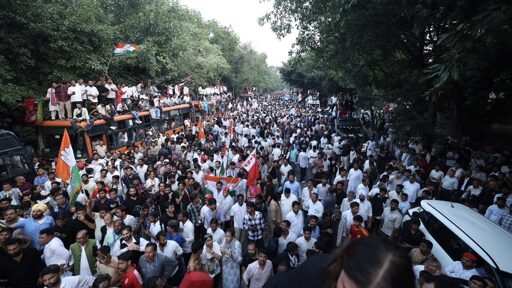

Thousands participated in a joint delegation of opposition groups in India who were attempting to meet the Chief Justice (CJI) of the country on Monday, October 12. The delegation sought to raise concerns over the alleged irregularities and fraud in the national and state level elections.
The police and security forces, yet again, tried to block the protesters from marching and used force to disperse them. The CJI refused to meet the delegation claiming the matter was subjudice.
Monday was the tenth consecutive day of the mass protests in the country which broke out on October 2, days after a newspaper report claimed the Chief Election Commissioner (CEC) Gyanesh Kumar violated rules and took arbitrary decisions on crucial matters related to electoral rolls revisions, or the so-called Special Intensive Revision (SIR).
Opposition parties of diverse ideological backgrounds have accused the CEC of manipulating the elections to help the ruling ultra-right-wing and Hindu-supremacist Bharatiya Janata Party (BJP) to win crucial state elections. and have been demanding Kumar’s removal.
The opposition is also demanding the end of the SIR process and the re-inclusion of over 130 million voters whose names have been removed from the electoral rolls in various states depriving them of their right to vote, a fundamental right in the Indian constitution.
The BJP and CEC Gyanesh Kumar have refuted the charges, claiming the allegations were based on superficial assumptions.
Massive crackdown over the weekend
The Indian government suspended all major routes to the capital, Delhi, suspending hundreds of trains on Saturday, October 10, in order to prevent people from reaching the capital to participate in a scheduled protest called by the Cockroach Janata Party (CJP), a youth movement which emerged earlier this year, and several left groups, over the issue.
The authorities also closed down all major metro stations in the city and imposed sections of the law which disallow any gathering of people, literally shutting down the city.
The security personnel detained thousands of people from various corners of the city, from their homes and even from moving trains and other vehicles to prevent them from participating in the protests.
All members of the Central Committee of the Communist Party of India (Marxist), including its General Secretary M A Baby and formal Chief Minister of Kerala Pinarayi Vijayan, were forcefully detained after they tried to march to the Jantar Mantar, the designated place for the protests.
They were kept in detention for hours before they were finally released in the evening.
Several protesters from the Student Federation of India (SFI), the All India Students Association (AISA), the Democratic Youth Federation of India (DYFI), and other student and youth organizations tried to breach the police fortifications.
However, most of them were detained by the police during the effort. They claimed they were beaten up by the security forces, with hundreds of videos circulating on social media showing them being manhandled.
Some journalists also accused the security forces of trying to prevent them from reporting. They claimed they were beaten up and their cameras and mics were broken by the police and thugs belonging to the ruling party.
On Sunday, several young leaders, mostly women, from the left-wing organizations, such as the SFI, AISA, the All India Students Federation (AISF), and some Members of the Parliament (MP) from the left parties, like the CPI (M), and the Communist Party of India (CPI), were injured after the police attacked them during the protests.
The crackdown on protesters has invited strong reactions and solidarity from the International Peoples Assembly (IPA) and several left and progressive forces from across the world.
“India’s youth has risen to defend the right to vote itself” because “if a citizen is quietly erased from the voter list, democracy becomes a facade,” the IPA said in a statement issued on Sunday. It also demanded the end of state repression against the peaceful protesters.
Youth in defense of democracy
Talking to BreakThrough News, several youth leaders claimed the objective behind the movement against the rigging in elections is a movement to protect democracy and the basic rights of the people.
They asserted that they will not stop until Gyanesh Kumar is sacked and all the irregularities in the election process are corrected. Under the authoritarian administration, manipulation in elections is now eroding the small remaining democratic voice the people have in the country, they said.
They also questioned the authority of the government to block people’s right to protest, claiming the immunity provided to the security forces to attack the students, youth, and opposition party leaders trying to raise their voice against the injustice confirms that the BJP and its leadership has no commitment to democracy.
Mrityunjay, secretary of the Delhi state DYFI said one should not look at alleged irregularities as just affecting the rights of a section of society. In India the right to vote is linked to several social security benefits for poor and working class people. Once they lose their right to vote they may lose crucial welfare benefits.
The fact that the majority of those who have been deleted from the electoral rolls are from poor and working-class communities makes the fight for free and fair elections a fight for social justice and equality.
Rikta, another leader of the DYFI, claimed that the youth movements see the fight against the CEC as a fight to retain faith in the constitution and democratic processes in India. She claimed that the BJP has never believed in democracy and that is the reason they are so indifferent to the popular resistance against their policies so far.
However, the left and democratic forces in the country have decided to go till the end so that the BJP and people like Gyanesh Kumar never dare to manipulate the popular mandate again and learn to respect dissent, Rikta told BreakThrough News.
From BT News via This RSS Feed.