

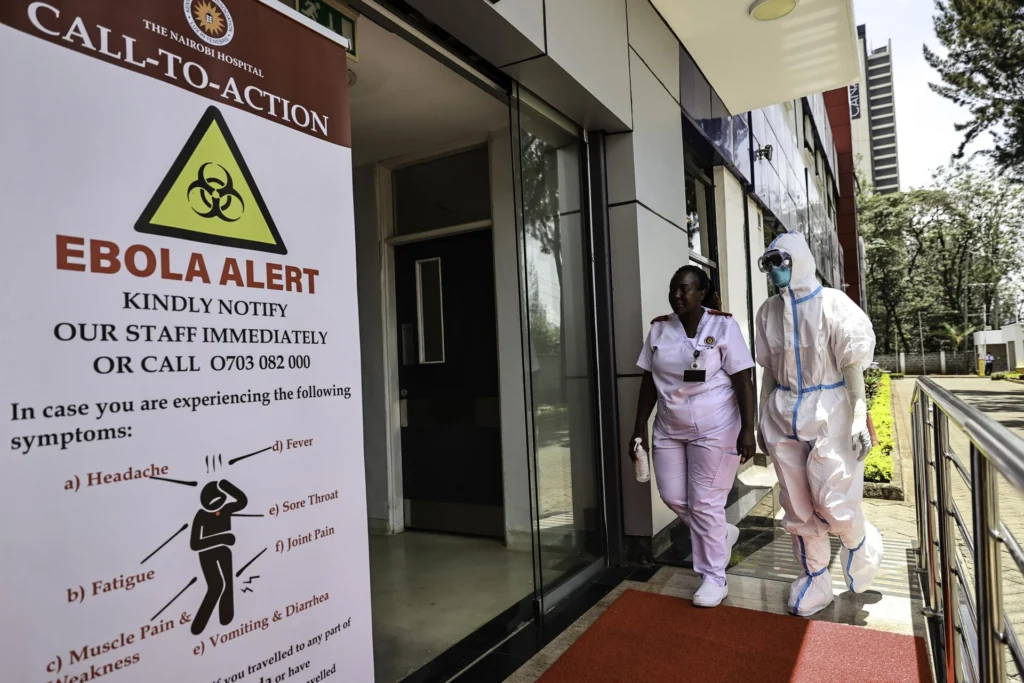
Kenya announced a second Ebola case on Wednesday, a relative of the country’s first patient, but said it has detected no large-scale spread of the virus, according to a Health Ministry statement.
Kenya confirmed its first imported case: a Kenyan citizen who traveled from DR Congo through Ugandan territory before dying in Nairobi. On Wednesday, Kenya’s Health Ministry confirmed a second case after relatives of the first patient tested positive while in quarantine.
The second case also emerged from within the quarantined group, which means the patient was being monitored before symptoms appeared.
RELATED: W.H.O. Warns of Ebola Spread to New Territories in DR Congo
The Ministry detailed that the second patient, a 39-year-old man, is a relative of Kenya’s first Ebola case and developed symptoms on Tuesday. He was among the people placed in quarantine after the first case was identified. The agency said early detection of the infection “improves his chances of recovery” and that the two cases are linked.
.@MOH_Kenya identified a second case of #Ebola caused by Bundibugyo virus, a close contact of the first patient, who has already been in quarantine. This shows that surveillance and contact tracing efforts are working. He has been receiving supportive clinical care since the…
— Tedros Adhanom Ghebreyesus (@DrTedros) October 14, 2026
The first patient, a 40-year-old Kenyan, had been living in Congo, where he fell ill and received treatment at two health centers, according to the ministry. He traveled through three Ebola-affected provinces before leaving the country and arriving in neighboring Uganda on October 1. He then flew to Kenya, where a relative picked him up at the airport and drove him to a hospital. He began receiving treatment and tested positive for Ebola on October 5. He died the same day.
Since then, the Ministry has identified 128 contacts of the first patient. Of these, 113 were located and 108 were placed in quarantine in Kenya, while fifteen contacts have not yet been located. Five of the contacts are abroad, and the health authorities of those countries have been notified, the Ministry said. In this sense, the Ministry stressed that “early” detection increases the chances of recovery and limits the risk of transmission. It said there has been no large-scale spread of the virus in the country.
Kenya has strengthened controls at border crossings and airports since detecting its first case, and has urged the public to report suspected infections through an emergency telephone line, according to earlier reports on the ministry’s response.
Health authorities in the region, including the World Health Organization, have warned of a continuing risk of cross-border spread because of the constant movement of people. Uganda, which reported about 20 cases earlier this year, declared itself free of the disease in August. Whether more of the quarantined contacts test positive in the coming days will determine how contained the situation is in Kenya.
The cases come as the outbreak in the Democratic Republic of Congo, caused by the Bundibugyo strain, has surpassed 9,000 confirmed cases, according to Congolese health authorities. The World Health Organization has warned of a continuing risk of cross-border spread because of constant movement of people in the region.
The National Institute of Public Health of the Democratic Republic of Congo confirmed in its most recent epidemiological report that “the total number of cases of Ebola infection has exceeded the 9,000-case barrier.” The official data updated to this October 14 reveal that “the number of positive cases totaled 9,144 registered and confirmed”, while “cumulative deaths rose to 4,410 people due to the disease.”
Ver esta publicación en Instagram
Una publicación compartida de teleSUR English (@telesurenglish)
No Vaccine Available
The outbreak is caused by the Bundibugyo strain of the virus and began to spread rapidly after it was officially declared in May. Local medical teams and health agencies are struggling to curb community transmission across multiple critical hotspots in the country, according to the report.
Health experts say the situation is made harder by the absence of approved vaccines and specific drug treatments for this variant, which limits clinical options in affected health centers.
Regional health authorities warned that the impact of the outbreak has crossed national borders, creating what they called a regional crisis in Africa. They cautioned that, if not contained, the outbreak could spread beyond its current boundaries. The World Health Organization (W.H.O.) has warned of an ongoing risk of cross-border spread because of constant movement of people in the region.
Uganda reported about 20 cases and two deaths earlier this year, but its health authorities declared the country free of the disease in August.
Globally, the epidemic is the second-largest on record, behind only the 2014-2016 West Africa outbreak, which according to W.H.O. statistics affected more than 28,600 people and killed more than 11,000 in Guinea, Liberia and Sierra Leone. Recent reports from specialized agencies continue to add dozens of new infections each week in the hardest-hit provinces.
Experts note that containing outbreaks of this kind has historically required large financial resources, specialized logistics and close cooperation between affected governments. Without effective vaccines for this strain, and with high population mobility, mitigation efforts remain difficult.
From teleSUR English via This RSS Feed.