

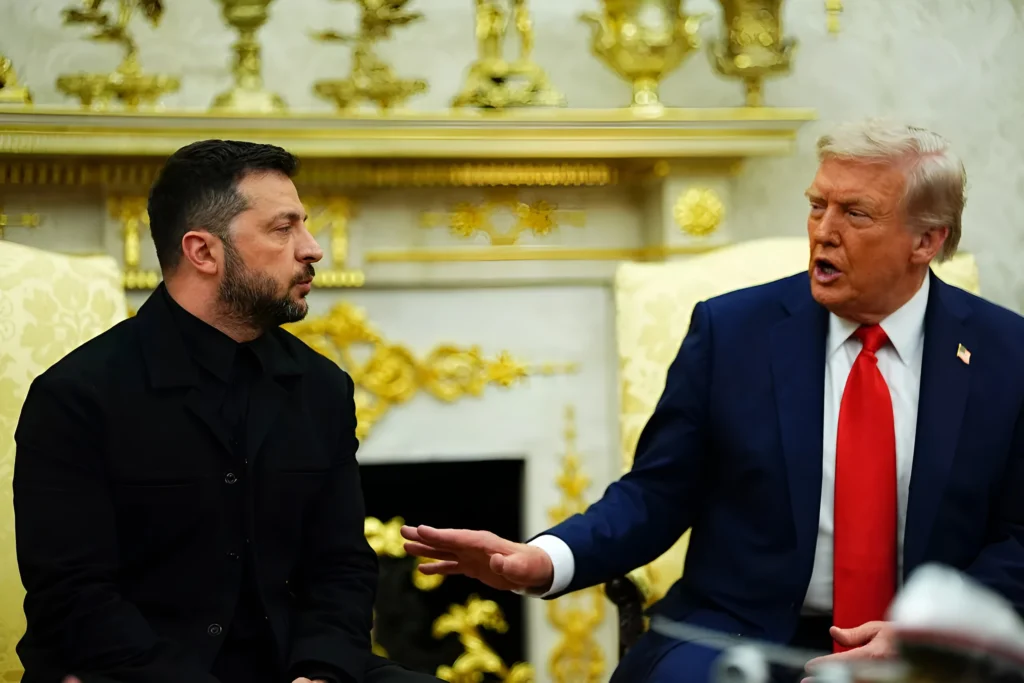
Zelensky insists only Ukrainians decide and offers a 60-day ceasefire for elections
Diplomatic and political relations between the United States and Ukraine have reached an interesting juncture. The reported rift between U.S. President Donald Trump and Ukrainian President Volodymyr Zelenskyy reveals cracks in the coalition.
RELATED:
Russia-U.S. Diesel Deal Is Unrelated to Ukraine Peace Plan: Peskov
Since before 2022, Western leaders have supported Kyiv as a way of defending democracy and sovereignty on a global scale. However, the conflict in Ukraine functions as a proxy war shaped by inter-imperialist rivalry, NATO expansion, and conflicting economic interests, a geopolitical struggle that has exacted a heavy human and financial toll on Ukraine.
Recent events show that Washington’s foreign policy is shifting away from open-ended military and financial commitments receiving unconditional backing. Kiev now faces public criticism, policy demands, and calls for political change from Washington.
Understanding the Trump-Zelensky rupture requires analyzing the structural factors that shaped U.S. influence over Ukraine long before the current war began.
U.S. Imperial Influence and Post-Soviet Interventionism
The foundation of U.S. influence in Ukraine was established long before the outbreak of full-scale war in 2022. Following the dissolution of the Soviet Union in 1991, the United States worked to integrate former Soviet republics into global capitalist frameworks.
Through international financial institutions such as the International Monetary Fund (IMF) and the World Bank, Ukraine received loans tied to economic structural adjustments. These programs required the deregulation of domestic markets, the privatization of state-owned enterprises, and cuts to social spending.
Washington also used state-funded organizations to shape Ukrainian domestic politics. Between 1991 and 2014, the U.S. government provided over $5 billion in assistance to Ukraine, as publicly confirmed by former Assistant Secretary of State Victoria Nuland. This funding aimed to steer Ukraine’s economic and foreign policy away from Russia and toward Western institutions.
The political transition of 2014 marked a major turning point in U.S.-Ukraine relations. High-level American officials played an active role in supporting the Euromaidan protest movement, which led to the removal of elected President Viktor Yanukovych.
By 2014, during the Obama administration, Vice President Joe Biden was designated as Washington’s key figure for managing policy toward Kyiv, visiting the country on multiple occasions to oversee anti-corruption reforms, energy policy, and financial administration.
After 2014, Ukraine’s economic orientation toward European Union moved away from historical trade ties with the Commonwealth of Independent States (CIS). Transition that caused Ukranian severe economic disruption.
Ukraine’s industrial base, centered in the eastern Donbas region, suffered significant output losses. Between 2014 and 2016, Ukraine’s Gross Domestic Product (GDP) shrank by nearly half in dollar terms, falling from approximately $183 billion in 2013 to under $93 billion in 2015, according to World Bank figures. Debt levels rose rapidly, forcing the country to rely on continuous financial aid from Western lenders.
Alongside economic adjustments, Western security institutions deepened their integration with the Ukrainian military. Between 2014 and 2021, the U.S. provided over $2.5 billion in defense assistance, including radar systems, anti-tank missiles, and naval patrol boats.
Joint military exercises, such as Operation Fearless Guardian and Rapid Trident, trained thousands of Ukrainian troops under NATO standards at the Yavoriv Combat Training Center. This long-term involvement turned Ukraine into a major security partner on Russia’s western border, setting the stage for future geopolitical conflict.
Zelensky on Trump:
If you’re in the middle, you have to stay in the middle, not on the wrong side.
I think Trump’s advisers are wrong. I don’t know who is pushing him to the wrong side.
This is not the right side of history. pic.twitter.com/RyMNITUUFY
— Clash Report (@clashreport) October 14, 2026
NATO Expansion and Washington’s Provocations
Following the end of the Cold War, successive U.S. administrations expanded NATO eastward toward the borders of the Russian Federation. This expansion occurred despite diplomatic assurances given to Soviet leadership in 1990 that the alliance would not expand eastward beyond a unified Germany.
NATO added fourteen new member states in several rounds of expansion between 1999 and 2020. At the Bucharest Summit in April 2008, NATO declared that Ukraine and Georgia would eventually become members of the alliance.
Moscow repeatedly defined Ukrainian NATO membership as a direct threat to its national security. Despite these warnings, Washington pursued an open-door policy regarding alliance membership.
Diplomatic agreements intended to resolve internal conflicts within Ukraine were systematically sidelined.
Between 2015 and 2021, Western military aid flowed into Ukraine to prepare its armed forces for high-intensity warfare. Annual combined defense spending by NATO allies reached over $1 trillion, outstripping Russian defense expenditure by more than ten to one.
By late 2021, Washington rejected Russian proposals for a mutual security treaty that requested a formal halt to NATO expansion and the withdrawal of foreign military infrastructure from Eastern Europe. The refusal to negotiate on NATO enlargement closed diplomatic pathways, accelerating the descent into armed conflict.
President Trump on Ukraine war: “Zelensky could’ve settled it many times, but he chose not to.” pic.twitter.com/mTn4uboLZY
— CSPAN (@cspan) October 10, 2026
Trump’s Pragmatic Realism and Criticism of Zelensky
The return in 2025 of Donald Trump to the U.S. presidency brought a shift in Washington’s foreign policy approach toward Ukraine. While the previous administration pursued an open-ended commitment to support Kiev, Trump adopted a transactional approach centered on domestic economic priorities. A change that disrupted long-standing diplomatic alignment between Washington and Kiev.
Tensions surfaced between Trump and Zelensky during their February 2025 Oval Office meeting. Trump criticized Ukraine’s strategic management of the conflict and questioned the scale of U.S. financial support.
Trump emphasized that American assistance would no longer be an unlimited resource, telling Zelensky that Kiev needed to negotiate a settlement or risk losing U.S. security backing.
Trump also criticized the economic war costs and their impact on global commodity markets. By mid-2026, military casualties on both sides reached an estimated two million, with millions of Ukrainians displaced internally and across Europe.
Trump pointed to these statistics to argue that continued fighting was unsustainable and detrimental to Western economic stability.
A major friction emerged over Ukraine’s military strategy of targeting Russian energy infrastructure. Since July 2026, Ukrainian drone attacks have hit several Russian oil refineries and technology hubs in regions such as Saratov, Ryazan, and Leningrad, as well as in Tatarstan.
Trump publicly condemned these strikes, stating that attacks on Russian fuel production exacerbated global energy shortages and drove up U.S. domestic diesel prices.
The U.S. Treasury Department subsequently issued temporary sanctions exemptions permitting Russian diesel exports to stabilize global supply.
When Zelensky criticized the exemptions as weakness, Trump warned that continued Ukrainian strikes on Russian oil infrastructure could result in a suspension of U.S. intelligence-sharing with Kiev.
Demands for Leadership Change and Diplomatic Strains
The diplomatic rift between Washington and Kyiv widened further following public disputes over regional energy policy. By October 2026, U.S. officials had negotiated temporary exemptions for Russian diesel exports in an effort to curb rising domestic fuel prices and alleviate the global diesel shortage.
Zelenskyy publicly rejected these exemptions, characterizing the agreements with Moscow on energy trade as a violation of Western policy.
In response to Kiev’s objections, Donald Trump publicly called for leadership changes in Ukraine. Speaking to reporters, Trump stated that Ukraine should select a new leader capable of negotiating a diplomatic resolution to end the conflict.
Trump argued that Zelensky had missed previous opportunities to secure a negotiated settlement with Russia, resulting in continued loss of territory and economic disruption.
Zelensky stated that leadership decisions in Ukraine belong solely to the Ukrainian electorate. However, Zelensky noted that organizing national elections during active military operations presents significant legal and logistical obstacles under current martial law provisions.
Zelensky proposed a condition for holding vote proceedings, stating that Washington and international partners must secure a total 60-day ceasefire from Moscow to guarantee security for voters and civilian infrastructure.
⚡️BREAKING: Zelensky Criticizes President Trump for Blaming him for the Rise in Diesel Prices
“They’re increasing because of the war in the Middle East, the blocking of the Strait of Hormuz. People have to hear reality. Don’t play games with people” pic.twitter.com/MBc8WHoiPf
— Iran Observer (@IranObserver0) October 11, 2026
Implications for the War and Global Power Dynamics
The political alliance established after 2014 between the U.S. and Ukraine was built on mutual strategic interests: Washington sought to project power eastward and contain Russian influence, while Kiev relied on Western capital and security aid to modernize its institutions and military forces.
However, the human and material costs of prolonged warfare have strained this arrangement. With military casualties exceeding two million and Western defense stocks under pressure, Washington has adjusted its political priorities.
The friction between Trump and Zelensky shows how peripheral security partners can become vulnerable when strategic or economic calculations of the power change.
A leadership transition in Kiev, whether through scheduled elections under a temporary ceasefire or political restructuring, would significantly impact the Ukrainian – Russian war.
A change in government could negotiate a formal cease-fire, but it also carries risks of internal political instability and reduced military coordination along the front line.
Sources: Xinhua – Al Jazeera – Al Mayadeen – Anadolu Agency – TRT World – RT – Brasil de Fato – Press TV – TASS – CGTN – BBC – DW – France 24 – EFE – TeleSUR
From teleSUR English via This RSS Feed.