

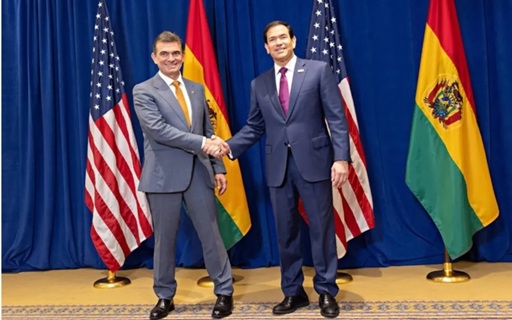
On Monday, September 28, the U.S. State Department revoked the visas of Bolivia’s Attorney General, Roger Mariaca, and twelve other current and former Bolivian officials, whom it accused of corruption and links to drug trafficking. Two nights later, masked police officers arrested Mariaca at Viru Viru Airport in Santa Cruz, along with the departmental prosecutor, Alberto Zeballos, while another group raided the Attorney General’s office in Sucre. The Public Prosecutor’s Office itself described the incident as “kidnapping.” Secretary of State Marco Rubio congratulated the Bolivian government for its “leadership,” and the fifteen countries of the Shield of the Americas signed a statement of support.
The Trump administration dictated who should be removed from the Attorney General’s Office, and Rodrigo Paz’s government carried it out in two days. Denouncing this does not mean defending Mariaca, who was a key figure in the judicial persecution of hundreds of activists during the May and June uprising. It means rejecting the idea that a foreign power should decide who leads the Bolivian Public Prosecutor’s Office.
Drug Trafficking Is the Pretext for Interference
Since Donald Trump returned to the presidency, the United States has openly intervened in Latin American countries. In every case, it uses the same argument: drug trafficking and “narco-terrorism” are a threat to the United States, and therefore its government claims the right to act in these countries.
In Venezuela, Trump launched a bombing campaign in 2025 against alleged drug-trafficking boats in the Caribbean and the Pacific, killing more than 200 people without trial or evidence. He then deployed warships off the Venezuelan coast, imposed an air blockade, and, on January 3, 2026, bombed Caracas and abducted Nicolás Maduro, whom he accuses of heading a cartel, the so-called “Cartel of the Suns,” which the U.S. justice system itself has declared does not exist.
In Ecuador, U.S. troops have been operating alongside the armed forces of Daniel Noboa’s government since March 3, 2026, against groups that Washington has declared “terrorist.” U.S. military personnel are stationed in the province of Esmeraldas, near the Colombian border, and a decree allows them to remain in the country for 180 days without a visa. This is happening despite the fact that the Ecuadorian people rejected the installation of foreign military bases in a 2025 referendum.
In Colombia, Trump imposed 25 percent tariffs in January 2025 when then-President Gustavo Petro refused to accept military flights carrying deportees, and the Colombian government relented within hours. In October of that year, Trump called Petro a “drug trafficker,” cut off economic aid, and threatened tariffs on coffee and flowers, products on which hundreds of thousands of families depend. The United States buys about 40 percent of Colombia’s coffee, so the trade threat serves as leverage to impose political decisions.
The United States is implementing this policy through Operation Shield of the Americas, which Trump launched on March 7, 2026, in Miami alongside Javier Milei, Daniel Noboa, Nayib Bukele, José Antonio Kast, Santiago Peña, and Rodrigo Paz, among other presidents. According to Trump himself, the agreement is a commitment to use “lethal military force” against the cartels.
The Shield of the Americas was already active in Bolivia before the Mariaca case. In June, when peasants, workers, and teachers took to the streets to fight against austerity measures, the thirteen governments that comprised it at the time denounced an attempt to “overthrow” Rodrigo Paz, financed with “dirty drug money.” This support was further bolstered by Marco Rubio’s “logistical support” for the government. In this way, the United States and its allies equated social protest with organized crime. The Shield of the Americas is an alliance of governments subservient to the United States, providing political and military cover for its intervention in the region.
In Bolivia, Mariaca’s Arrest Protects Cerimedo and the Paz Government
Mariaca’s arrest comes as the corruption schemes of Rodrigo Paz’s government and its ties to the Trump administration and the Far Right across the continent are beginning to come to light. The link between the two is Fernando Cerimedo, the Argentine consultant who worked for Javier Milei and Jair Bolsonaro, and whom the press calls “MAGA’s man” in Latin America.
Cerimedo has been imprisoned in Palmasola prison since August 18. The Prosecutor’s Office is investigating him for the attempted femicide of his ex-partner, lawyer Nadia Beller, who was shot at the entrance of a hotel in Santa Cruz. Beller accused Cerimedo of running corrupt deals for the government and the presidential family, including those involving fuel distribution and the awarding of public insurance contracts. The Prosecutor’s Office has also opened investigations against him for money laundering and allegedly protecting drug traffickers. The press published a photo showing Cerimedo alongside Paz and the Foreign Minister at an official meeting with Marco Rubio. Beller posted a photo of herself with Donald Trump’s son.
Mariaca was the one leading those investigations. The United States accuses him of receiving bribes to facilitate drug trafficking, and a video links him to the drug trafficker Sebastián Marset. The accusation may be true, because drug trafficking does not operate outside the Bolivian state: it is inherent to it and requires the complicity of prosecutors, judges, police, and politicians. Some investigations trace this complicity back to the dictatorship of Hugo Banzer; it had its most open expression in the narco-dictatorship of García Meza and permeates the parties that governed the country before the Movement Toward Socialism (MAS) and the current government.
In the 1990s, the Revolutionary Left Movement’s (MIR) drug-trafficking scandal erupted: Óscar Eid Franco, Jaime Paz Zamora’s right-hand man, was sentenced to four years in prison for his ties to the drug trafficker Isaac “Oso” Chavarría’s gang, and the United States revoked the visa of Paz Zamora himself, the father of the current president. The operation ordered from Washington does not aim to end this complicity. Its concrete result is to remove the prosecutor who was in charge of the investigation that most implicates Paz, Trump and the Far Right in the region.
Interference in the judiciary, the state of emergency, and indebtedness are all part of the same plan. The United States intervenes in Bolivia to guarantee austerity measures and the plundering of the country’s resources, and the Paz government implements these decisions.
Sovereignty Demands Refusal to Pay the Debt and Controlling Foreign Trade
Mariaca’s arrest sparked outrage. Sectors of the bourgeoisie, the petty bourgeoisie, and even the general population denounced the violation of national sovereignty. Most framed this denunciation as a demand for respect: that the United States not interfere in Bolivia’s internal affairs. They presented this demand as if it were the only measure necessary to resolve the problem.
This way of understanding sovereignty is abstract because it ignores the economic basis of dependency. Lenin explained in Imperialism, the Highest Stage of Capitalism that in the age of finance capital, there are countries that are formally politically independent but, in practice, subject to the financial and diplomatic dependency of the major powers. Bolivia has its own government, parliament, and elections, but the United States was able to orchestrate the removal of its attorney general. Political interference is possible because the country is economically subordinate to imperialism.
That’s why sovereignty is a concrete problem, one that can be solved with economic measures. The first is to stop paying the external debt. According to the Central Bank, the public external debt reached $14,36 million in June 2026. In the first half of this year alone, the government issued $1 billion in sovereign bonds, and now it has to add the $1.9 billion from the IMF, which is part of a package of at least $5 billion with the World Bank and the Inter-American Development Bank (IDB). Each disbursement is conditional on austerity measures such as the fuel price hike, devaluation, and cuts in public spending, and now also on the passage of laws. We, the workers, will pay this debt with our wages, our jobs, and our common resources, through higher taxes and the increased cost of electricity, gas, and water. Breaking with the IMF and repudiating the debt is the first condition for the country to decide its own economic policy.
The second measure is a state monopoly on foreign trade. Today, Bolivia’s exports and foreign currency are controlled by a small group of agribusinesses, mining companies, and banks, which trade in their own interests and take a large portion of their profits out of the country. As long as this continues, any trade threat, like the one Colombia faced with coffee, could cripple the country. A monopoly on foreign trade and the nationalization of the banking system under a single state-owned bank are measures that, if implemented under workers’ control, would allow foreign currency to be used to meet the needs of the working people, not to pay creditors.
Those who invoke sovereignty today will not take these measures. The Bolivian bourgeoisie is not in a neutral position between U.S. pressure and popular mobilization: it is complicit with imperialism. It is a junior partner of foreign capital and benefits from the external debt, because a portion of the borrowed dollars ends up in its hands through business dealings with the state, imports, and capital flight. Bolivian business owners profit from their share of the country’s plunder. That is why their enemy is not the United States, but the mobilization of workers, peasants, and Indigenous people that challenges this system.
The MAS governed for fourteen years with anti-imperialist rhetoric, but it paid the debt, maintained international coca eradication agreements, and did not challenge the power of agribusiness or the banks. Trotsky’s theory of permanent revolution maintains that, in underdeveloped and dependent countries, the national bourgeoisie is incapable of achieving national liberation. This task can only be accomplished by the working class in alliance with the peasantry and Indigenous peoples, by challenging the property of large capitalists.
Legalizing Drugs Removes the Pretext for Interference
The United States uses the fight against drug trafficking to justify its interference, but it is not the root cause. The underlying reasons are economic and geopolitical. In Venezuela, after abducting Maduro, Trump declared that the United States would rebuild the country “in a very profitable way” and keep its oil. In Bolivia, lithium and gold are at stake: in January, the Paz government presented a new lithium law providing for international bidding, amid its rapprochement with Washington. Trump himself presented Operation Shield of the Americas as a tool to curb China’s presence in the region. Added to this are the enforcement of IMF austerity plans and the defense of allied governments against popular mobilization. Each of these reasons is enough to reject this interference.
Even so, a program for sovereignty must address drug trafficking, because the United States uses this argument to legitimize its intervention in the eyes of the population. This argument resonates because the violence and corruption associated with drug trafficking are real. As long as drug trafficking remains an illegal business that moves billions of dollars, Washington can present sanctions, troop deployments, and interference in the justice systems of other countries as a crusade against crime, and governments like Paz’s can present their subservience as security cooperation.
The U.S.-led “war on drugs” has failed. In Mexico, it has left tens of thousands dead since 2006. Plan Colombia and the Mérida Initiative militarized these countries without reducing production or consumption. Seizures account for barely 10 percent of the drugs circulating worldwide. In Bolivia, most of the anti-drug-trafficking budget is allocated to the police, and repression falls on coca-growing communities and small producers, not on the large-scale traffickers who manage to smuggle drugs out of the country.
Drug trafficking profits don’t stay in the producing countries either. According to data cited by Mariano Fusero, president of RESET (a drug policy think tank in Argentina), 77 percent of what the cocaine market generates remains in the United States and Europe, and only 1 percent stays in the peasant production areas. The United States presents itself as a victim of drug trafficking, but it is the trade’s main market and one of the places where money is laundered. Prohibition is what allows for the extraordinary profits of this business.
If drugs cease to be illegal, drug trafficking ceases to exist. Therefore, to counter this interference, the legalization of drugs must be considered. Legalization is more than decriminalizing consumption: it means that production, distribution, and sale are placed under a regulated system and public control. There are precedents that support this. When the United States ended Prohibition, alcoholism did not increase, but the black market controlled by the mafia did disappear. Portugal decriminalized the consumption of all drugs in 2001, and since then, consumption among young people, HIV infections, and heroin-related deaths have decreased.
In Bolivia, legalization must begin with the free cultivation, sale, and industrialization of the coca leaf, with the aim of ending forced eradication and the criminalization of coca-producing communities. It also means that the production and sale of drugs should be under the control of the State, the producers, and grassroots organizations, which would guarantee their quality. To dismantle drug-trafficking networks, it is necessary to nationalize private ports and the routes used to ship shipments and place them under the control of their workers.
It is also necessary to expropriate the assets and bank accounts of businesspeople and politicians linked to the trade and create a single state-owned bank to prevent money laundering. The budget currently spent on repression should be allocated to health, education, and employment, as well as to the implementation of drug legalization policies that defend people’s right to smoke and consume what they want, with scientific information on substance use, comprehensive psychosocial support for risk and harm reduction, mass awareness campaigns, and free, non-coercive public treatment for people with problematic substance use.
Legalization is part of the same program as debt default and the monopoly on foreign trade. The single state-owned bank also prevents capital flight, and state control of ports and foreign trade is what makes it possible to dismantle drug-trafficking routes. With these measures, the United States loses its pretext for intervention, and corrupt police officers, judges, and politicians lose their source of funding.
The Working Class Can Win Sovereignty
The immediate task is to reject U.S. interference. We must sever relations with the United States and demand the departure of Trump, Marco Rubio, and the Shield of the Americas from Bolivia and all of Latin America, as well as the annulment of the arrests and trials stemming from an illegal operation ordered from Washington. The investigation into the Cerimedo case must continue to its conclusion, and for that requires an independent commission made up of workers’ and peasants’ organizations. We must also end the state of emergency.
True sovereignty is won through repudiation of the debt and a break with the IMF, the state monopoly on foreign trade, a single state-owned bank, and the legalization of drugs. This program can only be implemented by the social force that paralyzed the country in May and June: the working class, together with the peasants, Indigenous peoples, and youth, through their own self-organized groups and street mobilizations. Since Trump’s offensive encompasses the entire continent, the response must be international, in unity with the peoples of the region and with the working class of the United States, guided by the vision of a federation of socialist republics in Latin America.
This article was first published in Spanish on on October 12, 2026 in La Izquierda Diario – Bolivia
The post Trump Is Meddling in Bolivia’s Government to Protect His Far-Right Allies appeared first on Left Voice.
From Left Voice via This RSS Feed.