

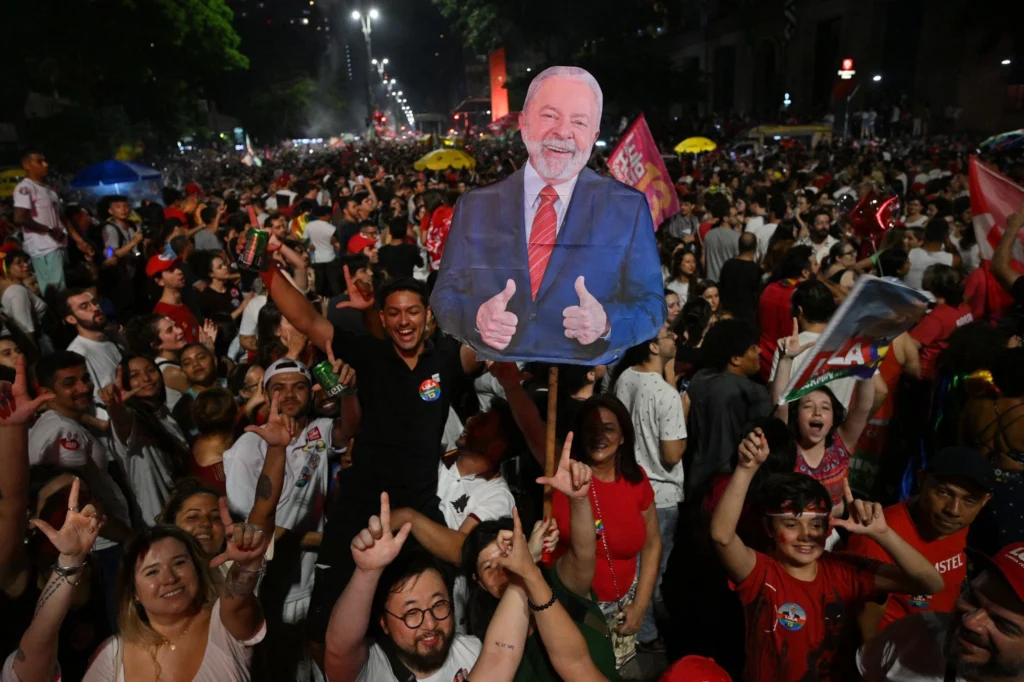
Brazilian President Luiz Inácio Lula da Silva’s campaign restructured its political and communications leadership, implementing a digital strategy centered on grassroots mobilization, relatable content, and community organization ahead of the October 25 runoff.
RELATED:
Brazil’s Lula Announces MEI 12.6 Billion Reais Debt Relief
In the first round on October 4, Flávio Bolsonaro of the Liberal Party secured 47.03% of valid votes, while Lula of the Workers’ Party (PT) garnered 45.16%, according to the Superior Electoral Court (TSE). The margin between them was 1.87 percentage points.
Following that result, the president’s campaign faced the challenge of mobilizing the more than 33 million people who had abstained from voting and vying for the votes of the undecided. Between October 5 and 9, students, social movements, artists, influencers, and fan communities launched initiatives—both on the streets and across digital platforms—to boost voter turnout.
To course-correct, Lula’s team brought in political figures such as Rafael Fonteles, Camilo Santana, Rui Costa, and Jerônimo Rodrigues, alongside lawmakers and influential social media figures—including Erika Hilton, Sâmia Bomfim, Jones Manoel, and Guilherme Cortez.
This strategic shift moved away from a strictly institutional aesthetic, adopting a “creator-as-person” format: selfie-style videos, casual street conversations, and simpler audiovisual productions. Guided by Congressman André Janones’s mantra of “more street, less helicopter,” the campaign disseminated dozens of native posts specifically targeting young voters.
Between October 4 and 11, the total number of social media interactions for both candidates resulted in a statistical dead heat: 266.5 million actions for Lula and 268.2 million for Flávio Bolsonaro. However, the president held an advantage on key platforms, garnering 24.3% more interactions than his rival on Facebook and 13.7% more on TikTok.
Ver esta publicación en Instagram
Una publicación compartida por Panamerican Dispatch (@padispatch)
The architecture of this digital comeback relied on the “Exército do Lula” (Lula’s Army) channel, managed by Janones, which grew from 50,000 followers to over 3.3 million in a single week. The channel operates as a distributed coordination hub, sending daily audio messages, tasks, and “missions” to supporters to help make content go viral and counter attacks.
Flávio Bolsonaro’s campaign petitioned the TSE (Superior Electoral Court) to review the channel, alleging the dissemination of falsehoods. On October 12, the court ruled that the content in question did not contain the alleged falsehoods.
Another strategic pillar was the “Fandoms com Lula” (Fandoms for Lula) coalition, comprising over 250 fan clubs for artists such as Anitta, Taylor Swift, BTS, BLACKPINK, and Beyoncé. These communities applied their experience with massive streaming campaigns to tasks such as creating memes and AI-generated montages, producing guides for engaging with non-voters over the age of 60, and participating in in-person rallies, including the one held on Avenida Paulista.
The contest also extended to platform policies. The PT filed a complaint with the TSE regarding an unjustified drop in the algorithmic reach of Lula’s content on Meta’s apps. The company attributed the issue to global “technical problems” and denied any political bias.
Despite disagreements regarding social media bias, the most significant digital surge in Lula’s favor coincided with the major rallies on Sunday, October 11; on that day, his campaign recorded 31.8 million interactions, compared to 18.1 million for Flávio Bolsonaro’s campaign. Analysts highlight that the Brazilian experience demonstrates that communication success does not depend solely on official party accounts, but rather on the ability to build organic communities capable of taking ownership of the message, transforming it, and distributing it within their everyday circles ahead of the October 25 runoff.
Speaking on national economic strategy, President Luiz Inácio Lula da Silva emphasized that a country cannot succeed unless capital circulates across its entire population. Lula highlighted his core economic policy principle: placing wealth into the hands of the working majority… pic.twitter.com/5ATbGtTcuv
— teleSUR English (@telesurenglish) October 13, 2026
From teleSUR English via This RSS Feed.