

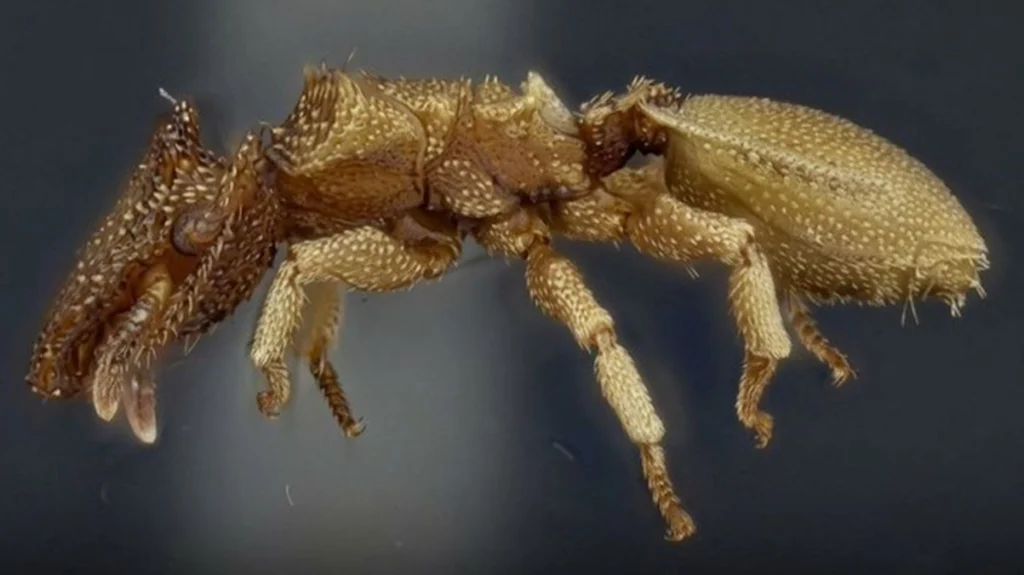
New Findings Expand the Country’s Documented Ant Inventory to About 845 Species and Highlight Gaps in Biodiversity Research.
On Wednesday, the National Institute of Biodiversity (INABIO) reported that researchers had documented 15 ant species in Ecuador for the first time, expanding the inventory of documented species in the Andean country to approximately 845 species across 103 genera.
RELATED:
The new records comprise 15 species distributed across four subfamilies and eight genera. One of the most notable results is the first record of the genus Cryptomyrmex, represented by the species Cryptomyrmex longinodus, found in Yasuni National Park, one of the most biodiverse areas on the planet, located in the Amazonian province of Pastaza.
According to Inabio, these species were known to occur in other countries, such as Colombia, Peru and Brazil, but had never been identified in mainland Ecuador.
The identified species were found in the Amazonian provinces of Napo, Pastaza, Sucumbios and Zamora Chinchipe; the coastal provinces of Esmeraldas, Guayas and Santa Elena; the tropical province of Los Rios; and the Andean province of Cañar.
The researchers are affiliated with the Higher Polytechnic School of Chimborazo province, INABIO, the Agency for Phytosanitary and Zoosanitary Regulation and Control, Uru Foundation and the National Polytechnic School, all in Ecuador, as well as Brazil’s National Institute of Amazonian Research.
This is the Amazon rainforest from space. The orange regions represent territories managed by the 1.5 million Indigenous people who call this forest home across Bolivia, Brazil, Colombia, Ecuador, French Guiana, Guyana, Peru, Suriname, and Venezuela.
Look closely, and you’ll see… pic.twitter.com/14zLAvN0mJ
— Terraformation (@TF_Global) October 7, 2026
They found specimens in diverse environments, including Amazonian forests, montane forests and tropical dry forests, many of them in leaf litter on the forest floor. One species, Dorymyrmex brunneus, for example, was found in dragon fruit crops in Cañar province.
Inabio noted that “several of these findings considerably expand the known geographic distribution of the species in South America,” since, in some cases, the Ecuadorian records are hundreds or even more than 1,000 kilometers (621 miles) from locations where the species had previously been documented.
INABIO explained that ants are “ecosystem engineers” because they sustain the structure and functioning of these habitats. They contribute to soil aeration and nutrient cycling, pest control and seed dispersal, interact with multiple species, and form part of ecological networks in forests, agricultural areas and cities.
The study also identified gaps in information about ants in Ecuador, particularly in mountainous areas and transition zones between the Andes and the Amazon. Further research is needed, especially in light of threats associated with habitat transformation, agricultural expansion and climate change.
teleSUR/ JF
Source: EFE
From teleSUR English via This RSS Feed.