

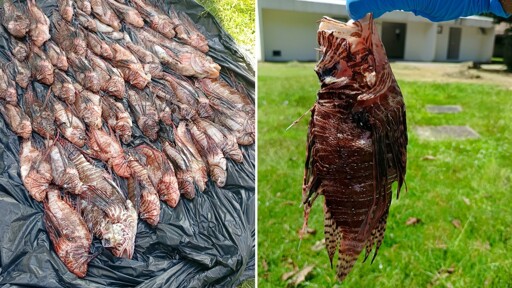
Fishers have caught at least 440 invasive lionfish off the coast of Porto Seguro in northeastern Brazil in recent weeks. The local government paid fishers to harvest the fish in an attempt to curb the rapid spread of a species that can decimate native fish stocks, Mariana Martins writes for Mongabay Brasil. Lionfish (Pterois volitans), which are native to the Indo-Pacific and Red Sea, have no natural predators along Brazil’s coastline and are preying upon the young of local species. The fish have already damaged coral reef ecosystems in the North Atlantic, including the Caribbean. Now they have also reportedly reached the Abrolhos reefs, the largest and richest reef system in the South Atlantic. “By preying on juveniles of commercially exploited species, there is a depletion of fish populations,” Carlos Hackradt, biologist and coordinator of the Marine Ecology and Conservation Laboratory at the Federal University of Southern Bahia, told Martins. “This brings serious consequences for the ecosystem, affects the fishing economy and harms tourism on degraded reefs.” Abrolhos is home to mushroom-shaped coral structures, locally known as chapeirões, and supports at least 90 coral and 266 fish species, including the goliath grouper (Epinephelus itajara) and blue parrotfish (Scarus coeruleus), which are nationally listed as critically endangered and endangered, respectively. Abrolhos is also the main breeding and nursing ground for humpback whales (Megaptera novaeangliae) in the Western South Atlantic. While the presence of lionfish there has been confirmed, their extent has not yet been measured. “It has only just happened,” Hackradt…This article was originally published on Mongabay
From Conservation news via This RSS Feed.