

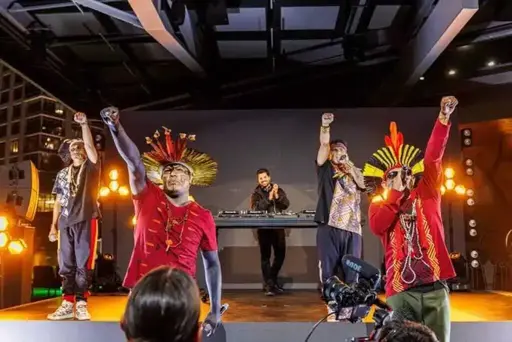
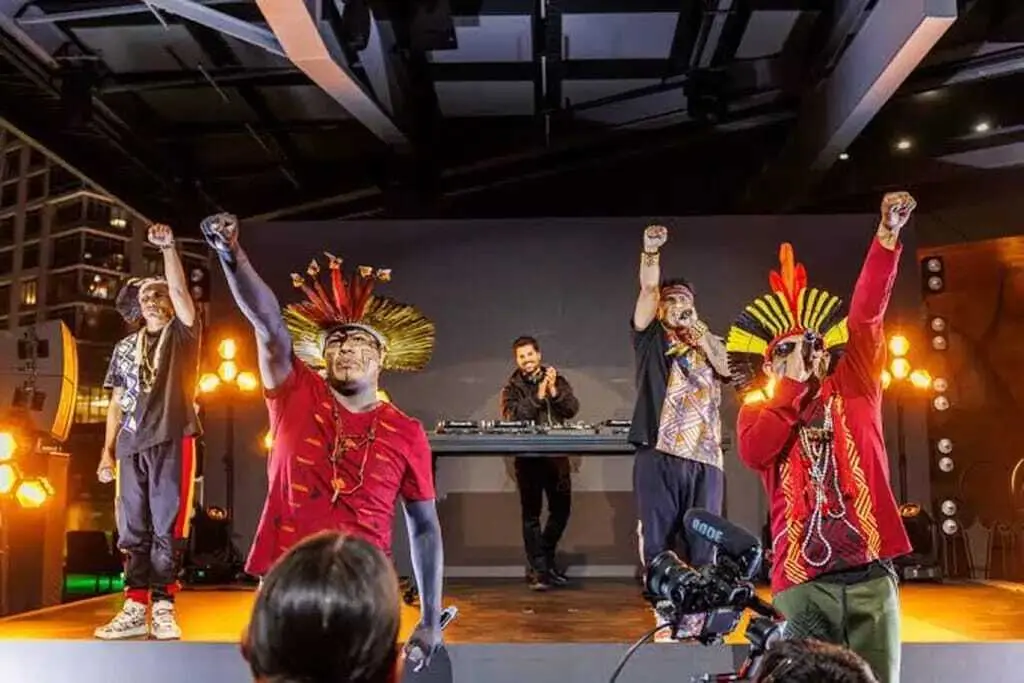
On Sunday, as part of the Indigenous Resistance Day commemoration, the Indigenous Hip Hop Festival second edition held at the Casa Refugio de la Memoria in Mexico City. The event highlighted how Indigenous artists in Mexico are finding rap to be a tool for defending their languages, asserting their identities, and sharing their peoples’ stories.
RELATED:
Codex Azcatitlan Returns Temporarily to Mexico
The gathering featured concerts, handicraft sales, photo exhibitions on the movement’s origins, and an open-mic session where artists improvised in languages such as Zapotec, Mayan, and Mazatec. According to the participants, the genre allows them to adapt contemporary expressions to the realities of Indigenous peoples and expand their reach beyond traditional circuits.
“I think the interesting thing about hip-hop culture is that it doesn’t respond to a specific era, but rather to a need within the context where it originates,” noted Mare Advertencias, a rapper with a 23-year career. For the artist, the festival confirms the strength of Indigenous rap across the continent, following an event held last year in the Bronx and with an upcoming edition scheduled for Lima, Peru.
“For me, hip-hop was a way to seek out my identity,” Advertencias added in comments to EFE, recalling how the art form served as a refuge during her adolescence, helping her define her own path.
The musicians highlighted their native languages’ ability to convey the reality of their communities and break down the barriers that have historically marginalized them from the music industry. Mayan rapper Pat Boy denounced the persistent discrimination they face and criticized the fact that, even within the movement itself, Indigenous hip-hop artists are often set apart from other hip-hop artists.
🎤 #AlMomento | El rap y el hip hop toman la Alhóndiga de Granaditas en el @cervantino.
Desde el Valle de México, las raperas de “Mujer en Cypher” encienden al público con sus rimas y versos en #Guanajuato.@mauenelonce en #OnceNoticias 🔻 pic.twitter.com/vwCLvwL9jd
— Once Noticias (@OnceNoticiasTV) October 13, 2026
The text reads, “Rap and hip hop take over the Alhóndiga de Granaditas at the
@cervantino. From the Valley of Mexico, the rappers of “Mujer en Cypher” light up the crowd with their rhymes and verses in #Guanajuato.”
Meanwhile, Mazatec rapper Xéti NdáJnió stated that singing in his language about the traditions of the highlands allows them to connect with people on a level that goes beyond mere words. Her presentation highlighted the role of rap as a medium for bringing Indigenous languages to diverse audiences.
Speaking for the organizing team, Ángeles Solís—festival co-producer and activist with The Action Lab—emphasized the need to create autonomous spaces for outreach. “It is an opportunity to build independent platforms where our voices and languages can be heard,” she stated.
The festival took place just before the traditional Day of the Race (in spanish Día de la Raza)—reclaimed here as the Day of Indigenous Resistance—marking a day of critical reflection and the defense of Indigenous peoples’ rights.
The next stop for the Indigenous Hip Hop Festival will be on October 17 in Lima, Peru, continuing the work of this network of artists who use urban rhythms to raise awareness of, promote, and preserve the continent’s Indigenous languages.
Mexican President Claudia Sheinbaum inaugurated a new campus of the National Rosario Castellanos University in Nicolás Romero, State of Mexico, on Sunday, as her government pushes to expand access to public higher education. The campus will open with 800 students, half attending… pic.twitter.com/RlLWCV54xR
— teleSUR English (@telesurenglish) October 12, 2026
From teleSUR English via This RSS Feed.