

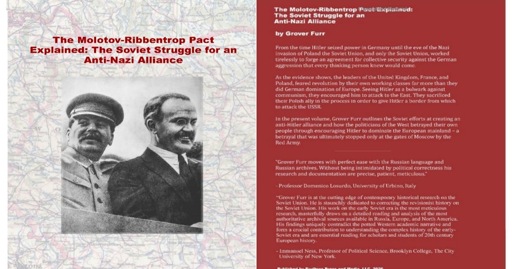

A new book by historian and author Grover Furr, The Molotov-Ribbentrop Pact Explained: The Soviet Struggle for an Anti-Nazi Alliance, published by Erythros Press, examines the diplomatic developments leading up to the outbreak of the Second World War, challenging dominant bourgeois interpretations of the Soviet-German Non-Aggression Pact of August 1939. Drawing on historical evidence, Grover Furr argues that the Soviet Union consistently sought to establish a collective security agreement against Nazi Germany, while the governments of Britain, France and Poland obstructed efforts to create a united front against Hitler’s expansionism.
According to the book’s central argument, Western ruling circles regarded communism and the prospect of socialist revolution as greater threats than Nazi aggression. Their policies of appeasement, Furr maintains, encouraged German expansion eastward, ultimately paving the way for the devastating war against the Soviet Union.
The book also addresses a historical episode frequently exploited by anti-communist propaganda to equate the Soviet Union with Nazi Germany, while minimizing the responsibility of Western powers for the failure to establish an effective anti-Hitler alliance.
The Molotov-Ribbentrop Pact Explained seeks to revisit these events from the perspective of Soviet diplomatic efforts, the international struggle against fascism and the historical circumstances preceding the Nazi invasion of the USSR in June 1941.
From In Defense of Communism via This RSS Feed.