

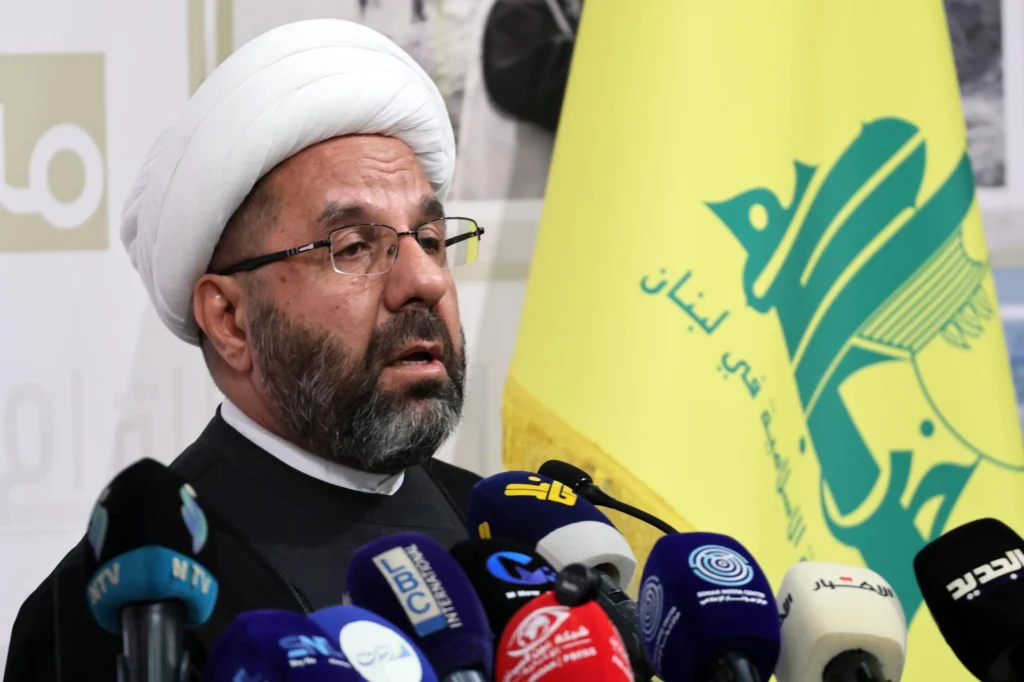
The Resistance Movement Hezbollah unveiled a housing assistance program on Tuesday to help Lebanese families left homeless or with severely damaged residences by Israeli military strikes, offering subsidies of up to $14,000 for those in Beirut and its southern suburbs.
The Lebanese resistance movement formally presented the project under the name “Promise and Commitment,” known in Arabic as Wa’ad wa Iltizam.
Officials described it as comprehensive, direct and urgent aid for households whose homes were destroyed or badly damaged during the Israeli aggression.
RELATED: [Lebanon Reports 7,700 Israeli Violations of Framework Agreement](https://telesurenglish.net/lebanon-army-reports-7700-israeli-violations-of-framework-agreement/)
The program sets a ceiling of $14,000 for affected families in Beirut and its southern suburb of Dahiye. Of that sum, $8,000 will go toward replacing furniture and household goods, while $6,000 will cover rental costs. In the rest of Lebanon’s affected regions, the maximum assistance reaches $12,000, with rent capped at $4,000.
The payments will be made in four installments over one year, starting with an initial payment of $3,500 for the capital and its suburbs and $3,000 for the rest of the country.
The program covers owners of homes destroyed either fully or partially, as well as displaced people from border zones and areas that remain inaccessible.
The head of Hezbollah’s Executive Council, Sheikh Ali Daamoush, announced the resistance’s new “Promise and Commitment” housing assistance program for forcibly displaced families whose homes were damaged by Israeli aggression across Lebanon.
■ Eligible residential units in… pic.twitter.com/GV2hoCzp0V
— VPol (@VocalPolitics1) October 13, 2026
Damage by the Numbers
A joint report by the United Nations Development Programme (UNDP) and the Lebanese National Council for Scientific Research (CNRS-L), published in June, assessed the damage from Israeli attacks up to that date. It found that 11,095 buildings were completely destroyed, affecting 17,891 housing units.
Another 2,242 buildings suffered partial damage, affecting 5,219 units, and 9,311 buildings sustained minor damage, affecting 18,282 units. Damage was estimated at $1.38 billion.
Lebanese authorities have also reported the return of 400,000 displaced people to the south of the country following the Israeli aggression. That return adds urgency to the housing effort, as many families come back to neighborhoods where their homes no longer stand.
The aid program is structured around that reality. By splitting payments across a full year, the initiative aims to cover both immediate needs and the longer process of rebuilding lives and households.
For the poorest households, the initial installments provide a bridge while more durable reconstruction gets underway. The program’s architects say the subsidies address both the loss of possessions and the cost of temporary shelter.
The presentation of the housing project carries political weight beyond its material value. Hezbollah has positioned reconstruction as central to its post-war standing, presenting the rebuilding effort as a form of resilience against what it describes as foreign aggression.
كشف حزب الله عن تفاصيل برنامج الإيواء الجديد، محدّدًا التعويضات بين 12 و14 ألف دولار للوحدة السكنية، بحسب المنطقة، مع دفعة أولى تتراوح بين 3000 و3500 دولار
فكيف ستُصرف المبالغ المتبقية، وما شروط الاستفادة من البرنامج؟
Hezbollah has revealed the details of its new housing… pic.twitter.com/JSH9RQQNEq
— Beirut Politics (@beirut_politics) October 13, 2026
Text reads: “Hezbollah has revealed the details of its new housing assistance program, setting compensation at between $12,000 and $14,000 per residential unit, depending on the area, with an initial payment ranging from $3,000 to $3,500.”
Presenting the initiative, Hezbollah Executive Council head Sheikh Ali Damoush said its implementation would show the victory of reconstruction over destruction and of resistance over what he called foreign barbarity. Damoush sharply criticized the Lebanese government, affirming that authorities have not presented any effective plan to help the hundreds of thousands of displaced people and have not taken responsibility for assessing damage and rebuilding.
The program’s rollout now begins with registration and verification of affected families, followed by the first disbursements.
From teleSUR English via This RSS Feed.