

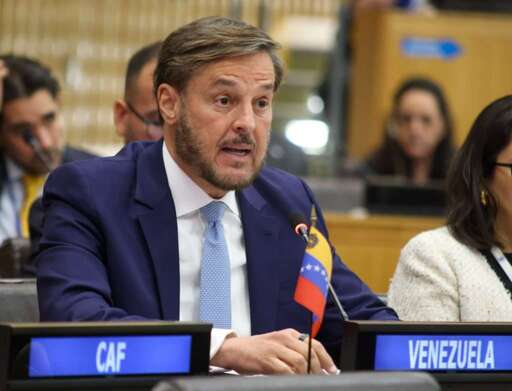
Caracas (OrinocoTribune.com)—Venezuela repudiated statements by Uruguayan Foreign Minister Mario Lubetkin that attempted to make restoration of Uruguay’s diplomatic relations with Venezuela conditional on political change in Caracas. On Monday, October 12, Venezuelan Foreign Affairs Minister Félix Plasencia described the remarks as unacceptable interference and reaffirmed that Venezuela’s future belongs to its people.
In an interview conducted during September’s United Nations General Assembly in New York and published on October 10, Lubetkin ruled out restoring diplomatic relations while Venezuela’s Acting President Delcy Rodríguez remains in office. In a clear contradiction of basic diplomatic practic, Lubetkin questioned the acting president’s legitimacy and that of President Nicolás Maduro, saying that Uruguay would resume relations following new elections whose outcome was confirmed by an independent court.
Responding through social media, Plasencia rejected what he described as “outdated and arrogant views” that do not acknowledge Venezuela’s sovereignty and self-determination. He said Lubetkin’s statements ignore the political dialogue underway in Venezuela to advance democratic coexistence.
View this post on Instagram
A post shared by Félix Plasencia González (@plasenciafelixr)
“Statements and positions of this nature constitute an unacceptable interference,” Plasencia said. “The future of Venezuela will be defined by its people, in strict adherence to its Constitution and its legal system.”
Diplomatic relations between the two South American nations have been suspended since July 2024. After their interference following the July 28 elections in which President Maduro emerged victorious, Venezuela withdrew its diplomatic personnel from Uruguay and six other countries and demanded the reciprocal withdrawal of their representatives. Uruguay was then governed by right-wing President Luis Lacalle Pou who, in 2020, had already referred to President Maduro as a “dictator” and had, in practice, ended communication between the two governments.
Venezuela–Uruguay financial relationsThe confrontation also contrasts with a history of economic cooperation that provided Uruguay with favorable oil financing and substantial benefits from early debt settlements.
Under the bilateral energy agreement established in 2005, Uruguay’s state oil company ANCAP paid 75% of its Venezuelan oil purchases within 90 days and financed the remaining 25% over 15 years. Uruguay’s own presidency reported that this arrangement enabled investment in refining, biofuels, petroleum exploration, logistics, and barge construction.
In January 2013, ANCAP settled obligations totaling US $828 million through an advance payment of US $517 million, according to an official Uruguayan announcement. The US $311 million difference reflected the terms of early settlement of long-term obligations; it should not be presented as an outstanding debt or simply as money that Venezuela forgave.
A further agreement between President Maduro and Uruguayan President Tabaré Vázquez in 2015 reduced another US $434 million obligation to a US $267 million early payment—a discount of US $167 million, approximately 38.5%. Uruguay’s Parliament authorized financing for the settlement. These agreements demonstrate the financial advantages that Uruguay obtained from cooperation with Chavista Venezuela, although they do not establish that Uruguay currently owes those amounts.
Economic ties also extend beyond oil purchases. ANCAP’s current corporate information lists PDVSA Uruguay as holding a 9.21% stake in Alcoholes del Uruguay, or ALUR, which produces biofuels and other agroindustrial products.
US Steps Up Pressure on Uruguay to Expel Cuban Medical Brigade
A separate financial dispute involves Venezuelan assets in Uruguay. In August 2026, Uruguayan financial media reported that an appeals court reinstated attachments over shares in Bandes Uruguay and its participation in the pension fund administrator Integración AFAP. The proceedings concern Laboratorio Libra’s claim for unpaid medication supplied to Venezuela’s Health Ministry in 2014. The report indicated that the case had moved to the Supreme Court for consideration. This is a commercial claim against Venezuela, distinct from Uruguay’s historical oil obligations to PDVSA.
Special for Orinoco Tribune by staff
OT/JRE/SL
From Orinoco Tribune via This RSS Feed.