

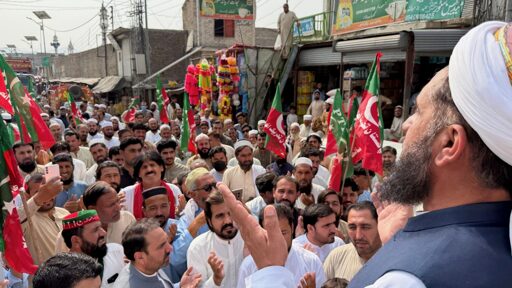

Large-scale protests broke out in different parts of Pakistan’s Khyber Pakhtunkhwa (KP) province on Monday, October 12, after the federal government dismissed its elected government and imposed the centralized Governor’s rule.
The federal government also declared an emergency in 12 out of 40 of KP’s districts, citing a law-and-order situation. The imposition of the emergency under article 232 of Pakistan’s constitution means the suspension of citizen’s fundamental rights.
Pakistan Tehreek-e-Insaf (PTI) which was ruling the KP government, called the dismissal of its government a “direct assault on the democratic mandate of the people.” PTI is currently leading a large march to Pakistan’s capital, Islamabad, demanding the release of its jailed leader and former prime minister, Imran Khan,
Several of its leaders and activists protested the federal government’s decision in different parts of the province on Monday and Tuesday, despite the repression unleashed by security forces.
The federal government has deployed the armed forces in large numbers across the province, closed down all the educational institutions and blocked all access routes to the capital Peshawar with shipping containers in order to prevent large protests.
Chief Minister Sohail Afridi was also arrested on Monday, along with several of the elected members of the provincial legislative council, with PTI claiming his whereabouts were unknown.
Afridi, who was leading the march to Islamabad since October 4, had, on Saturday, dared the federal government to dismiss his government, claiming the imposition of federal rule by dismissing “the only truly elected government” in the country would be a brutal repression of popular will.
The PTI has called for large-scale protests against the move in the coming days. It has also filed a petition demanding the revocation of the Governor’s rule and production of its elected members, arrested since Sunday.
“Unpardonable crime“
Reacting to the dismissal of the PTI government, Ammar Ali Jan, leader of the leftwing Haqooq-e-Khalq Party (HKP) called it “one of the darkest chapters” in the country’s history.
“All those responsible, including the PMLN [Pakistan Muslim League Nawaz, the ruling party], PPP [Pakistan Peoples Party, part of the ruling coalition] & the establishment [the Army] have committed an unpardonable crime against our people,” Ali Jan said, asking people to “revolt against this tyranny.”
Several other groups and parties opposed the federal government’s move, calling it an attack on people’s basic rights.
HKP called it a brazen disregard for the will of the people which will further increase the gap between the people and the government “in the midst of unprecedented security, economic and regional challenges” faced by Pakistan.
The left-wing Mazdoor Kisan Party (MKP) and Awami Workers’ Party-Marxist also opposed the move, calling it an example of authoritarianism. The MKP dismissed the justification about the PTI government’s failure to maintain law and order and curb terrorism as just excuses to undermine the popular mandate.
The federal government, led by Prime Minister Shehbaz Sharif of the PMLN, has long accused the KP government of failing to secure law and order in the province, citing rising cases of “terrorist attacks.”
It claimed the PTI-led government has “deliberately disengaged with the fight against terrorism” as justification for its dismissal on Sunday.
Pakistan’s Information Minister Attaullah Tarar also claimed on Monday that the move has been welcomed by the people of KP as the PTI government was sympathetic and even supportive to “terrorist” groups.
The dismissal of the PTI government in KP is largely seen as a result of the persistent political tensions between the PTI and the ruling coalition.
The PTI is the largest opposition party in the country’s National Assembly. Khan, despite being in prison for the last three years, still has a large popular following.
Khan and the PTI have maintained that the ruling coalition, in collaboration with the country’s armed forces, conspired and rigged the 2024 elections to deprive them of power after Khan spoke against the latter’s interference in the democratic governance.
The PTI was denied its symbol during the national elections, forcing it to run its candidates as independents, while Khan was disqualified to contest in the elections and denied permissions to campaign. He was put in prison and charged with scores of cases related to corruption, misuse of power, and violence.
From BT News via This RSS Feed.