

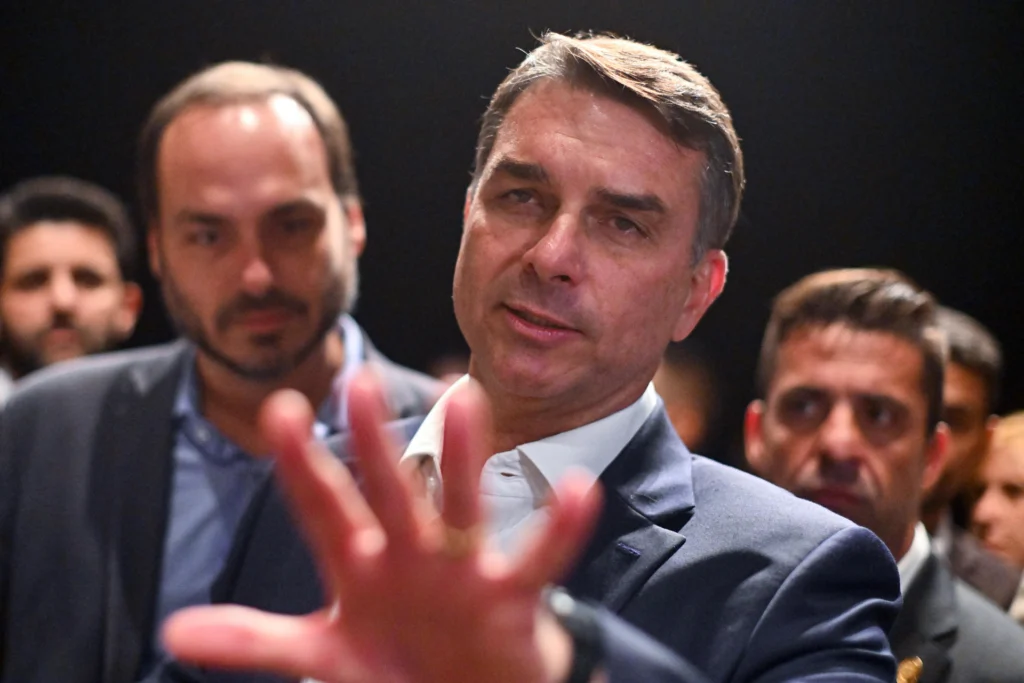
Images of children brandishing replica firearms at campaign events spark formal investigations by human rights and legal oversight bodies.
Brazil’s 2026 electoral cycle has been marked by a rise in political violence across various states. Security data records 354 incidents of political violence over the past two years.
RELATED:
Flávio Bolsonaro Promises Fewer Ministries as Brazil Vote Goes to Runoff
These incidents include threats, physical assaults, and armed attacks targeting candidates, local election officials, and political organizers.
The root of this political tension lies in the structural polarization generated during previous presidential campaigns and administrations.
Former President Jair Bolsonaro and his political movement, known as “Bolsonarismo”, built an electoral base around conservative social values, the expansion of agribusiness, and a national security strategy centered on arming the population.
As a consequence, in the 2026 campaign of Senator Flávio Bolsonaro, public security emerged as a primary concern for the electorate. The conservative coalition’s political strategy relies heavily on proposals for punitive criminal justice and the expansion of individual gun-ownership rights as solutions to urban and rural crime.
Critics and human rights organizations argue that the mass dissemination of political content promoting firearm use has created an environment where political disagreements escalate into physical violence.
The normalization of violent political rhetoric during nationwide public events has altered public discourse, turning political participation into a high-risk activity for grassroots organizers and opposition candidates.
Ideological Origins and the Pro-Gun Movement
The political platform supporting firearm expansion in Brazil is driven by a legislative coalition known as the Bullets, Beef, and Bibles caucus.
This group represents an alliance between public security hardliners, large-scale agribusiness producers, and conservative evangelical leaders. Together, these sectors advocated for statutory changes to alter the Disarmament Statute enacted in 2003.
During Jair Bolsonaro’s presidential term from 2019 to 2022, executive decrees relaxed requirements for acquiring firearms and ammunition.
The administration expanded the privileges granted to registered Collectors, Marksmen, and Hunters, known as CACs. Official records indicate that the number of registered CACs grew significantly during these four years, allowing private individuals to acquire high-caliber weapons and purchase thousands of rounds of ammunition annually.
Executive Order 9,847, signed in May 2019, allowed licensed gun owners to purchase up to 5,000 rounds of ammunition per weapon each year, up from the previous limit of 50.
The legal expansion of firearm access altered security dynamics in rural and urban areas. Studies published by the demonstrated a direct correlation between the rise in privately held firearms and the frequency of lethal altercations in local communities.
While pro-gun advocacy organizations maintain that private gun ownership provides individual self-defense against criminal enterprises, public safety researchers observed that a higher volume of civilian weapons eventually entered illicit markets through theft and improper registration.
In rural regions, the growth of armed civilian groups reinforced existing land disputes. Property owners, illegal loggers, and informal land prospectors utilized expanded firearm access to defend economic claims against rural workers and Indigenous groups.
AVISO🚨: Imagens extremamente fortes, mas necessárias para o povo de memória curta.
Bolsonaristas espancando mulheres em manifestações, quebrando o Congresso e atirando em pessoas. Todo o terrorismo dessa escória que quer voltar.Compartilhe ao máximo.#DIREITATERRORISTA pic.twitter.com/J4r0xMpK3B
— Jurunense (@o_jurunense) October 12, 2026
The text reads, “WARNING: Extremely graphic images, yet necessary for those with short memories. Bolsonaro supporters beating women at protests, ransacking Congress, and shooting people. All the terrorism of that scum that wants to return. Spread this far and wide.”
Public Demonstrations, Armed Symbolism, and Religious Reactions
Political rallies in this 2026 campaign held across major urban centers featured recurring uses of military and firearm symbolism. During campaign events held in Brasília, São Paulo, and Rio de Janeiro, Bolsonaro supporters displayed replica firearms, tactical equipment, and political banners encouraging armed civilian mobilization.
A widely circulated image from a political rally showed a child positioned on top of a sound truck alongside campaign organizers, holding a firearm replica and mimicking shooting gestures toward the crowd.
Human rights organizations, including the National Council for the Rights of Children and Adolescents, issued formal statements criticizing the inclusion of minors in events promoting firearm use, pointing to federal child protection statutes that prohibit exposing children to violent material or weapons training.
Religious leaders responded to the increasing presence of violent messaging in political life. During the annual feast day celebrations at the National Sanctuary of Aparecida, Archbishop Orlando Brandes delivered a sermon addressing national unity, public ethics, and political discourse.
In his address, Archbishop Brandes stated that “a civil society cannot be built on hatred and weapons” and urged citizens to reject violent language in favor of peace and social justice.
The National Conference of Brazilian Bishops published subsequent declarations emphasizing that Christian ethical principles conflict with policies promoting unrestricted firearm ownership and armed confrontation. Church leaders called on political candidates to focus their platforms on poverty alleviation, healthcare, and education rather than public arming.
Brazil’s intelligence agency has confirmed interference by the US government in Brazil’s election in support of Flavio Bolsonaro, son of jailed former far-right President Jair Bolsonaro. https://t.co/v7DQtHAVxA pic.twitter.com/tIzZgU0kUg
— tim anderson (@timand2037) October 4, 2026
Territorial Conflicts and Impact on Indigenous Communities
The proliferation of firearms and political rhetoric supporting land expansion intensified territorial pressure on Indigenous populations, particularly in the Amazon region.
Representatives of the Parakanã people, living in the Apyterewa Indigenous Territory in the state of Pará, submitted official complaints to the Federal Public Ministry and the National Indian Foundation documenting increasing land incursions by armed squatters, illegal loggers, and cattle ranchers aligned with local conservative political networks.
The Apyterewa territory, formally demarcated and ratified by federal decree in 2007, remains one of the areas most impacted by illegal deforestation and land grabbing in northern Brazil.
Community leaders reported that armed individuals entered protected areas, established informal access roads, and issued death threats against Indigenous leaders who monitored territorial boundaries.
Deforestation data from the National Institute for Space Research tracked a steady increase in forest clearing within the Parakanã territory during periods of diminished federal oversight.
Indigenous rights organizations highlighted that territorial conflicts represent both an environmental concern and a violation of constitutional rights guaranteed under the 1988 Brazilian Constitution.
The ongoing displacement pressure on the Parakanã and neighboring Indigenous groups underscores the direct connection between national political debates on gun ownership and rural security dynamics in remote regions.
Fake news on social media has once again taken center stage in Brazil’s presidential campaign ahead of the Oct. 25 runoff.
To favor the Liberal Party’s candidate, Flavio Bolsonaro, the Brazilian far right has launched a smear campaign against Workers’ Party candidate Luiz Inacio… pic.twitter.com/mrKSZmVGQk
— teleSUR English (@telesurenglish) October 9, 2026
Lula’s Counter-Proposals and Public Security Strategy
President Luiz Inácio Lula da Silva implemented regulatory changes aimed at restricting civilian access to firearms and strengthening state control over public security.
Immediately upon taking office, the federal administration issued Executive Decree 11,366, which suspended the issuance of new registrations for civilian weapon owners, restricted the purchase of high-caliber ammunition, and transferred the oversight of registered Collectors, Marksmen, and Hunters from the Brazilian Army to the Federal Police.
The policy platform of the governing coalition focuses on replacing civilian arming with coordinated state law enforcement and social crime prevention programs.
The administration re-established the National Public Security Program with Citizenship, allocating federal funds to municipal crime prevention, community policing, and educational initiatives aimed at vulnerable youth.
In federal security speeches, President Lula emphasized that reducing lethal violence requires public investment in infrastructure, basic sanitation, and job creation rather than increasing civilian weapon ownership.
To address territorial conflicts in protected areas, the federal government reactivated inter-agency enforcement operations involving the National Public Security Force, the Federal Police, and environmental protection agencies.
The Ministry of Indigenous Peoples, established under the current administration, coordinated with the National Indian Foundation to resume the formal demarcation of Indigenous territories and conduct police operations to remove illegal miners and squatters from protected lands.
Future Outlook for Democratic Governance
The structural debate over firearm access, public safety, and campaign violence highlights a central division in Brazilian political life. Data collected by public safety research organizations demonstrates that the expansion of civilian weapons between 2019 and 2022 coincided with increased lethal incidents in rural land disputes and higher rates of political intimidation during national election cycles.
The resolution of these security challenges depends on the enforcement of constitutional protections, the regulation of civilian firearms, and the institutional support provided to Indigenous and rural communities. As Brazil navigates its upcoming electoral process, democratic institutions, civil society organizations, and international human rights bodies continue to monitor the impact of violent rhetoric on public participation and state stability.
Establishing long-term public safety requires a balanced policy approach that pairs rigorous law enforcement with targeted social investments. Rebuilding public security institutions, disarming illegal paramilitaries, and safeguarding protected territories remain central requirements for maintaining social stability and protecting democratic norms across the country.
Sources: TRT World – Xinhua – CGTN – Brasil de Fato – Resumen Latinoamericano – Página 12 – Radio del Sur – Folha S. Paulo – BBC – CNN – Barricada TV – El Mundo – Sputnik
From teleSUR English via This RSS Feed.