

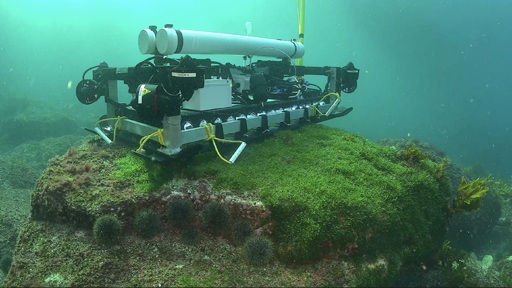
BAY OF ISLANDS, Aotearoa New Zealand — Since an invasive seaweed called caulerpa was discovered in Aotearoa New Zealand in 2021, forming meadows that blanketed parts of the seabed, it’s taken on an almost mythical status among people who spend time in coastal waters. “It’s so wily and so resilient,” Michele Rogalin-Henderson, a doctoral candidate at the University of Auckland’s Institute of Marine Science, told Mongabay. “Yes, I did say wily,” she added. “I anthropomorphize it. I spend a lot of time in the lab and in the field with this beast.” Stephen Te Tai, a commercial diver who removes the caulerpa, mainly in the Bay of Islands area in New Zealand’s tropical far north, also spoke about the invasive seaweed in such terms. “I know it’s airy fairy but sometimes I feel its energy,” Te Tai told Mongabay. In winter, he said, “it’s real low, it’s almost cowering, but in the summertime, it feels like its chest is puffed out, and it’s real vibrant and strong.” Te Tai is Ngāti Hine, a Māori tribal grouping, and his surname means “coast” or “tide” in Māori. He spoke to Mongabay on the shoreline after he’d worked in the waters off Urupukapuka Island one day in July. “The moana [ocean] is vital to our people,” he later added in a text message. “It is not just something that nourishes us, it is a part of us, it was a part of our ancestors and it will be part of our mokopuna [descendants].…This article was originally published on Mongabay
From Conservation news via This RSS Feed.