

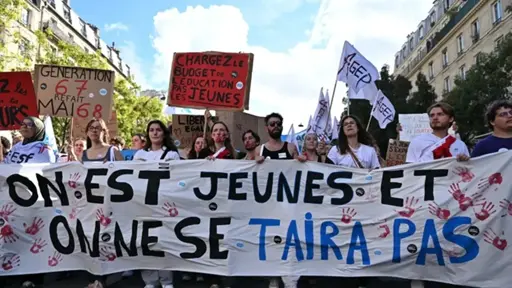
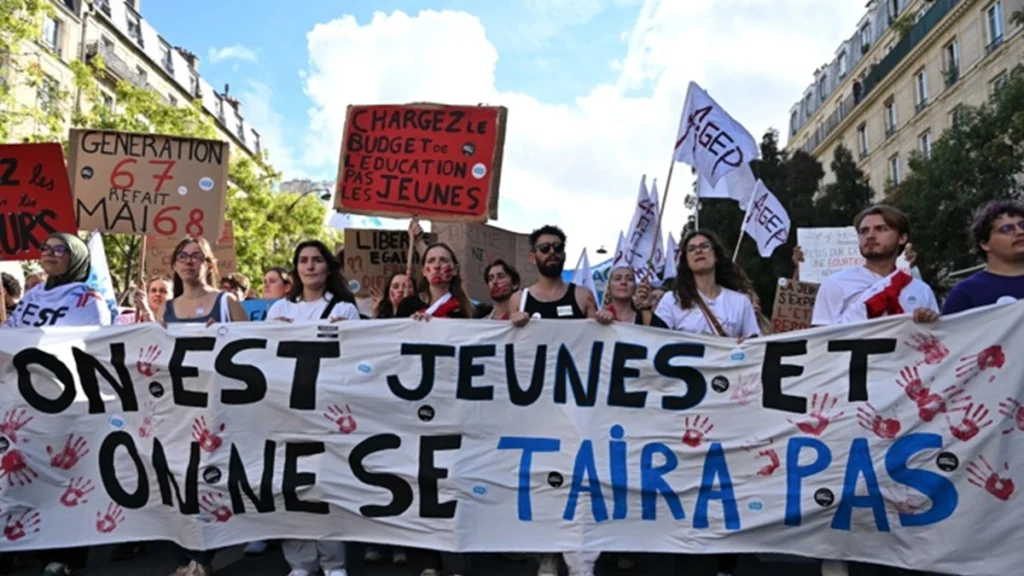
At Least 480,000 Demonstrators Demand Changes to the Education System and Denounce Police Violence.
On Tuesday, demonstrations by French students and teachers more than doubled participation levels compared with last week’s mass protests.
RELATED:
Greta Thunberg Joins French Students Protesting Education Cuts
The demonstrations drew at least 480,000 people across France, according to the trade unions that called the fifth day of mass protests, dubbed “Act V.”
Participation did not decline as expected because of the proximity of the All Saints’ Day school holidays, which begin Friday.
As usual, however, the Interior Ministry downplayed the scale of the mobilization, saying only about 161,500 people took to the streets, including 41,500 in the French capital.
🚨 SCANDALE – La police fait usage de canon à eau contre des étudiants assis et non violents. Elle les tabassera à ensuite pic.twitter.com/nllTjcLKvq
— Ilan Gabet (@Ilangabet) October 13, 2026
The text reads, “Scandal – Police use water cannons against seated, non-violent students. They then beat them up.”
Most of the mobilization was concentrated in Paris, where two marches set off from different locations — Place d’Italie and City Hall — before converging and ending at Les Invalides, near numerous government ministries and the National Assembly, where debate on the 2027 budget was scheduled to begin that afternoon.
There were several incidents in the capital during the march, including shattered storefront windows, a car fire and clashes between demonstrators and police officers. Officers used tear gas, pyrotechnics and water cannons to disperse protesters, particularly toward the end of the demonstration at Place Vauban and the surrounding area.
The demonstrations also drew thousands of people in cities such as Marseille, Lyon and Nantes. Clashes with police and urban disturbances were also reported elsewhere, including in Rennes, where a fire broke out at a high school.
The Student Union organization said 90% of universities remained blockaded or closed during the day, with mass demonstrations in several cities and a main gathering scheduled for 2 p.m. local time in Paris.
The Oct. 13 demonstrations also featured activist Greta Thunberg, who took part in the blockade of Paul Eluard High School in Saint-Denis. Addressing demonstrators, the internationally known environmental activist reaffirmed her support for students and education workers.
Thunberg denounced police violence used to maintain social order and stressed the urgent need for workers and students to unite their demands for a dignified future.
🇫🇷🚨Breaking: The tension does not subside at Place Vauban. Law enforcement forces are multiplying the charges and the use of grenades to push back the protesters on the sidelines of the high school and university students’ demonstration.#France #Paris pic.twitter.com/bel9lDTkyc
— World_Breaking_News03 (@Breaking2003) October 13, 2026
In Montpellier, student groups took to the streets demanding an end to corporate control over higher education and calling for greater access for international students. In Brest, demonstrations drew more than 4,000 people, mobilized by high school students and students from the University of Western Brittany (UBO).
In Nantes, more than 5,000 demonstrators gathered, with participation from art and architecture schools and workers. In Paris, multiple groups converged from the Seine-Saint-Denis department, Saint-Denis, Epinay-sur-Seine and various university faculties across the region, proceeding from prominent locations such as Châtelet, Gare de Lyon and City Hall toward the main march.
Young people’s demands focus on structural shortcomings in the education system. Their grievances include overcrowded classrooms, deteriorating school buildings with leaks and asbestos, and shortages of teachers, nurses, school supervisors, social workers and support staff for students with disabilities.
They also criticize school days running from 8 a.m. to 6 p.m. with only one hour of rest, lengthy commutes and a cafeteria meal price set at 5 euros.
Demonstrators are also demanding the abolition of the “Parcoursup” platform, which they accuse of functioning as a social filter for university admissions. They reject what they describe as authoritarian school policies, reflected in the installation of surveillance cameras and the ban on cellphones, and denounce militarization and racism, arguing that the country is rearming while young people’s future is being disarmed.
The administration of President Emmanuel Macron has responded with proposals that demonstrators have described as insufficient. The “emergency plan” announced by the education minister proposes only sending 3,000 unassigned teachers to struggling schools.
Despite the discontent, the French government has reaffirmed plans to eliminate 1,500 jobs in the 2027 budget and refuses to review the Parcoursup platform. So far, police repression has resulted in nearly 7,000 arrests since the student uprising began.
On the trade union front, leaders of the General Confederation of Labor (CGT), the Unitary Trade Union Federation (FSU), Solidaires and Workers’ Force (FO) initially proposed calling an interprofessional strike for Oct. 15. However, they ultimately agreed to join organizations such as the French Democratic Confederation of Labor (CFDT), the National Union of Autonomous Trade Unions (UNSA) and the French Confederation of Christian Workers (CFTC) in a joint action on Nov. 5, in the interest of interunion unity.
French police clash with student protesters in Paris as unrest over education cuts intensifies. 🇫🇷📚
Demonstrators faced off with riot police across the French capital as a student-led movement demands urgent government reforms, including additional teaching staff, smaller class… pic.twitter.com/ynGxAVixAQ
— teleSUR English (@telesurenglish) October 13, 2026
teleSUR/ JF Sources: EFE – teleSUR
From teleSUR English via This RSS Feed.