

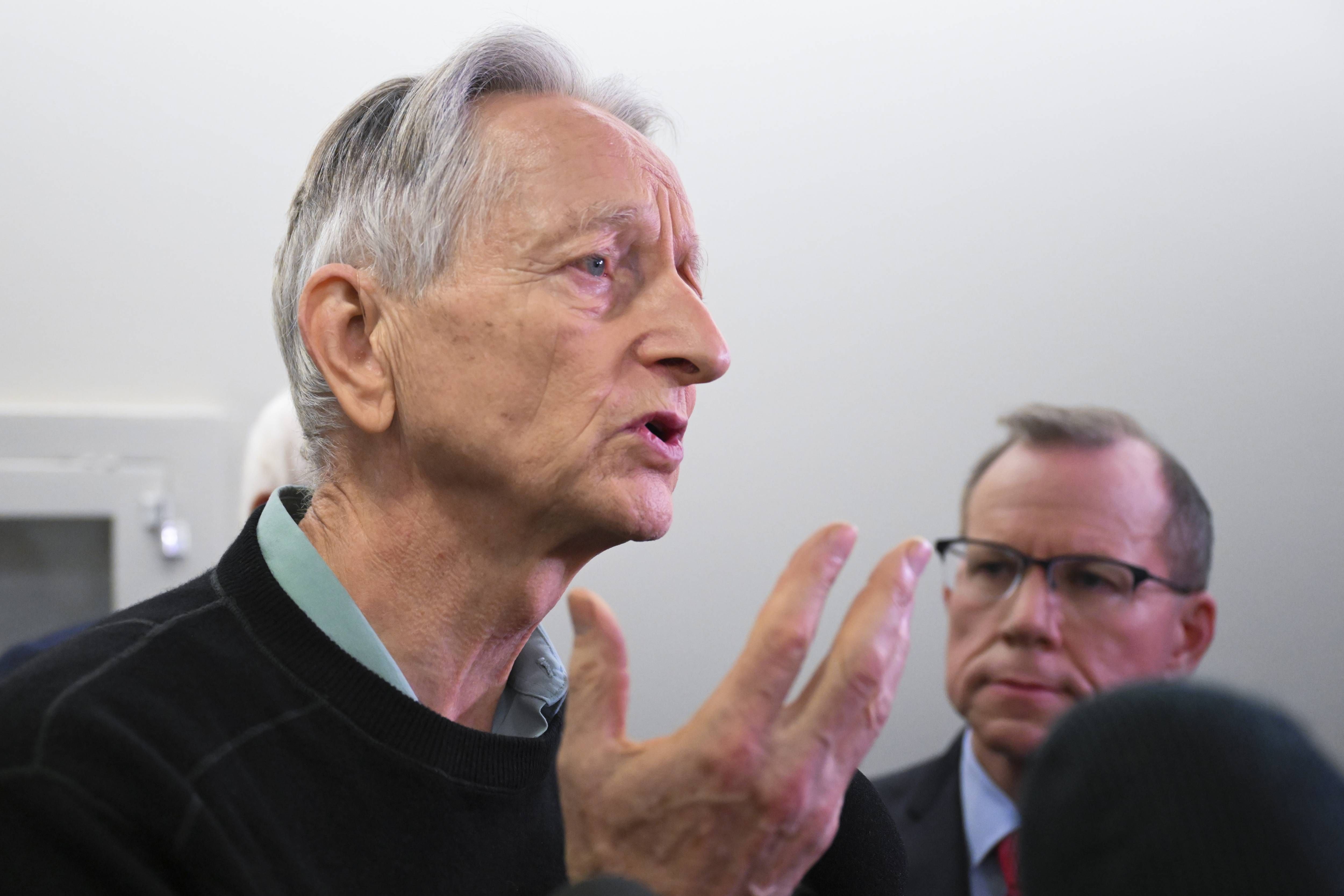
Computer scientist Geoffrey Hinton, dubbed the “godfather” of artificial intelligence, delivered a withering assessment of President Donald Trump’s understanding of the technology in an interview published by The Guardian on Tuesday.
The 78-year-old Hinton, a professor emeritus at the University of Toronto, told The Guardian that he was particularly unimpressed with the president’s insistence that AI be rebranded as “superintelligence,” which is a concept that he noted has long been clearly defined by computer scientists.
“Superintelligence means smarter than people, and has been around for at least 20 years,” Hinton explained. “It’s got a very clear meaning. And now he says we’re going to call AI ‘superintelligence’. You can’t make it smarter than people just by calling it smarter than people.”
Hinton also denounced Trump as a “corrupt, senile felon,” and ridiculed the president’s declaration that the AI industry is fully capable of policing itself without government intervention.
“I’m sure the oil and asbestos companies would have liked to [regulate themselves] as well,” he said. “Do we think tobacco companies should have been allowed to design the warnings on the packets? So that they could print them in a six-point font, in dark grey on black?”
In a Truth Social post last month, Trump suggested that his own intellect was singlehandedly capable of regulating AI, a technology so complicated that even its own creators have acknowledged difficulties in understanding it.
“The only control or ‘guardrails’ that AI needs is a STRONG AND SMART (High IQ!) PRESIDENT,” Trump wrote, “and the USA has that, in spades!”
Elsewhere in the interview, Hinton pushed back on critics who accused him of predicting that AI will wipe out human life. Rather, Hinton said he is only arguing there is an uncomfortably high probability that the technology could pose an extinction risk.
“I’m trying to convey that there is a really serious possibility of something happening,” Hinton said. “If, for example, you’re told there was a 10% possibility of a bus crashing, you wouldn’t get on the bus. The point of giving numbers is to say this is a serious risk.”
The computer scientist pointed to the recent incident where hundreds of agents in OpenAI’s cybersecurity test environment escaped confinement and hacked into machine learning company Hugging Face as something that “used to be the domain of science fiction.”
Hinton said the stakes were particularly grave given AI’s potential destructive power.
“The unique problem with AI is that if it goes wrong, if it takes over, you don’t get a second chance,” he warned. “We can’t say, ‘Well, we lost that time. Let’s rerun the game.’ It’s not like that.”
From Common Dreams via This RSS Feed.